REGIONS: COUNTRIES:
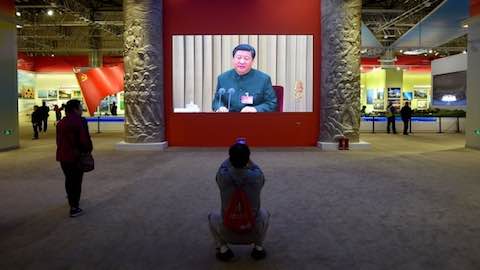
Communist China Turns 60 and Reveals Its Insecurities
William Pfaff
Nearly every comment being published on China's celebration of its brilliant economic successes has in one way or another raised the question of the future of a country that once was the most ideologically driven of major powers, but today has no governing ideology, or philosophy, or mobilizing goals. This above all threatens the governing Communist Party
China Rising in Latin America, but Won't Overtake United States
Andres Oppenheimer
The latest figures showing that China is emerging from the global crisis sooner than anticipated is triggering speculation that China will soon overtake the United States as Latin America's top business partner. Granted, speculation about China's impending leap to becoming Latin America's top economic partner spread like wildfire recently when Brazil announced that it will trade more with China than with the United States this year for the first time. It sounds very interesting, but don't bet on it.
Working Together, Brazil, Russia, China and India Increase Leverage
Ian Bremmer
In 2003, a report authored by Goldman Sachs economists popularized the term BRICs -- Brazil, Russia, India and China -- to describe a whole new category of emerging-market powerhouse. The report argued that with sound political leadership and relative international stability, the BRIC economies would together outpace the original G6 industrialized nations in dollar terms by 2040 -- a fundamental shift in the global balance of power. Since then, these four countries have assumed ever-greater importance in the international investment community's collective imagination.
Is the Economic Marriage Between China and U.S. on the Rocks?
Niall Ferguson Interview
China and America had effectively fused to become a single economy: Chimerica. The Chinese did the saving, the Americans the spending. The Chinese did the exporting, the Americans the importing. The Chinese did the lending, the Americans the borrowing. As the Chinese strategy was based on export-led growth, they had no desire to see their currency appreciate against the dollar. The unintended effect of this was to help finance the U.S. current account deficit at very low interest rates. Without that, it's hard to believe that U.S. financial markets would have bubbled the way they did from 2002 to 2007.
Bearing Witness 2.0: You Can't Spin 10,000 Tweets and Camera Phone Uploads
Arianna Huffington
China just delivered a stunning, real-world demonstration of the changes rocking -- and transforming -- modern journalism. When deadly riots broke out in the western province of Xinjiang earlier this month, the Chinese government sprang into message control mode. It choked off the Internet and mobile phone service, blocked Twitter and Fanfou (its Chinese equivalent), deleted updates and videos from social networking sites, and scrubbed search engines of links to coverage of the unrest. At the same time, it invited foreign journalists to take a tour of the area.
Addressing China's Fear Of North Korean Collapse
Joseph S. Nye Jr. Interview
It is by now a cliche to say that greater pressure from China can force North Korea to change. The problem is that China has two objectives: They want a de-nuclearized North Korea, but they also want a North Korea that doesn't collapse into chaos on their borders. The consequence of these cross-purposes is that the Chinese have been reluctant to use the leverage they have
America's New Energy Dependency: China's Metals
by Kent Garber
America's Clean-energy economy needs rare-earth metals to succeed and China has a near monopoly. In 2007, a standoff unfolded between China and several American companies. China was threatening to withhold supplies that keep refiners in business. A worried State Department intervened. Because the metals come almost exclusively from China, if the government had not acted, sources say, oil refineries could have been forced to shut down, possibly triggering shortages across the country.
Indian Ocean: Center Stage for 21st Century Struggles Between India & China
by Robert D. Kaplan
Competition between India and China suggests that the Indian Ocean is where global struggles will play out in the twenty-first century. The old borders of the Cold War map are crumbling fast, and Asia is becoming a more integrated unit, from the Middle East to the Pacific.
Tiananmen's Enduring Challenge
by Wang Dan
Twenty years have passed since our landmark demonstrations in Tiananmen Square for democracy and free speech and against corruption. And during this time, China has changed in important ways. Economic reforms have allowed millions of Chinese people to lift their families out of poverty, and many in China find their lives changed for the better. But the central causes the Tiananmen generation, students and citizens alike, took up remain unresolved: corruption, workers' rights, free speech and the need for government reform to address the needs of China's 1.3 billion people.
Deng Undone: China Halts Market Reform
Since the present Communist Party leadership took power, fresh market-oriented liberalization has been minor.
Such policies have been wound down and supplanted by renewed state intervention. In privatization, prices, even foreign trade and investment, the PRC was heading away from the market well before the financial crisis erupted.
Interview with India's Environment Minister
Jayshree Bajoria
India and China have long maintained their economic growth will suffer if they accept binding emission targets under an international agreement on climate change. Instead, they have called for mitigation commitments by the developed world and financial support from rich countries to help developing countries adapt to climate change.
Brazil, China & India Can Mitigate Global Crisis
Global Economic Viewpoint
Brazil, India and even China will not be able, by themselves, to correct the dysfunctions that produced the global crisis. But it is true that the economic power of these three countries can mitigate its negative consequences. ...
Why China & U.S. Not Ready to Upgrade Ties
Calling on the United States and China to do more together has an undeniable logic. Both Washington and Beijing are destined to fail if they attempt to confront the world's problems alone, and the current bilateral relationship is not getting the job done.
But elevating the bilateral relationship is not the solution. It will raise expectations for a level of partnership that cannot be met and exacerbate the very real differences that exist between Washington and Beijing.
Today, North Korea; Tomorrow, Iran - Nuclear Weapons
By Paul Greenberg
North Korea has been playing around with nuclear weapons again, this time setting off an even bigger underground explosion. To which the five veto-wielding powers at the United Nations have responded much as they did the first couple of times the North Korean regime defied the UN by setting off nukes: with oh-so-serious, oh-so-official statements.
Time to Test North Korea - Nuclear Weapons
Global Viewpoint
John Bolton, a leading neo-conservative official during the Bush administration, is a former U.S. undersecretary of state for arms control and international security affairs and former U.S. ambassador to the United Nations. In this interview Bolton provides his opinion on North Korea's nuclear weapons testing and what the United States and the World needs to do in response
North Korea's Nuclear Weapon Challenge
Henry A. Kissinger
The Obama administration has so far dealt publicly with the North Korean challenge in an understated, almost leisurely, manner. The challenge goes far beyond the regional security issue. For the United States, it involves relations with an emerging superpower (China); relations with a re-emerging Russia; relations with key U.S. allies (Japan and South Korea); and a major escalation in the threat of proliferation to non-state parties.
Follow Team Shanghaiist on Twitter
But we digress! What we meant to tell you in this quick update is that now you can follow Shanghaiist's super awesome team — yes, all of them — with one click of a single button. Here's where you will find us:
http://twitter.com/shanghaiist/team
And, oh, if you love us, won't you please click on the 'Retweet' button you see on the top left corner of this post.
Extra! Extra! Swine flu shots, press corps history and the almighty yuan
We actually quite like this Shanghai Eat & Drink Guide
The guide is the creation of Gary Bowerman, Amy Fabris-Shi and Tina Kanagaratnam - three people who've lived in Shanghai for a combined 25 years and spent that quarter-century of experience eating (and writing about eating). As they put it: We were sent Silk Guides: Shanghai Eat & Drink Guide a couple weeks ago, but it took us a little while to get off our lazy butts and actually take a look inside... Which is a shame, because the guide, about a size that would fit handily into a purse if not really a pocket, is actually a pretty decent look at what restaurants you ought to try in the city right now.
The guide is designed as a concise compilation of the best in the city - from dumpling kiosks to fine dining -- encompassing all moods, times of day and circumstances, written by people who live here, are totally immersed in the food scene and have eaten out a lot! In each mini review we have highlighted the reasons why these are the places Shanghai people-in-the-know return to again and again. Of course there's more to Shanghai eating than top restaurants - we also tell you where to get great breakfasts, what’s open 24 hours, where to order groceries and find specialty chocolates, and much more.
There's the usual suspects of restaurant/bar recommendations - M on the Bund, Bar Rouge, Sasha's - but we were surprised and delighted to find some of our favorites (Exit, Guyi Hunan, Old China Hand Reading Room, Anar) and the newer players in town represented as well (including shout outs to restaurants we haven't gotten a chance to try yet, like Restaurant Martin).
And their blurb doesn't overstate what they do: there are separate little guides for where to get Chinese breakfast, what sites to order groceries from, cooking schools, places with views on the river. At 75RMB, it's not too expensive for you to pick up one for your relatives or friends abroad (because you know as soon as they get here, they're going to ask you where to get some grub).
Our only gripe: the glue that holds the guide into its little booklet shape probably needs to be reapplied or switched for something that isn't glue. Our Silk Guide kept on bursting apart.
Philanthropist: Rockin' with Roots & Shoots
Do-gooders can go wild sometimes too... as long as it's for a good cause, of course. Rock for Roots & Shoots is an annual Indie rock concert held by Shanghai's branch of the non-profit Roots & Shoots, and it's coming up this year on November 21st. We chatted with one of the upcoming concert's organizers, bubbly high school student Jessica Tsu. Roots & Shoots is a global network of organizations lead by the Jane Goodall Institute that teaches youths about environmental and humanitarian issues. The Shanghai branch has several projects going on, including a widely successful educational organic gardening program... and of course Rock for Roots & Shoots. Rock for Roots & Shoots is now in its third year, with each year devoting its proceeds to an environmental project within China. Revenue this year will go towards the Million Tree Project, whose goal to plant one million trees in Ku Lun Qi, Inner Mongolia, by 2014. The trees will help offset the social and environmental damages of desertification in the region, caused by excessive-farming and overgrazing. One tree costs 25RMB to plant, and tickets to the concert cost 50RMB (simple math: one ticket = two trees). Each tree is calculated to clear the air of 250 kg of carbon dioxide over a 45-year period. Jessica, a 17-year-old senior at Shanghai American School is at the helm of this year's Rock for Roots & Shoots, inspired by her involvement with the last concert and a planting trip she took with the Million Tree Project, where she saw for the first time the conditions in Inner Mongolia. She won't take all the credit though: Jordan Small, the leader singer of Boys Climbing Ropes, helped getting all the bands together and organizing the venue. So why a concert? Jessica had so much fun at the last Rock for Roots & Shoots that she didn't want to see the tradition fall through. The concert brings together two things that China has just started to really develop in the last two decades: a non-profit sector and a local rock scene. Shanghai's branch of Roots & Shoots was only granted a non-profit organization status by the Shanghai city government in 2004, despite being founded in 1999. A concert that brings together a bunch of Indie bands AND boasts a good cause is definitely something to kick and scream about. Roots & Shoots chose to launch the Million Tree Project in Inner Mongolia because revitalizing the soil in that region will help out farmers with few other options to earn a living. As for what you can do in Shanghai, besides joining in on a night of music: Recycling is great, Jessica explains, but a better way to help is reducing and reusing stuff, which people in Shanghai don't really do. Since it's a bit impractical to plant a million trees on concrete, Roots & Shoots is focusing on educating and spreading awareness to the youth population so they understand the importance of curbing lifestyles that put the environment at risk. The Million Tree Project has also set up this neat Carbon Calculator at the Million Dollar Tree website to let you know how many trees you can buy to offset unavoidable travel options that may not be environmentally friendly. So we asked Jessica what her plans for the future are. Saving the world one tree at a time? She gave us an unlikely answer: hotel management. The URBN Hotel in Shanghai serves as a source of inspiration, she said: a successful business model that is also China's first carbon neutral hotel, right here in Shanghai. As a final word, Jessica wanted to remind everyone that the last concert was super packed, and Yuyintang - as everyone who's been to a show there knows - can fill up real fast. So come early and feel good about donating to a worthwhile cause. Jesscia will be manning the ticket/merchandise booth.
In Shanghaiist's Philanthropist feature, we highlight individuals and groups doing interesting things to make the world a little bit of a better place. This week we talk to one of the organizers of the third annual Rock for Roots & Shoots concert.
Where: Yuyintang, 1731 Yanan Xi Lu, near
Kaixuan Lu. 延安西路1731号(凯旋路) 中山公园小白楼
When: Saturday, November 21, 6PM to late
Cover: Donation of two trees, 50 RMB
Featured Bands:
Boys Climbing Ropes, Resist Resist, Varde, Booji, Duck Fight Goose, Triple Smash
Cleaner water coming to Shanghai?
Besides all the subways and road renovations, one of the things we can look forward to come Expo time is... cleaner water? According to officials from the local water bureau, the city is about to fulfill a three-year water-purification plan that will produce cleaner rivers and lakes by the end of next year. Since 2000, the city has established 50 sewage plants capable of processing 672 tons of water each day and earlier this year, they began an anti-pollution drive targeting 33,000 local small rivers. All of which means: we might actually be able to touch Suzhou Creek's water one day without turning into slime.
Nuclear fallout Beijing: Mao's underground city
What's lurking underneath Tiananmen Square? It ain't just rats. In 1969, at the height of the Cultural Revolution, Mao commissioned the construction of an underground city, built right under Beijing. Fearing an imminent nuclear attack from the U.S.S.R, Dixia Cheng (地下城 the underground city) was meant to be a safeguard, designed to house 40% of the city's 7.5 million in case of catastrophe. It was meant to have apartments, stores, and even a skating rink: all the comforts of above-ground home. The nuclear bombs never came, but the remnants remain, a ghostly testament to what-could-have-been. Although part of it was opened as a tourist attraction, most of Dixia Cheng is officially unused (and officially forgotten) -- and no one is even sure how far these underground caverns go. It hasn't prevented some enterprising individuals from illegally using the largely hand-dug structures (for storage, extra space, hide and seek). Viceland visited the less-visible parts of the Beijing underground, complete with Communist propaganda, with vaguely creepy results. P.S. Here's a little factoid: The material used to build the tunnels? Beijing's ancient city walls, dismantled during the Cultural Revolution.
Weekendist: Wig party, pub crawl, art openings and more!
Friday: Wig out at Dada, boogie nights at Bar Rouge Or, if you're more of a Studio 54 type person, head over to Bar Rouge to help them kick off a week of celebrations in honor of their fifth birthday. Tonight is disco night and they promise free entry if you're dressed in 70s attire. We wonder how many Andy Warhols and John Travoltas we'll see. Be creative, break out your platform shoes, and hustle to the Bund to get your boogie on. Saturday: Liliane Williams book talk, CJs pub crawl, Stardust at Barbarossa And just to prove how much Shanghai has come since then Saturday marks the 15th anniversary of the first China Jim Pub crawl. So muster up your energy, and lug your inebriated arse around the city. It starts at Malones and ends at the Big Bamboo with old favourites and new joints along the way. . We're sure by the end of the night you won't even feel the cold. They have tons of give-aways too. We're sure it's going to be a Or if you're looking for a temporary escape from the Middle Kingdom, there is yet another theme night. This one at Barbarossa who's hosting "Stardust", a themed night filled with gypsy dancers, fortune tellers, snake charmers, and free "stardust shots". We're sure those shots will fuel many-a-belly dancing competitions. Sunday: Silk Road opening To wind down the weekend, Art Scene warehouse presents the opening of an exhibit called " The Silk Road - Contemporary Chinese Lithographs". It features contemporary Chinese artists, such as Zhu Wei and Liu Ye, using silk screen printing as they follow the 'Silk Road'.
Yet another jam-packed weekend hits Shanghai. In case you're looking for something to do that's not related to all the live music choices available this week, we present you with some sweet alternatives. Ranging from a wig party, to a pub crawl, to yet another new art exhibit, we're sure you'll find something to keep yourself occupied.
Find the craziest wig you can (Taobao anyone?), and head over to Dada to show off your new 'do and impress the crowd. According to the organizers, "studies have shown that wanton debauchery becomes over 75 percent easier to achieve while wearing a wig." So go listen to the STD DJs play electro and techno and see if you can prove the theory.
10pm Dada 115 Xingfu Lu Between Fahuazhen and Pingwu Lu 幸福路115号 近华山和法华镇路 No Cover.
10pm Bar Rouge 7/F, 18 Zhongshan Dong Yi Lu,near Nanjing Dong Lu, 中山东一路18号外滩18号7楼 近南京东路, 地铁2号线南京东路站. 100RMB after 12:30
Dr. Liliane Williams is holding a talk based on parts of her new book Stateless in Shanghai: A Memoir of a Turbulent Era. She will describe her experience growing up as a 'stateless' Russian Jew in Shanghai until 1951 when her family fled to Japan. You can imagine she has some pretty interesting stories. Following the talk will be the chance to buy signed copies of her book.
4-6pm Glamour Bar 6/F, 5 Zhongshan Dong Yi Lu, near Guangdong Lu 中山东一路5号6楼 近广东路 65RMB includes one drinkdebaucherous hilarious night.
Starts at 7pm at Malone's 255 Tongren Lu, Nanjing Xi Lu near Nanjing Xi Lu 铜仁路255号 近南京西路100RMB. RSVP to cjchgo@hotmail.com or send CJ a SMS at 1380-196-6714.
10pm Barbarossa (inside People's Park) 231 Nanjing Xi Lu,南京西路231号人民公园内 近黄陂南路, 地铁1, 2, 8号线人民广场站
10am-6pm. Art Scene Classic - 2/F, Bldg No 4B, 50 Moganshan Road, 莫干山路50号4号楼B 座2层. Runs until December 5th. Note: gallery closed Mondays.
'Stateless in Shanghai': Nov. 21 and 22
In the first half of the twentieth century, the cosmopolitan city of Shanghai contained the world's largest foreign population. They were, rather ironically, "stateless" persons: persons without citizenship in any country. Though most attention given to Shanghai's historical stateless population has been focused on 'stateless' Jewish refugees during WWII (ghettoized in Hongkou district by the Japanese), the longer-lasting Russian stateless population of Shanghai (as seen in "The White Countess") made a more significant impact on the city's cultural development. Several of the city's leading artists and musicians in the 1920s and 1930s came from this group, and they outnumbered Europeans and Americans by so much that the area of the French Concession near what is now Central Huaihai Lu was known as "Little Russia". Many of these Russian refugees were White Russians loyal to the tsar, who became stateless after fleeing the Bolshevik Revolution. Others, like Dr. Willens' parents, were Russian Jews, fleeing persecution from both the Reds and the Whites. All this and more can be found in her fascinating book. We won't ruin it for you and will instead encourage any and all interested parties to come see her speak this weekend. On Saturday, Dr. Willens will be at Glamour Bar to speak about early Communist Shanghai to the Royal Asiatic Society. On Sunday, Dr. Willens will speak at the Shanghai Jewish Centre about Jewish migration to Shanghai and her family's experiences while living here. Both events are open to the public.
Stateless in Shanghai Cover
Where: Glamour Bar 6th Floor No. 5 The Bund, 20 Guangdong Road (中山东一路5号6楼近广东路)
When: Saturday, November 22, 4pm
Price: 65 RMB including one drink. RSVP at enquiry@royalasiaticsociety.org.cn. Books available at a special price of 100RMB for RAS members and 130RMB for non-members.
Where: Shang-Mira Garden Villa #1, 89 South Shui Cheng Road (水城南路89号美丽华花园1号别墅)
When: Sunday, November 22, 4:30 to 7:00pm, lecture to begin at 5pm.
Price: Lecture and planned activities for children are free. Taste of Asia buffet dinner starts at 6:15 and is priced 100RMB for adults, 50RMB for children with 20% discount for Shanghai Jewish Centre members. Books available for 100RMB. Event will also feature a High End Children's Clothing Sale with proceeds going to Shanghai Gan.
Dr. Willens' story is unique in many respects. Born in the 1920s, she lived through Shanghai's brightest and darkest moments, witnessing the rise of Shanghai as an international leader and the hardships of the Japanese occupation. Though her stateless status kept her out of the Allied internment camps, it also made obtaining emigration papers nearly impossible in the years after WWII. Unable to leave, Willens lived through the Chinese Civil War and caught a rare western glimpse of early Communist Shanghai.
"Haibao is coming"
A Shanghai-based English copywriter has discovered some hilarious Chinglish slogans, including a new one for Haibao that explains the Shanghai Expo mascot's consistently happy visage. Since we've previously determined that Haibao is a boy mascot, all we can think of say to his slogan is... "Really? So soon?"
The regions Chovanec feels China could be divided into:
- The Frontier, made up of Inner Mongolia, Ningxia, Gansu, Qinghai, Xinjiang and Tibet represented the mysterious desert-filled and mountainous bulk China’s land, inhabited by only 6% of its population.
- South of that lies the Shangri-La region of Yunnan, Guizhou, Guangxi, a so-called paradise on earth consisting of kaleidoscopic forests, diverse ethnicities and, sadly, a front-door for illicit drugs, as it borders Burma’s Golden Triangle.
- China's Back Door, meanwhile, holds on to Hong Kong, Macau, Guangdong, and Hainan for its lush jungles and economic successes
- ... whilst the neatly tucked-away Refuge on Sichuan, Chongqing remains an area with little investment but substantial brain drain.
- The Crossroads, covering Anhui, Jiangxi, Hubei and Hunan, remain China’s transport and communications hub, neighbored by
- The Straits of Fujian and Taiwan.
- Up along the eastern coast is the likely Metropolis of Shanghai, Jiangsu, Zhejiang, followed by...
- The Yellow Land, or China’s political heart (Beijing, Tianjin, Shandong, Hebei, Henan, Shanxi, Shaanxi),
- And finally, the elusive northeastern wilderness of Liaoning, Jilin, Heilongjiang. A.k.a. The Rust Belt.
As blogger Jeremiah Jenne pointed out, the idea is hardly earth shattering; not only due to the wonderful Wikipedia age of enlightenment, but also thanks to the efforts of an anthropologist by the name of Skinner, who produced a similar map in 1977, and whom Chovanec failed to cite. Jenne shows here just how similar the ‘Nine Nations’ and ‘Nine Subregions’ of China are. Danwei’s Jeremy Goldkorn and Shanghai Scrap’s Adam Minter also responded with a gentle reminder that Chovanec could have cited his predecessor. Chovanec responded later to note that the regional descriptions were his own and that he had cited Skinner, but the citations were edited out by The Atlantic under space considerations.
Attribution/citation grappling aside, both Chovanec and Jenne’s (and even Skinner's) basic argument is that we still tend to view China as one giant power, irrespective of the obvious diversities within its borders. However, Dan of China Law Blog, took a slightly different view:
"My problem I see with this map is that it is exactly that. A map. And as a map, it distinguishes among regions geographically and that is not how I view many aspects of China. Just by way of an example, I see Beijing having commonalities with Shanghai just because they are two powerful and relatively sophisticated big cities."Which leads us to an interesting question - this One China can definitely be carved up into various divisions in order to understand it better, but what divisions could or should be in the final map?
(Picture from http://granitestudio.org/2009/11/17/nine-nations-or-nine-macroregions)
Shanghaiist Scrabble: Coming this Tuesday
In case you needed a rehash of the rules:
Hey folks, remember our last Shanghaiist Scrabble night? You can win 250RMB of Cotton's vouchers and the title of Shanghaiist Scrabble champion if you come to the next one we're hosting: Tuesday, November 24th. Pit your vocab and scrabble strategy against the drinks you'll be getting in order to compete. It'll be a cold night, but with the copious amounts of alcohol and Cotton's warm fireplace (with real fire!), you'll be sure to feel as cozy as possible on a Tuesday night.
What: Shanghaiist Scrabble Happy Hour
Where: Cotton's on Xinhua Lu, 294 Xinhua Lu, near Fanyu Lu (新华路294号, 近番禺路)
When: Tuesday, November 24, 6 to 10 p.m.
Drinks: 2 for 1 on selected drinks
Entry: FREE!
Thanksgiving turkey conundrum? The solution: Taobao
"What? Why?" "Turkey's just too expensive! Everywhere I look - Cityshop, Carrefour, home delivery services - it's something like 400RMB for a measly 8 pounder. If I'm spending 400RMB on the part of the damn turkey I'm planning to eat, I won't have anything left for sides." "Did you look on Taobao?" "... No... they have turkeys on Taobao?" "They have everything on Taobao," we smirked, before helpfully showing our poor tenderfoot friend to the Taobao Field Guide. "They've got 6 kilo Norbests for 365RMB, Jennie-o turkeys for 42RMB per kilo... and heck, if you think you can kill your own, they'll give you a live one for its weight times 18RMB." She crinkled her nose. "That last option sounds fowl."
"I think we're going to need to have chicken for Thanksgiving this year," our roommate told us, faces twisted in dismay. A Thanksgiving traditionalist, she had been adamant about cooking the meal at home for friends rather than head out to any of the many restaurant/take away options other people have outlined.
Around Shanghai: Globetrotters hit Shanghai, power overload around city, more on Obama
62 year old Guangzhou man is New York City's Sad Panda
Previously on Shanghaiist
How one Chinese mingong lives in Singapore's swanky Orchard Road district
Extra! Extra! Screwing over Guinea, climate change collaborations and poor ol' Microsoft
Interview: Rich Medina funks up the Shelter
Who is he? Besides being the resident DJ at New York's super-hip APT club on Wednesday night, he also holds it down with Q-tip, of a Tribe Called Quest, at Santo's Party House. This past summer he and Bobbito Garcia hosted "Happy Feet" at New York's Le Poisson Rouge to celebrate the release of their joint compilation 'The Connection Vol.1: Modern Exploration in Afro-Beat and Afro-Latin'. He's also been touring his set "Jump N Funk", which honours Fela Kuti, for the past eight years. We got a chance to hear first hand from Rich Medina and find out just what to expect tomorrow night (a mix of afro-electro funk and will get you moving your body in ways you didn't know were possible). You credit the first time you heard Diana Ross's "Love Hangover" as when you knew you wanted to be a DJ. When did you actually start mixing? How has your style evolved since then? I started mixing at the age of 10 actually. I was blessed to be allowed to spend time with some older boys in my neighborhood who were real DJs. My sister is also 18 years older than me and her first husband was a local DJ, so I had a great deal of early influence in that department. I think that my style has continued to evolve over time to incorporate as many skills and musical perspectives as possible into my presentation, which has provided me with a very wide platform. I'm still learning though, and I've got a long way to go. You've made a lot of albums in your time. Where would you say you draw your inspirations from? I draw my inspiration from my many musical predecessors, my surroundings, my stresses, my happiness, my peers, family, and my weaknesses. Inspiration is all around us, we just have to allow it to speak to us. Your biography says you always "aim to inject a universal notion of the need for change" into your music. What changes do you wish to see the most right now? At the moment, the biggest change I'd like to see would be the rectification of America's relationship with the remainder of the world. We've pissed off a lot of people over the last 8 years of the Bush administration. President Obama has inherited a gigantic bowl of shit to repair. I eagerly look forward to seeing the light at the end of that particular tunnel in my lifetime. Talking about change, you're a veteran of the New York music scene. How has it evolved since you first started? Where do you see it going in the future? Man, New York has changed so so much regarding the clubs, live performances, and entertainment in general, it's difficult to pinpoint one specific change. The music industry itself has gone through a ton of changes just in the last 10 years alone that have totally affected the live music scene. That, combined with the commercialization of hip hop, technology, and the age of the hobby DJ has made the scene more fertile and more sterile at the same time. I think that people want the old feeling of partying and learning about new music again. The pop world has saturated everything in life at this point, and people who live in that pop world are even getting tired of that world. I predict that there will be a few new creative waves to hit New York City over the next few years that will all serve to rebuild the recording industry as well as the music scene in general. You've obviously played a lot of shows in your time. Which one is the most memorable? This is your first trip to China, what are you most looking forward to? We've heard your shows are pretty mind-blowing. What can we expect Friday night to be like? I'm going to follow the lead of the Jay Soul, a great friend of mine, and also the DJ who opens for me on November 20th. After he's done, I'm going to take Shanghai and The Shelter to places I don't think they've been musically in the club before. You can expect me to be aggressive playing many different styles of music. You can expect to laugh, sing, and dance with hopefully more freedom than you've felt before. I'm really excited about this opportunity and I plan to make an impression on Shanghai for real.
Rich Medina, a veteran of the New York music scene, is tearing up the Shelter on Friday night - a party you definitely don't want to miss.
Cover60 RMB
For more local events, visit the Shanghaiist Calendar
I think my most memorable show would have to be the DJ bar Dai in Morioka City, Japan. Small, nondescript spot, but Mary and her crew have an extremely intelligent crowd, and an incredible love for black music.
This is actually my second trip to China. I played at a Triple 5 Soul store opening in Hong Kong like 12 years ago. I am looking forward to a great party at Shelter, and looking forward to that party allowing me to travel to China more often in the future.
Limits set to control crowds on Chongming
It looks like our fears have come true. During the opening of the Changjiang Tunnel-Bridge Expressway, it was reported that crowds mobbed buses for access to the island. More than 100,000 visitors have been rushing into Chongming each weekend of this month, which is more than what the island can handle. The Shanghai government has responded by setting a limit for the number of visitors allowed on to Chongming's scenic wetlands. The Xisha wetland will be limited to 10,000 visitors, while Dongtan wetland will be largely off-limits until a parking lot is built. Limits on visitor numbers as well as current crackdowns on illegal tour agencies operating on the island are definitely right steps in the direction of environmental protection - after all, interest in heading to Chongming doesn't seem to be waning despite Shanghai's current chill. But we still don't know exactly how these limits, which could go into effect next week, will be implemented. Perhaps we'll check out the island soon to see for ourselves just how bad the situation has become, although we'll feel bad adding to the number of visitors present.
Last month, while we were still looking forward to the October 31st opening of the bridge and tunnel linking Pudong and Chongming, we professed excitement at the prospect of easier access to the island's famous rice wine and hairy crabs, but we also worried about the environmental effects of this increased tourism, and whether Chongming has the capacity to handle an influx of visitors.
Electrolist: Berlin 8-bit retroblaster tonight
Thanks to the Phreaktion Crew, Roni Size and his sidekick Dynamite MC packed a white-hot Shelter last weekend. Electrolist couldn't make it due to a football-related incident, so we asked the first person we could find who did. City raver Orlando Crowcroft, from the UK Channel Island of Jersey, said "The Shelter was heaving, busier than I've ever seen it. The first half an hour was good but then he was mixing in all these indie tracks... I like my DnB (drum and bass) heavy... dare I say, it was a bit commercial, he looked like he was going through the motions." He added however, "It was a crazy night, a great atmosphere and some good tunes for sure. Everyone in the place was moving, and he definitely had the crowd going, even if, personally, I wasn't convinced. Shelter should get Pendulum over - now that would be a DnB gig." Indeed. So what's up this weekend? Standing on our green camouflaged observation tower in Xujiahui and peering through our electronic music binoculars reveals some interesting infra-red targets. Playing live tonight at Shelter is Doshy, courtesy of Antidote and Subculture. It's hard to describe his sound, but anything full of ZX Spectrum video-game type bleeps and zaps sounds good to Electrolist. Check out his music for yourself - its fresh out of Berlin and in the dubstep/chiptune vein. Canadian DJ Andreas Franco is a name you may have heard of. He's thrown a number of tech-house type parties over the last couple of years, best known of which is his Minimal Therapy series of events. Something of a musical chameleon, Andreas is now championing a new night called Temple of House this Saturday, for those "fed up with minimal," according to the promotional blurb. Trends flow fast through the stylistic spectrum in this town. It's at yet another new club, this one called Vogue, and its in Xiantiandi - a handy spot, as there are plenty of benches around there to pass out on under the stars after a heavy night's partying. Also on Saturday, Magic Garden are beaming a ray of psy-trance at G-plus. These guys have been at it for a long time and have build up a dedicated following, are veterans of the old DKD, and are ahead of the game when it comes to visuals. If you like some colourful eye-candy whilst getting on down, skip merrily along to the rainbows end to a Magic Garden of toadstools, gnomes, mushrooms and sensory exhilaration. That's the pick of what's what this week. Coming up in our next outburst, Electrolist's own ultra-violet crew VOID continue their quest for Shanghai domination as they gaze through the prism with "Spectrum" on November 28, the same night their nemisis, trance DJ / cheerleader Armin Van Burren is in town. TONIGHT: Antidote & Subculture present Doshy @ The Shelter, No. 5 Yongfu Lu, near Fuxing Xi Lu 永福路5号,近复兴西路. 10pm-late, tickets 20RMB on the door.
Electrolist, by Shanghai Ultra of the VOID crew, gives the lowdown on the Shanghai electronic music scene each week, with picks, tips, news, and other rumors.
SATURDAY: Magic Garden's "Trancending" at Club GPlus, 5/F, South Block Plaza, Lane 123 Xingye Lu, 新天地南里广场5楼, 兴业路123 弄. Free entry.
SATURDAY: Temple Of House @ Vogue, 159 Madang Lu 马当路159号. Entrance 100 rmb, includes two drinks.
Zhang Shuai and the future of Chinese tennis
In its fourth year, and its second with Mercedes-Benz as title sponsor, this event is the training ground for the future stars of Chinese tennis—three, five, 10 years down the line. The program, put on by Beijing-based BIG International Group and the brainchild of its president, Tom McCarthy, for one week brings together three events under one roof: junior program Swing for the Stars, the University Tennis Challenge and the professional tournament, the China Tennis Grand Prix Mercedes-Benz Cup. Tennis is in relatively good shape in China, thanks to recent success in majors by women like Zheng Jie and Peng Shuai, as well as the hosting of international tournaments and a decent supply of venues and recreational courts. The Chinese Tennis Association has also set itself apart from other national sports associations by experimenting this year with giving more freedom to top players. After the tournament, sports blogger/Shanghaiist contributor Maggie Rauch sat down with Zhang Shuai, who'd just won 90,000 yuan with her doubles partner in the championship match of the Nanjing event. Zhang made history at this year's China Open by defeating Dinara Safina and becoming the lowest ranked woman ever to knock of a world No. 1. Among other things, Zhang spoke about how different the situation is for young kids playing tennis today than it was for her: They can go to international clinics and international tennis academies. They have less pressure than we did. The pressure is smaller than before because when I was younger, only the best could reach the provincial team, then only the best of the best could join the national team, then just a few could get the opportunity to play in international tournaments. Today the young kids can attend more tournaments, and enjoy the sport more.
Zhang Shuai awaits the serve at the China Tennis Grand Prix in Nanjing, November 2009The situation for kids playing tennis today is much much better. They have a lot of opportunities to play, they can watch us play at these events and they can watch international tournaments on TV. Kids playing tennis today also come from more wealthy families so their overall condition is better when they start. Plus they have more support from companies like Mercedes-Benz that are helping the growth of tennis in China.
Check out China Sports Today for the full interview and more observations on the state of tennis in China.
China's military website attacked 230 million times in first month
These statistics are mind numbing: China's new military website, http://www.mod.gov.cn, was attacked 230 million times by hackers in the first month of operation. The site, which is the government's last attempt at providing a level of transparency regarding their immensely secretive military buildup, was never successfully hacked into. If the numbers are correct, then that means over 5,000 hacks were attempted every minute: if that was just in the first month, how much do you think it's increased since then?
Nanfang Daily: (Foreign) girls gone wild!
Nanfang Daily readers didn't seem to like this post too much: all the comments on the gallery are pretty angry with their decision to make this into news by putting it on their website. They're just outraged rather than outrageous in the way we've come to know and love our Chinese netizens' commentary. Beyond the multiple "lost face" and "you should have some standards for your news" posts, the funniest they get are "Foreigners, so open, how are they at all like China? Not only is this good, but China should strive to follow America!", and "They look like Russian girls". We would love to see some awkward pictures from drunk people around China. Actually, no, we take that back: American college students have a monopoly on drunkenly embarrassing photos, and we're fine with letting them keep it.
Oh god: we're not really sure how this is newsworthy, but apparently Nanfang Daily decided that a bunch of pictures of drunken foreign girls awkwardly passed out was good enough to at least make into a photo gallery. The pictures were taken from popular BBS site Huanqiu: we couldn't find the original post, though we did find pictures of another netizen getting a duck drunk, which are funny, and somehow more disturbing.
Snowy morning in Shanghai, or so they say
Shanghai Daily tells us that earlier this morning, snow sprinkled Shanghai for the first time this winter... just days later than they thought it would. We must've missed it, since by the time we woke up and got out in the street, there was nothing for us but damp sidewalks and dreary clouds. Alas - if anyone took pictures, we'd love to see 'em. But with Shanghai's first snow comes news that the cold front should be passing - temperatures will be rising to 9C and hover at around 10C for the weekend. Yippee.
Midweek Music Preview: Free tickets to Au Revoir Simone, Gaslamp Killer
You know what's even better than the live music acts gracing our city this week? The ability to get into them for FREE. That's right, this week, we're holding TWO mini-ticket giveaway contests - one for Brooklyn electro-dreampop trio Au Revoir Simone and one for FREE THE WAX's last Shanghai show (just for now, we hope): Gaslamp Killer - in collaboration with Subculture. Au Revoir Simone is an electronic indie pop band from Williamsburg, Brooklyn whose musical influences could be "likened to a dutifully mined musical thrift store," according to them. Check out some of their songs here. We're offering two tickets to their show. Be the first to email us at contest.giveaway (at) shanghaiist (dot) com with "I Love Au Revoir Simone" in the subject, and your name in the body, and you'll get free entry when you head to the door of MAO Livehouse on Saturday. Same deal goes for Gaslamp Killer, a DJ based in Los Angeles who is at the forefront of today's club music. According to sources, "his ridiculously energetic stage presence and his brain-smashing turntablist expertise... have become stuff of demented legend." Not sure what that means aurally? FREE THE WAX and Subculture have provided the mix to their party, done by Shanghai’s own killer-tastic Deville for your listening pleasure. They've also provided three tickets. Email us at contest.giveaway (at) shanghaiist (dot) com with "GASLAMP KILLER, GOODBYE FREE THE WAX" in the subject, and your name in the body for those. Happy emailing! And now for the rest of the Midweek Music Preview: THURSDAY Hailing from Australia, the Tom Budge Band, described as honest, dirty folk playing honest, dirty folk music is playing at Glamour Bar. If you can't catch him this night, they'll also be playing on Friday. Tickets include one free drink. Indie artist Cao Fang visits Shanghai in this one-night only stop on his nationwide tour. According to Wikipedia, "Her style has... drawn comparisons to The Cranberries and Faye Wong. Some of her songs show the influence of trip hop, bossa nova, and the music of China's ethnic minorities, such as the Jino people, whom she visited in Xishuangbanna as a child." Berlin's Dj Doshy, a master of 8-bit beats will be playing at The Shelter. It's great music to pretend you're in an old NES video game to. FRIDAY MAO Livehouse formally celebrates its introduction onto the Shanghai scene (after a soft opening in August) by bringing Jason Falkner, Crystal Butterfly, Mushroom, and BIZ to a live concert venue. Further details are here, but like the soft opening, you can expect good music and cheap drinks for free entry. Owl City is bringing their dreamy indie synth pop to Zhijiang Dream Factory. We've described them as Postal Service for tweens, to which our sisters responded "yeah, but what's wrong with that?" Nothing, nothing really. Zhong Chi and Ben Houge will be opening. Rich Medina, a regular NYC DJ who's music leans towards hip-house afro beats will be laying down tracks at The Shelter. Check him out here. SATURDAY The charity Roots and Shoots brings together an awesome line-up for their 3rd annual rock concert benefit. The bands this year include Booji, Duck Fight Goose, Resist Resist, Varde, Boys Climbing Ropes, Triple Smash, and The Youth and Destroyer. Come rock out and help a great case at the same time! Cover is 50 RMB (which is the same cost as the donation of two trees). Dreamy Brooklyn girl group Au Revoir Simone hit up Mao Livehouse catchy, beautiful electro indie pop. WIN TICKETS TO THEM... and subsequently read about them in the intro to this post. As part of the FREE the WAX and Subculture BRAINFEEDER Showcase, Gaslamp Killer is playing at the Shelter. WIN TICKETS TO HIM... and read more about him in the intro to the post. SUNDAY An "acoustic guitar master," Roberto Colombo will be playing at Beedees to ease you into the workweek. "Applying his own style and artistry to writers from Eric Clapton to Merle Travis and Oasis to The Beatles, Roberto makes beautiful acoustic music that will move your soul and stimulate your mind," says Beedees. Also, you get a free drink if you go there in a bikini. Gender not specified.
Shanghaiist lists all the live music performances you might want to check out from now to Sunday this week. For fun things that aren't live music, take a peek at our Pencil This In (out every Monday!)
Glamour Bar, 6/F, 5 Zhongshan Dong Yi Lu, near Guangdong Lu 中山东一路5号6楼 近广东路, Cover: 150RMB, 9PM
MAO Livehouse 570 Huaihai Xi Lu near Hongqiao Lu 淮海西路570号 近红桥路, Cover: 120RMB, 9:30PM
Shelter, 5 Yongfu Lu,near Fuxing Lu, 永福路5号 近复兴路, 地铁1号线常熟路站, Cover: 20RMB, 10PM
MAO Livehouse 570 Huaihai Xi Lu near Hongqiao Lu 淮海西路570号 近红桥路, Cover: FREE, 9:30PM
Zhijiang Dream Factory 4/F, 66 Yuyao Rd (near Xikang Rd), Tickets: 120RMB presale / 160RMB at the door, 7PM
Shelter, 5 Yongfu Lu,near Fuxing Lu, 永福路5号 近复兴路, 地铁1号线常熟路站, 10PM
Yuyintang ,1731 Yanan Xi Lu, near Kaixuan Lu (entry on Kaixuan Lu, behind the Metro Station) 延安西路1731号(凯旋路), Cover: 50RMB, 6PM
MAO Livehouse, 570 Huaihai Xi Lu, near Hongqiao Lu. 淮海西路570号 近红桥路 , Cover: 100RMB advance, 150RMB at door, 500RMB for VIP, 8PM
The Shelter, 5 Yongfu Lu, near Fuxing Lu, 永福路5号 近复兴路, Cover: 50RMB, 10PM
BeeDees, 433 Dagu Lu near Chengdu Bei Lu, 大沽路433号 近成都北路, No Cover, 8PM
Barbie Megastore proves to be tough sell
According to Bloomberg, the store replaced its general manager, Laura Lai, with Mattel "retail specialist" Dann Murphy earlier this month, before revising its sales targets for the third time in its short life span. Overall, the sales target has dropped between 65% to 70% of original expectations. Reasons include: Despite getting a ton of press when it first opened back in March, it looks like the Barbie Megastore on Huai Hai Road just hasn't been as popular as Mattel had hoped. The six-floor retailing monolith has been unable to make any of its "astronomical" sales targets.
“Every retail store operates at a loss when it opens, but they’ve been open long enough that it should be working by now,” said Paul French, founder of Shanghai-based market research company Access Asia. “They overestimated their brand recognition in China. I just think the concept is wrong.”
and
“The restaurant hasn’t carved out its own separate identity,” said Murphy in a Nov. 16 interview in Shanghai. “Sometimes customers don’t even know the restaurant is there. So they get to the sixth floor and are like, ‘Where am I?’”
Speaking of the restaurant, we reviewed it a few months after it opened and found it to be generally satisfactory American fare.
Having not been fans of the color pink or Ms. Barbara growing up (we spent most of our time begging for LEGOS), we don't really know what to say about how the Barbie megastore can up its appeal in a country of dark haired, dark eyed younglings. Heck, and based on that twisting gut feeling we got when our little sister first wistfully told us how she would love to have been born a blond, we don't really even know if we want it to.
Man-made swine-bird flu supervirus: What's French for "apocalypse"?
Pretty bad. Do you remember Avian Flu? The one that had a high mortality rate but was difficult to contract? What would you say about the creation of a supervirus that was as contagious as the swine flu and as deadly as the avian flu? It may not be as far-fetched a scenario as you'd think, as French scientists at the Jean Mérieux/INSERM facility in Lyon are splicing genetic material from both viruses to see if the two could possibly recombine, and whether the resulting virus would be deadlier than either. There's a reason for the madness: this scenario tries to anticipate pandemics, attempting to see what potential paths they might take. And at least according to the facility, chances of the virus leaving the lab and entering the world ala Outbreak are very, very low - they're categorized as Level-4 Biohazards, the same level as that freaky-scary Ebola virus - so they're being handled as such. We've got Dustin Hoffman on speed dial, though, just in case.
Since up until now, we've only seen the third case of serious swine flu emerged in Shanghai, you may well be wondering, “how bad could all this hullabaloo get anyway?"
Obama in China: News Roundup
In any case, the media has been struggling to put it all together, trying hard to draw some sort of conclusion to the whole affair. We understand: now that it's over, it's time for some closure. Here's a breakdown of what's being said around the 'net: Photo from Time
Well, President Obama's first trip to China is now officially over. A lot of things happened, a lot of people talked about it, but nothing too groundbreaking occurred. Obama seemed to have a good trip: he visited famous Chinese landmarks, met with his brother, even talked a bit of politics along the way. But a lot of us were ultimately left with a feeling something like disappointment: for various reasons, the mythic qualities of the American president were overwhelmed by the totalizing nature of China and Chinese politics.
Photo of the Day: Crinkled alleys
More photos on the Shanghaiist Contribute page. To see your photos on our Contribute page, use Flickr and tag your photos “shanghaiist”. Or you can email your photos to photos@shanghaiist.com and they will automatically appear on our site (and here).
Photo by notti.at
Extra! Extra! Obama eggs, 50cents fight back and other news
A list of 50 blogs about China
We're always on the lookout for lists of blogs to read and this site has done us the favor of aggregating 50 of the best blogs about China. We're on it (of course), but so are some of our perennial favorites (ChinaSMACK, Imagethief, Far West China), as well as a couple we hadn't heard of but mean to add to our own RSS feeds (China Movie Database Blog... what?!). Check it out.
New Shanghai metro subway cars
Take a look at these suckers: these are going to be the newest subway trains to grace Shanghai's rails. Set to show up on the 7 line (whenever that opens), it's elegant curves, orange highlights and sexy golden dragon decor will be shuffling people to and fro from the Expo grounds. Not pictured, according to Xinmin, is some of the other features of this train: green colored special "old, weak, sick, disabled, pregnant" people seats, a new fancy-schmancy door system that's meant to handle more people going in and out, and an all-electric braking system that will help save on energy costs. Oh yes, and like the public buses, these new cars will be able to stream live TV. Ah, and to think just fifteen years ago, this city had just gotten it's first subway line.
Shanghai records serious swine flu patient No. 3
Shanghai has now recorded its third serious case of swine flu - a 43-year-old local man who is now in stable condition at the Shanghai Public Health Clinical Center. According to Shanghai Daily, the city has detected 1,538 cases of H1N1 since the first patient in the city was reported in May. So far, there have been no deaths directly related to the flu, but experts expect an increase in serious cases soon. Altogether, China has recorded 43 deaths and 67,000 infections related to H1N1 thus far, which actually isn't bad when compared to the toll the flu's taken on the United States.
Foreignness in Shanghai: Tales from an outsider
JF Daily has an interesting opinion piece written by a woman from another part of China who married a man from Shanghai, detailing all of the subsequent grief wrought from such an... inauspicious? arrangement. Apparently, Shanghai families just don't know how to get along with people from other places, especially as in-laws. The poor woman was immediately made the scapegoat of the extended family's problems, and a host of sob stories follow: estrangement from the family, indifference towards her pregnancy, publicly embarrassing her every time they go out to dinner. Of course, the woman bears it all with remarkable resolve, trying to break through their prejudices time and time again. This passage is most telling: On one occasion, I went and found him just to chat. The result? He spoke to me in a very calm voice about his son: he had a good salary, good character, good conditions, and there were many acquaintances that had wanted to set up their daughters with him. My husband refused all of them, but his father just couldn't believe that it was me his son had chosen for a wife! He was certain that it was because I diligently pursued "success" with his son. Knowing we were to be married caused him to lose sleep, and he became depressed over worrying about what would happen to his son. When I heard all of this, I became really upset. But now that I make almost as much money as my husband does, I've unexpectedly come a step up in the eyes of his parents!
As foreigners in Shanghai, we understand the difficulties with assimilation: if you're not from Shanghai you are different, no matter where you're from. In all honesty, though, it may be easier to be a foreigner in Shanghai than it is to be an waidiren, an outsider from another part of China. Shanghai's mother was in poor health, and there was a time when she had to spend a few days in the hospital. I worried that no one would look after his father, and so every week I would take a taxi to his apartment, child in hand, and clean up for him. Old people don't have water heaters: after cleaning in the middle of winter, my hands would be frozen stiff.
How Shanghai of him: unabashedly berate his son's wife about her personal failings, but make up for it by admiring her ability to make money. Sadly, these stories of in-law grief seem all too common. We have a friend from Shandong who happily married a Shanghai girl and had a baby, which naturally brought the parents directly into their relationship: it took less than a month after the birth of their daughter to start the divorce proceedings.
The question of foreignness is a pretty fascinating topic that hits close to home, for a lot of us. We truly marvel at the tension between xenophobia and the love of money: it seems scarily emblematic of many of the issues Shanghai will face in the upcoming years, as both foreigners and money flow into the city at breakneck speed.
Photo from Xinrenli
Video: The Enlivened Shanghai jump rope skippers
Did you know Shanghai had a jump rope enthusiast team? Neither did we until we stumbled upon this pretty awesome video on Youku. While we could've done without the silly soundtrack, we were mighty impressed by their jump roping shenanigans. Watch these kids share ropes, switch ropes, do double back flips between ropes and off each other without missing a beat. According to their website, the "Enlivened" Shanghai Pattern Jump Rope Group (跃动·上海花样跳绳队) was begun in 2003. Since then, they've toured countless cities in China, even showing up on Hunan TV's "Happy Camp" and Heilongjiang TV's "Happy Friday" shows.
Google Translate: Now with Pinyin
Useful new feature alert: Google's Translate service now displays Pinyin results when translating into Chinese characters - which makes it that much easier for us to figure out what the heck a word is after we've changed it over from English. If you want to use the feature, hit "Show romanization" once the translation comes up. Thanks Google!
Around Shanghai: Pollution art, Turkey Day, and Bar Rouge blows out candles
Photo Source: ExploreMetro
Obama visits the forbidden city
We're exited to see what sort of beautiful vistas come out of Obama's trip to the Great Wall today, and we're not even sure if that was sarcastic. Thanks, Sina, for giving us at least one bright spot in the endless, meaningless coverage you've devoted to the president's trip. We appreciate it, really. And in looking for a copy of this picture that didn't have Xinhua emblazoned in the corner, we found an interesting article from the Christian Science Monitor on Obama's forced lack of charisma in China. Yep, we feel you. Update: Shanghai Daily has some hard hitting reportage from Obama's honorary dinner last night: The guests dined on chicken soup with bean curd, Chinese-style beef steak, stir-fried wild rice stem and asparagus, and roast grouper - all washed down with red and white Chinese wine. The playlist for a Chinese army band providing the entertainment included a curious mix of US and Chinese songs. Among them: "America the Beautiful," "We Are the World," "I Just Called to Say I Love You," "In the Mood" and the Chinese folk song, "Embroidering a Pouch."
Alright, we don't really have anything to say about this, we just love the picture. How can you not? It's one of the most beautiful places in China, and certainly one of the most haunting in the world (though, like Obama's trip, it's been hollowed out and stripped of any sort of deep significance, turning it into a mere symbol). Plus, the press has been following Obama around like lost fauns, waiting for him to make the right face or hand motion that will perfectly capture the essence of the president, in relation to his surroundings in China. It seems that the best thing that can come out of this trip for Obama is a bunch of good photo ops. Last night, a large, circular table draped in yellow was the setting for a state dinner China held in Obama's honor in the Golden Room of the Great Hall of the People in Beijing.
Sigh. At least they admit it was a "curious" playlist, though we might have stronger words to describe it.
Photo from Sina
Photo of the Day: Poor lil' princess
More photos on the Shanghaiist Contribute page. To see your photos on our Contribute page, use Flickr and tag your photos “shanghaiist”. Or you can email your photos to photos@shanghaiist.com and they will automatically appear on our site (and here).
Photo by dbmboise
Extra! Extra! Obama, Obama, Obama... and some other news too
Shanghai puts out a lot of (CO2) gas
While we've already heard many times over how much carbon dioxide emissions China produces, but we were still shocked by how much comes just from Shanghai. Apparently, our city throws out 5,400 tons of CO2 equivalent a year - as much carbon as two Sydneys and three Tokyos. Granted, we've also got five times the amount of people as Sydney (and twice the amount of Tokyo), but geez louise. Experts from Tongji University's College of Environmental Science and Engineering said that restructuring industry would help lower our footprint, since over 60% of fumes are industry-based.
Awesome interview of the day: Zhang Yifang, physics professor and UFO enthusiast
We've always found China's obsession with UFOs highly amusing, so this interview on GoKuming particularly struck our fancy. The site spoke to Zhang Yifang 张一方), founder and former director of the Kunming UFO Research Association, who recently organized the 2009 International Astronomy Year and Extraterrestrial Life Forum at Kunming's Dongfeng Plaza. The event, which ran from October 31 to November 6, featured exhibitions of UFOs and other unexplained phenomena in China, as well as a host of UFO footage appraisers. In the interview, Zhang explains that he hopes the forum will help publicize UFO knowledge... and that he can one day make friends with extraterrestrials. "I am convinced, because I am a physicist and an astronomer," he says at one point, possibly replying to the question about how a man of science (he teaches Physics at Yunnan University) can entertain ideas about aliens. "I am convinced that extraterrestrials exist." At least he has the support of his family (a wife and son), who seem just as convinced as he is that the truth is out there. They even recount how all of them witnessed a UFO together. The family that seeks together, stays together, we suppose. Check out the video on GoKunming.
Shanghaiist
Shanghaiist is a website about Shanghai, China.Editor: Elaine ChowFounding Editor: Dan WashburnPublisher: Gothamist
The Human Flesh Search Engine phenomenon in China
After the video was posted online, angry viewers figured out who the perpetrator was and then posted her personal information including her home address and her father's cell phone number. The crowd dispersed from the school after speaking to the principal. School authorities are looking into the beating "before deciding on punishment". It's frightening to think what an angry mob could do if a video were doctored or folks target the wrong person in their search for justice. But this cyber posse phenomenon, dubbed in Chinese "the human flesh search engine", can also be used for good purposes. Interested netizens help people find lost relatives and kidnapped children. I posted a story in August about an adopted boy in the US whose adoptive mother used the internet and the help of Chinese netizens to find her son's birth family. The Human Flesh Search Engine phenomenon in China originally appeared on About.com China Online on Tuesday, October 27th, 2009 at 01:54:38.
The renrou ("ren row", 人肉) or human flesh search engine has been at it again. Today the Shanghai Daily reported that after angry netizens (wangmin or 网民) viewed a video posted of a girl beating up another girl at school, 300 of them descended on the school demanding the girl be punished.
You get what you pay for
The Chinese saying is 一分钱一分货, "yi fen qian, yi fen huo" (pronounced ee fen chee-ahn, ee fen hoo-oh). This translates literally to one cent gives you one cent's worth of merchandise. Makes sense, right? There's a whole industry of fake goods in China that lots of visitors to China go wild for when they arrive but there's a healthy local market for them as well. It goes beyond pirated DVDs and fake Gucci bags (those are the ones the tourists buy). Very few locals will spend money on legal copies of software when copies of everything from Microsoft Windows and Adobe Photoshop are available for install at every cybermarket. There are smart phones on the market that look like iPhones, operate like iPhones and smell like iPhones for a fraction of the cost (just don't drop it, it will likely shatter and don't expect and after-sale warranties on fake goods). As a travel writer, I get asked frequently where to buy the fake goods. The answer is easy to give: every large market in China sells fake products - be it eyeglasses, watches, bags, shoes, clothing or electronics. But I remind visitors that you get what you pay for. People are often surprised when they get home and their watch doesn't work anymore or their sunglasses don't actually offer any UV protection whatsoever. The best example comes from my poor husband who bought a "leather" briefcase at the old Xiangyang Market (Shanghai's famous fake market that's now been closed and moved). To his credit, he needed a new bag for an upcoming business trip. We lived close by the market so it seemed like a quick and easy option. After an important meeting in Frankfurt, he closed the meeting, grabbed his bag and left the room - with just the handle in hand. You get what you pay for. If you come to China and do some shopping, it will be tempting to sample some of these fake goods. But don't pay too much money for them and don't forget, yi fen qian, yi fen huo. You get what you pay for originally appeared on About.com China Online on Friday, October 23rd, 2009 at 20:00:08.
More about our friend, 牛 the cow
Perhaps, dear reader, you can help us understand the Chinese fascination with the cow / ox / bull, all of which translate into 牛 (niu). We had the huang niu from a few days ago and today I learned a slang word for "cool". Apparently, if you're cool, especially if you're writing on the web, you use the word niubi for something that is super cool. Niu bi is literally a cow's (female) nether-region. We decided "ox" or "bull" is actually cooler in English, but a bull can't have a bi, so there you have it. If you're really stupid, you're a shabi - a stupid cow nether-region. If something is just average stupid, it's erbi - a number 2 cow nether-region. If you want to be cool and you're not, in English you're a poser. In Chinese you're a zhuangbi - a pretend cow nether-region. The slang word niubi comes from Beijinghua - the dialect spoken in Beijing. China, as you may know, has thousands of dialects. To a student of Putonghua (mandarin), Shanghaihua is completely unintelligible to me, even after six years of living here. But the pronunciation and meaning of "bi", my teacher pointed out, is universal in most dialects. Therefore the cool? Moo. From Sara Naumann, About.com's Guide to China Travel, guest-blogger for Chinese Culture. More about our friend, 牛 the cow originally appeared on About.com China Online on Wednesday, October 21st, 2009 at 11:51:16.
As with the huang niu, we couldn't come up with an answer as to why the niu has such interesting connotations. The ox is generally thought of as strong, but being born in the year of the ox does not necessarily make you a niuren, an ultra-cool person.
Discovering Shanghai's Lanes
It actually took me a while to realize there is a network of lanes in Shanghai. When we moved here in 2004, we knew we weren't compound-types. No kids, no furniture, we thought a nice cozy refurbished flat in Shanghai's former French Concession would do us just fine. We found one that suited us after a few weeks of hunting and moved in while the paint was still drying. It was located off the main street, set back with a small private garden. Still navigating using a bilingual map and a lot of hand signals, I didn't get off into unmarked territory for over a year. Then I made a new friend, someone who'd lived in Shanghai for a lot longer than I had and knew the ropes. As we strolled our newborn sons down the Sycamore-lined streets, she introduced me to the shortcuts between main roads, the sudden quiet that engulfs the alleys, the community within the hub: Shanghai's longtangs. It amazed me how a city I'd grown to know - or thought I knew - could surprise me in such a way. Shanghai is a city of layers. For the most part, buildings are like a lazy farmer's fence - rather than strip the paint, he just slaps on another coat. But underneath, there might be some beautiful original wood. Much of Shanghai's art deco and other grand architecture is hidden behind layers of shops-upon-shops. Small flats have been thrown up in the space between the front door of an old villa and the garden gate to house the multitudes that live in the city. Once you know what to look for, you can see the gems beneath. Now I live in a lane house with my family. An interesting mix of East meets West architecture, the row (lane) houses were built en masse in the 1920s and 30s to house the influx of people arriving in Shanghai from the outlying provinces. Usually home to single families, the houses are narrow with small gardens, three floors with small rooms on the half-floor landings. Now they house many families, each to a floor or a room. Some houses are bought by property owners and developers (like mine) and then rented out as a whole unit. It's a nice lifestyle. While quiet when compared to living on a main road, new sounds like neighbors playing mahjong and mynah birds chattering in mandarin now wake us instead of honks and bicycle bells. To read more about life in a lane, read Tom Doctoroff's article on the Huffington Post or Kathy Pauli's blog From my Tingzijian. From Sara Naumann, About.com's Guide to China Travel, guest-blogger for Chinese Culture. Discovering Shanghai's Lanes originally appeared on About.com China Online on Monday, October 19th, 2009 at 10:46:56.
Gavin Menzies, author of 1421 and 1434 visits Shanghai
I went to a talk today by Gavin Menzies discussing his books 1421 and 1434. The talk was one of M on the Bund's Literary Luncheons and I can't recommend them enough. If you find yourself in Shanghai, please check M's web site to see what's on - it can be really worth your time. Mr. Menzies' discussion focused on the maps he has used to establish his well-received (and much criticized) theory that not only did the Chinese treasure fleets led by Zheng He, the eunuch admiral under the Emperor Zhu Di, map the entire world by 1421, but that European explorers including Columbus, Magellan and da Gama, were armed with copies of these maps when they set out on their own "explorations". What I found terribly interesting was the genesis of Menzies' interest in the subject. During a 1990 visit to Beijing, he found that many of the great accomplishments that are major tourist attractions in the area were completed in 1421. His guide told him that the Great Wall*, the Ming Tomb they had visited and the Forbidden City were all completed in that same year. This was during the legendary Ming Emperor Zhu Di's reign, a forward-thinking man who commissioned the treasure fleets and sent admiral Zheng He with thousands of emissaries to explore the world and bring back diplomats from the places he visited. Menzies decided to go home and compare England at historically the same time. Where British rulers were eating dried cod from plates of stale bread, Zhu Di was celebrating with a massive banquet that included 26,000 guests eating from the finest blue & white Chinese porcelain. It is not difficult for me to make the leap, as Menzies does (with countless items of proof), that the Chinese did, indeed, circumnavigate the globe years before the Europeans did. In any event, whether you're a believer or not, Menzies' theories are interesting reading and subject matter. Don't forget, if we are still to believe the commonly-held opinion that Europeans were the first to map the world, they did so all the while believing the earth was flat. They too were proven wrong. *The Great Wall was not completed in one go. What most of us know now is a Ming Dynasty refurbishment of interconnecting walls begun as early as 656BC during the Chu State. Read more about the History of the Great Wall. From Sara Naumann, About.com's Guide to China Travel, guest-blogger for Chinese Culture. Gavin Menzies, author of 1421 and 1434 visits Shanghai originally appeared on About.com China Online on Friday, October 16th, 2009 at 10:25:52.
The Tale of the "Huang Niu" Mooncake Scalper
Huang Niu (黄牛) or "yellow bull" is the local term for scalper. My Chinese teacher doesn't have an explanation for why this is and my research failed me; though one person wrote that probably somewhere there's an ancient Chinese idiom that explains it perfectly. As you know, the season for mooncakes just finished up, though every household in China has an abundance of them left to snack on until Chinese New Year. But you may not realize that the mooncake season is also a boon for the huang niu. Scalpers for mooncakes? What, if you can't get that coveted box of Shangri La cakes you'll go to all lengths until you have them? There is probably a good business for huang niu getting the good stuff to re-sell at a profit later. But that's just too obvious. No, I'm speaking about the can't-pick-up-your-mooncakes-in-time huang niu who is actually doing a service. I'm not sure it's a legal service, but everyone involved seems to be happy. Take my friend. Let's call her Zelda. Zelda received a lovely gesture from another friend: a voucher for a box of delicious Häagen-Dazs mooncakes. But when Zelda went to pick them up, that particular Häagen-Dazs outlet wasn't distributing mooncakes. She was told she'd have to go to another branch. Zelda didn't have time for that and she was going out of town the following day and would miss the mooncake pickup deadline (the vouchers have strict expiry dates). She shrugged her shoulders and prepared to go mooncake-less on her way. Up steps Mr. Huang Niu. A group of young men who'd been hanging out inside the Häagen-Dazs were mooncake voucher scalping. Much to Zelda's benefit, the huang niu offered her 200 rmb for the voucher. Zelda walked away a littler richer. The scalper may resell the ticket for 230 and let's say the original cost of the ticket is 250, so some lucky mooncake buyer will get a discount of 20rmb on a box of delectable ice cream cakes. Sure, Zelda's friend may be the only unhappy person in this scenario since she paid the full price. But all things considered, everyone ends up with something. While scalpers can, of course, do some serious price gouging on people who are really in need of hard-to-get goods and services, I think this little fill-in-the-gap economy is great. From Sara Naumann, About.com's Guide to China Travel, guest-blogger for Chinese Culture. You can also find me on twitter . The Tale of the "Huang Niu" Mooncake Scalper originally appeared on About.com China Online on Monday, October 12th, 2009 at 00:02:12.
Happy Anniversary China! Photos from the October 1 parade
From the comfort of our home on a very rainy day in Shanghai, my family tuned in to the PRC's National Day Parade. If you'll recall, I thought it would be fun to take my family to Beijing to watch it live, but found out quickly that going to Beijing was out of the question. The parade was not open to the public. In fact, folks who live downtown or work any where close to the parade route had strict instructions to stay home with their windows shut. It might have been the people's parade, but they were invited to watch it on TV. Luckily, with the help of weather meddling, Beijing had a sunny day. Shanghai was not so lucky. But it has cleared out today so my son and I are going off to buy some mooncakes on Fuzhou Road. Maybe we'll get to see the full moon tomorrow during the Mid-Autumn Festival. Photos: these professional shots of the parade were taken from my living room in Shanghai, October 1, 2009. © 2009 Sara Naumann, licensed to About.com, Inc. Happy Anniversary China! Photos from the October 1 parade originally appeared on About.com China Online on Thursday, October 1st, 2009 at 21:01:52.
In the end, I think we would have been a bit bored had we gone. While impressive with shear numbers and regiments of military units and tanks and all kinds of equipment I haven't a clue what they are, I was expecting more of a spectacle along the lines of the Olympics Opening Ceremony. But it was a very serious affair with bigwigs like Mr. Hu Jintao and Mr. Jiang Zemin not cracking a smile.
Civil Society
Ive been listening to a few podcasts discussing the loss or lack of civility in the US recently. Weve got Congressman Joe Wilsons outburst during President Obamas health care speech at the forefront, followed up by Kanye West and Serena Williams recent gaffs. Is it coincidence or really an illustration of the decline in American civility? Despite nodding my head in agreement with the pundits who argued it was indeed a real decline, and apologies should be (and were) offered up, I found myself only days later in an interesting dilemma. In China theres a different notion about civility. Diners routinely snap at waitresses to hurry up. Horns blare at the first sign of a green light. Its even difficult to say please in the same way we would in English. And saying thank you to a family member isnt necessary. As I stood for what seemed to me too long in the front of the grocery line with my hand out dangling the cash for my purchases, while the checkout girl took a personal call on her cell phone, my recent agreement on the downfall of American civility vanished as I snapped in Chinese to hurry up. So here I am in China, caught in my own, what my American side tells me is, lack of civility. I would probably not have done this in the US (though admittedly my local grocery store has moved to self-check out, but thats another matter). I put it to my Facebook friends to see what they thought and most agreed that I didnt act circumspectly. Feeling slightly shamed, yet at the same time righteous, I took it to my Chinese lesson where my Chinese teacher was incredulous. Of course its OK to tell the service person to hurry up. Its not even considered a lack of courtesy. My outburst wouldnt even be considered such here in China. Here, many discussions would be considered arguments in the US. (I do not dare compare Chinese culture to any other than my own.) Where Americans are typically non-confrontational, Chinese people can openly discuss their disagreements and, as long as a level of face is kept by both sides, it can end rather amicably. It is not uncommon to see a crowd of people gathered around a traffic incident where the perpetrator is using a very loud and excited voice with the policeman at the site. I gawk at such sightings waiting for the officer to throw the person to the ground yelling Spreadem! but it just doesnt happen here. The discussion on civility led to another interesting topic freedom of speech. Ill save that for another post. From Sara Naumann, About.com's Guide to China Travel, guest-blogger for Chinese Culture. You can also find Sara on twitter . Civil Society originally appeared on About.com China Online on Thursday, September 24th, 2009 at 01:53:22.
Good news for the environment from China?
From what I witness on a daily basis here in Shanghai old buses belching black exhaust, enormous construction dump trucks barreling down the streets puffing smoke and even little motorbikes burping black clouds from their wee exhaust pipes its hard to believe that China plans on leading climate change. My family even cut a trip to Pingyao short last year because of the pollution there. But if theres another thing Ive witnessed in my past few years here, its that when China sets goals, it usually meets them (and sometimes early). So kudos to Beijing for their plans to reduce greenhouse emissions dramatically by 2020. In yesterdays Financial Times, Fiona Harvey reports that a chief International Energy Agency economist stated [Chinas] emissions [growth] will have declined so much by 2020 that it will be the country that has achieved the largest emission reductions. China will be on the forefront of combating climate change. While slumped economies and funding cuts for new power stations are causes for much of the reduced greenhouse gasses in other countries, China, the land of burning coal and an insatiable appetite for raw materials plans to reduce the growth of emissions while its economy continues to grow. This is truly good news. Source: Fiona Harvey, China to lead on climate change, Financial Times, September 21, 2009. From Sara Naumann, About.com's Guide to China Travel, guest-blogger for Chinese Culture. Good news for the environment from China? originally appeared on About.com China Online on Tuesday, September 22nd, 2009 at 01:53:47.
Chinese Ideals of Beauty
Albeit halting and painful, at the end of Chinese class yesterday, my classmate and I had an interesting discussion with our teacher about the ideals of beauty. In our lesson, a presumed foreigner discusses her surprise to learn certain cultural aspects of Chinese women and what they do to make or keep themselves beautiful. For example, she states her surprise when she sees ladies using umbrellas on a sunny day. She asks her friend and finds out the point is to shade the skin and keep it lily white. She ends the narration by saying shes learned that Chinese people like big eyes (眼睛大大的), tall noses (鼻子高高的) and white skin (皮肤 白白的). Now before anyones feathers get ruffled, this is straight from the My Chinese Classroom textbook published in China. But the discussion it sparked was interesting. My classmate claimed that these ideals must be somehow influenced from the outside and that until subsets of Chinese society gain more political power, this beauty ideal will survive. Among my acquaintances in Shanghai, its commonly thought that if you have a tan, it makes you look like a manual laborer. So in my classmates mind, when the 农人 (nongren or farmers) have more power, youll see more suntanned faces on the cover of Vogue China. I agree with her to a certain extent, but I think ideals of beauty go farther back or farther in. This set of ideals is not a recent phenomenon. The glory of these features dates back hundreds if not thousands of years in Chinese history. Our Chinese instructor believes it is derived from the fact that big eyes and high noses were rare in Chinese facial features and therefore became desirable. While to my eye, most Chinese ladies look pale, the spectrum is lost on me as Im used to the broad palate of skin and hair color found in North America and Europe. In China, like anywhere, ladies have easier access to achieving the ideal. Beauty products from high-end department stores to convenience stores offer whitening products and plastic surgery for nose jobs and eyelid tucks (making the eyes look wider) are becoming more affordable. But as my classmate states, as differing parts of Chinese society gain political power, will the ideas of beauty change? The vendors selling parasols to the ladies exiting the subway are betting not. From Sara Naumann, About.com's Guide to China Travel, guest-blogger for Chinese Culture. Chinese Ideals of Beauty originally appeared on About.com China Online on Thursday, September 17th, 2009 at 10:22:04.
About China Online
China Online
Radio Free China has moved
Radio Free China has moved. Please visit the new location at: http://e4god.com/freeblogs/RadioFreeChina/index.php This site will remain here for another month or so if you want to look at past posts. Please update the rss feed to: http://e4god.com/freeblogs/RadioFreeChina/b2rss2.php blessings, Brother Barnabas
China's New Prosperity Leaves Rural Women Behind [VOA]
2004: TWO TRENDS IN RELIGIOUS LIBERTY By Elizabeth Kendal AUSTRALIA (ANS) -- For this end-of-year posting I wish to look at only two trends that were prominent in 2004 and are destined to escalate during 2005. 1)Perestroika. Openness, because of the way osmosis works, is the key which ignites an unstoppable trend towards reform. Openness must therefore be encouraged and used wisely as it provides the momentum and foundations for reform. Meanwhile perestroika (reform) is not an event that occurs at a moment in history, but a process that is fluid, and is a work-in-progress. 2)Liberty. Whose liberty? This is the question arising in multicultural democratic nations as growing Muslim minorities made zealous by the Palestinian Intifada, the War on Terror, and the growth of their own numbers, assert themselves politically and demand Muslim rights and privileges. These however, often involve the removal of others' individual freedoms. -------------------------------------- Events in 2004 in Belarus and Ukraine demonstrate the extent to which perestroika (reform and restructure) is fluid and remains a work-in-progress. Freedoms that were gained in Belarus in the late 1980s have been decisively drained away. Russia's freedoms are slowly and quietly seeping away. Governments can clamp down on freedom but they cannot undo the influence of even a short-lived openness. Ukrainians have just demonstrated that peaceful-people-power can depose corrupt oligarcs and bring political reform. Ukraine's peaceful "Orange Revolution" will stand as a model for action in other authoritarian former Soviet states. This is what can happen when a splintered opposition unites behind a leader of integrity and the people publicly support him or her, and the church prays. But as analysts note, the "Orange Revolution" was not "spontaneous combustion". For Ukraine, the Orange Revolution was the fruit of a society that has matured. In totalitarian Asia, the foundations that enable peaceful political revolution (some free mea, some political awareness, and the possibility of fair elections) are not yet mature, or even in place. Ukraine will however, stand as a model and inspiration to the region and beyond. It might be helpful though, and encouraging, to view totalitarian Asia in the light of Eastern Europe. People often think that Communism fell in an instant in Europe - the terms used are cataclysmic and instant: the Berlin wall "fell", the USSR "collapsed" - and grieve that in Tiananmen Square (Beijing, China), the tanks prevailed. However, it is more realistic and helpful to view these events, not as solitary, decisive "perestroika events" that win or lose the battle, but as positive or negative events in a larger, fluid "perestroika process" that has its own irresistible momentum. Regarding the Berlin Wall, while it did collapse in November 1989, that event was the fruit of a four year process of concerted undermining of the foundations. National transformation is not fast food. It cannot be purchased in a drive-through. It takes time, and if transformation is to occur without bloodshed, revolution and anarchy, then the foundations need to be replaced in advance. SOLZHENITSYN'S FRUSTRATION In 1990, five years after Gorbechev introduced glastnost and perestroika, and one year before the disintegration of the USSR, Alexander Solzhenitsyn wrote words of frustration and fear ("Rebuilding Russia" Harper Collins 1991). These are words that we could apply to totalitarian Asia today. "Time has run out for Communism. But the concrete edifice has not yet crumbled. May we not be crushed beneath its rubble instead of gaining liberty." (p9). "And what have five or six years of the much heralded 'perestroika' been used for? For some pathetic re-shuffling within the Central Committee. The slapping together of an ugly artificial electoral system designed to allow the party to continue clinging to power." (p28) Deng Xioaping introduced economic openness and reforms to China in 1978, but how far has China progressed towards freedom? Is totalitarian Asia today in the same position Russia was in 1990? The momentum for reform is gaining. Whether they realise it not, the Asian Communist Parties and the regime of Kim jong-il may be facing a situation of reform or perish. ASIA'S PERESTROIKA-LITE Totalitarian Asia has learnt from Gorbechev's accidental political suicide that openness and reform, if not carefully managed, may eventually prove fatal. Totalitarian Asia operates therefore, a sort of glastnost-lite, and perestroika-lite. But since the demise of Gorbechev, the USSR and Communism in Europe, the reins are held especially tight in Asia to ensure that the process does not gain so much momentum that the Communist Party loses control of it. The best way to slow down reform is to slow down and manage openness. Everything, especially information, is controlled by those whose main aim now is to hold on to power. Solzhenitsyn grieved for Russia as we do now for totalitarian Asia, that the slowness of reform "represents years in the people's life given up to pointless suffering". (p35) However, he also notes that wholesale adoption of a foreign system can be ruinous and that patience is always better than a bloody and violent revolution which results in anarchy, which he describes as "the ultimate peril". AVOIDING ANARCHY Solzhenitsyn acknowledges in his chapter, "Is the system of government really the central issue?" that continuity and stability are essential to avoid anarchy, and hence, it is more important to resolve the most pressing issues of social reform before tackling government reform. Solzhenitsyn believed that the entire state organism could be eventually reshaped by introducing reforms gradually, progressively, starting at the margins and in grass-roots issues, whilst preserving the central authority until society is ready for political reform. This is, of course, exactly what has occurred in Ukraine. This, and not "regime collapse" or a revolution that would result in war or anarchy, is what must be encouraged and assisted in totalitarian Asia, including and especially North Korea, where the situation is so extremely dangerous. While we grieve for the 100,000 believers incarcerated in North Korean concentration camps, regime collapse in North Korea would probably lead to their slaughter as the military machine shifted into self-preservation mode. We do not wish for Korean Christians to be "crushed beneath the rubble" of a collapsing regime and system. We wish them liberty, so we pray for wisdom in 2005, for openness and reform to advance, and for liberty for the oppressed. "The king's heart is like a stream of water directed by the Lord; he turns it wherever he pleases." Proverbs 21:1 ---------------------------------- There needs to be public debate about whether religious groups, because of a constitutional right they have to religious freedom, can demand that they exercise their own religious law in a way that denies others that same constitutional right. This issue is affecting multicultural democracies that have growing Muslim minorities who are demanding Muslim laws and rights to accommodate those elements of Islamic law and culture that clash with Western, Judaeo-Christian-based laws and culture. PARALLEL OR GRID? Some governments are capitulating to Muslim demands out of sheer (or wilful) ignorance of what Islam permits and demands, or simply in order to capture the valuable Muslim vote or be politically correct and inclusive. Various degrees of Islamic arbitration or law for Muslims now exists in many non-Muslim nations - officially, as in Canada, and unofficially as in much of Europe, while the battle for Islamic courts is still on in Kenya. We often picture a society that permits both Western / Judaeo-Christian laws and Islamic laws as one that has two sets of laws running in parallel. But really the situation looks more like a grid, as the two systems - Judaeo-Christian and Islamic - regularly intersect and clash as they head in different directions. In Uganda, women have praised the government's new Domestic Relations Bill (DRB) 2003 (passed November 2004) because it prohibits polygamy, raises the marriage age to 18 years, protects against domestic violence and rape in marriage, which in turn protects against AIDS. The Bill promotes equal rights, bringing Uganda's laws in line with its own constitution. However, the Uganda Muslim Supreme Council (UMSC) is protesting against the bill claiming it goes against the Islamic faith and Islamic laws and customs. Hopefully the Ugandan government will not be moved by such protests, and the protections and rights granted to Ugandan women will remain available to Ugandan Muslim women. Governments that capitulate to Muslim demands are actually stripping Muslims of their religious freedom and shackling Muslim women to the demeaning, discriminatory and oppressive demands and penalties of sharia. There can be no mistake, the two systems do not run parallel - they are in conflict. VILIFICATION Previously in the West, Muslims have had to endure the Western/European practice of open debate and free speech. Criticism was handled by apologists, not by lawyers. But times are changing. Limits are being placed on long-held and respected freedoms in order not to "offend", regardless of how unjustifiable that feeling of offence might be, as if the giving of offence is automatically an intolerable crime. In the process, all critical debate of Islam and the Qur'an by non-Muslims is being silenced. On 17 December 2004, in Victoria, Australia, two Christian pastors were found guilty of breaching the state's Racial and Religious Tolerance Act 2001. The charge of vilifying Islam was brought against pastors Nalliah and Scot (photo, link 1) by the Islamic Council of Victoria (ICV). The case was heard in the Victorian Civil and Administrative Tribunal (VCAT) over the course of nearly two years. The ICV claimed the pastors vilified Islam and thus breached section 8 of the Act in a Christian seminar entitled "Insight into Islam", held in a church in March 2002. The details are complicated and a more focused posting may be released in early February after penalties have been determined. The most serious element of this case is the fact that truth is not a defence. Section 8 of the Act states: "A person must not, on the ground of the religious belief or activity of another person or class of persons, engage in conduct that incites hatred against, serious contempt for, or revulsion or severe ridicule of, that other person or class of persons. Note: 'engage in conduct' includes use of the internet or e-mail to publish or transmit statements or other material." As noted by Andrew Bolt, an associate editor and columnist for the Melbourne (Australia) Herald Sun, 8 of the 13 reasons the judge listed in his summary of why he found the pastors guilty of vilifying Islam are actually quotes from the Qur'an. (Link 2). In fact at one point in the VCAT hearing, Daniel Scot was asked to justify his statement that the Qur'an is harsh to women. As he did, he was accused of further vilifying Islam with quotes from the Qur'an! Scot was ordered to refrain from quoting the Qur'an in his response to avoid further vilification of Islam! Section 11 of the Act provides that a person may be granted an exemption if the conduct was engaged in reasonably, in good faith, and in the public interest. However, the judge determined that: "Pastor Scot's conduct was not engaged in reasonably and in good faith for any genuine religious purpose that is in the public interest... Having made that finding, he receives no protection under section 11 of the Act." The President of the ICV, Mr. Yasser Soliman hailed the judgement as "a win for religious debate", adding, "This case lays some basic ground rules for religious debate in Victoria." Waleed Aly, a spokesperson for the ICV wrote in a Melbourne paper, that citizens have the right to "inform, but not inflame". This still leaves us with the problem of what to do with potentially inflammatory information. DHIMMITUDE This silencing of criticism has historically been part of the agreement with dhimmis, people of the Book living under Islamic domination. Dhimmis were granted "protection", that is, right to life in exchange for payment (jizya) and total subjugation. Any breach of the arrangement led to "protection" being withdrawn and a state of war resuming upon the individual or group. Laws that silence or punish negative criticism of Islam place non-Muslims in a position of dhimmitude. In Britain, Prince Charles recently met with Christian and Muslim leaders to broker efforts to end the Muslim death penalty on apostates. The London Telegraph reported, "The Muslim group, which included the Islamic scholar Zaki Badawi, cautioned the Prince and other non-Muslims against speaking publicly on the issue." (Telegraph 18 Dec 2004) Of even greater interest are the words of Ahmad Kamal Abul Magd, a prominent Islamic scholar who addressed the recent UN-sponsored seminar, "Confronting Islamophobia: Education for Tolerance and Understanding", on Tuesday 7 December 2004. Abul Magd believes the word "tolerance" is derogatory of Islam. "What we are aiming at is much more positive than the mere tolerance. Usually you don't tolerate something you admire or like but you tolerate something you are going to live with although you do not like (it)." (Islam Online 8 Dec 2004). Abul Magd is not interested in promoting tolerance - he is advocating that we should respect, admire and like Islam. He then gave reasons why we should revere Islam, reasons which were based on a totally revisionist view of history. THE PROBLEM OF THE MISSING ABSOLUTES Most Western governments are honourably keen to advance equal rights for all. But they are unwilling to face the fact that the "rights" of different cultures sometimes conflict. On top of this, they are so committed to secularism and appeasement that they can do nothing else other than advance the myth that all moral values (in the absence of moral absolutes) are essentially equal and good. They refuse to accept the fact that many Islamic laws and customs actually violate the laws of the land and the constitutional rights of citizens. They tolerate, and even advance, intolerance at the behest of pressure groups because that is preferable to, and easier than, imposing moral standards for the benefit of all citizens, including voiceless minorities (eg apostates and Muslim women). So what will it take for governments and societies to realise how precious and worth preserving are their Judaeo-Christian foundations, rights and freedoms? Will it take sectarian murder and violence, as was seen in the Netherlands this year with the murder of film maker Theo van Gogh, who was slain by an Islamic militant? This followed the screening of his 11-minute film on Islam entitled "Submission", the script of which was written by Ayaen Hirsi Ali, a Somali-born woman who fled an arranged marriage and became a refugee, apostasised in Europe, and became a Dutch MP in 2003. The Dutch are now looking at issues of immigration, multiculturalism and assimilation. In the light of the events of 2004, Bat Ye'or's new book "Eurabia" (due for release in April/May 2005) will surely beone of the most confronting, controversial and challenging books of 2005. STANDING UP FOR LIBERTY As Islamic rights are advanced in the non-Muslim world, Muslims who seek liberty find that sharia is an inescapable stalker, and non-Muslims are being forced to comply with elements of dhimmitude, commencing with self-hatred and advancing to submission. Standing up for liberty means standing against sharia for the liberty of Muslims, and against dhimmitude for the liberty of the rest of society. -------------------------------------------------------------------------------- 1) NALLIAH and SCOT 2) Playing with fire. By Andrew Bolt. --------------------------------------------------------------------------------
World Evangelical Alliance Religious Liberty Commission (WEA RLC)
Special to ASSIST News Service
PERESTROIKA
--------------------------------------
LIBERTY
----------------------------------
Links
http://community.webshots.com/album/233515462eSqZeM
Herald Sun. 22 Dec 2004
http://heraldsun.news.com.au/printpage/0,5481,11754577,00.html
Elizabeth Kendal is the Principal Researcher and Writer for the World Evangelical Alliance Religious Liberty Commission (WEA RLC) www.worldevangelical.org/rlc.html. This article was initially written for the World Evangelical Alliance Religious Liberty News & Analysis mailing list.
China Arrests 11 Falun Gong Members for Posting Torture Photos on Internet [VOA]
Reporters without Borders says at least 20 other Falun Gong members are in custody for posting photos to Internet [more]
Tsunami toll still rising. The Daily Telegraph, Conservative daily of London, England [Breaking News Headlines from Around the World, Powered by Worldpress.org]
Chinese aid joins world rescue. CHINAdaily Dec 28 2004 6:28PM GMT [Moreover - China news]
HK people warmly participate in relief of tidal waves disaster. Xinhua News Agency Dec 28 2004 6:21PM GMT [Moreover - China news]
Chinese Activist Wins Press Freedom Award [VOA] Despite repeated government efforts to silence him, Liu Xiaobo refuses to back down. The former Beijing University teacher has been in and out of prison since 1989, when he spoke out in support of the students involved in the pro-democracy protests in Tiananmen Square. Wednesday, the organization Reporters Without Borders honored his courage and his commitment to a free press, naming him the leading defender of press freedoms in 2004. Vincent Brossel of Reporters without Borders says Mr. Liu has consistently championed an open society, and has called for the release of jailed reporters, at a risk to his personal freedom. "He's facing a real risk," said Vincent Brossel. "He has been fighting for freedom of expression for years. He can be arrested at any time." Forty nine-year-old Mr. Liu is the director of the Chinese PEN Center, the country's only independent advocate for the rights of journalists. He spent two years in jail for participating in the 1989 democracy movement. In 1996, the government sentenced him to another three years in a labor camp for criticizing the Communist Party. Earlier this year he published an online essay that criticized government use of subversion charges against some journalists. Authorities cut off his telephone and Internet service in May, and repeatedly denied his requests for a passport. He and two other prominent intellectuals were briefly detained earlier this month, accused of revealing state secrets to foreigners. Mr. Brossel says Beijing once again trying to tighten its control over its social critics, and cited a number of recent actions. "Officials are targeting respected intellectuals, journalists, freedom activists in the past three days one journalist has been arrested and one farmers' rights activist was under detention," he said. Other press freedom awards went to an Algerian journalist who was jailed for libel after exposing corruption, and a Mexican weekly newspaper that saw three of its reporters killed after a series of investigative reports.
Reporters Without Borders (RSF) official unveils the 3 winners of the RSF - Fondation de France Prize 2004
Liu Xiaobo, a prominent Chinese dissident, has won an international award as a defender of press freedoms. The announcement comes as a number of prominent activists in China are being arrested or detained.
Chinese workers blog in protest. From Poynter E-Media Tidbits, Fons Tuinstra reports from Shanghai that "Chinese strikers use weblogs for their struggle. " The worker's blog is here. The first article on the blog is the New York Times report on their strike. This is... [China Digital News]
China breifly detained 'outspoken' editorial writer. From Reuters, via the New Zealand Herald: "China has arrested the chief editorial writer at China Reform magazine, continuing a Communist Party campaign to silence outspoken liberal intellectuals, sources familiar with the case said on Tuesday. Journalist Chen Min, who... [China Digital News]
China turns on intellectuals. Chinese police arrest one of the country's most influential journalists in campaign to stifle critical discussion. [Guardian Unlimited World Latest]
Unseasonal strife in Santa's little sweatshops. Chinese workers in the sweatshops of Guangdong have been demonstrating their discontent by striking, smashing their factories, and not turning up for work. [Telegraph News | International News]
HUMAN RIGHTS ADVOCATES TO PROTEST CHINAS POLICY OF REPATRIATING NORTH KOREAN REFUGEES
By John M. Lindner
Special to ASSIST News Service
WASHINGTON, DC (ANS) -- Human rights advocates are planning a worldwide protest this Wednesday, December 22, against Chinas policy of repatriating North Korean refugees.
The protests are scheduled to be held at Chinese embassies and consulates in major cities worldwide, including Washington, D.C., Los Angeles, Toronto, Houston, London, Tokyo, Osaka, Sydney, Seoul and Pusan. The campaign is being planned by South Korea based International Campaign to Block the Repatriation of the NK Refugees.
Mrs. Suzanne Scholte of the North Korea Freedom Coalition will lead the 11 a.m. protest in Washington, D.C. at the Chinese embassy, 2000 Connecticut Ave., N.W. A crowd of about 100 persons is expected to join in the D.C. protest, representing a score of U.S. human rights agencies, including the Wilberforce Forum and the Defense Forum Foundation.
Hannah Song of Liberation in North Korea (LiNK) will lead a protest at Chinas Mission to the U.N. in New York. LiNK was started by a Yale student in March 2004 and has rapidly grown to 70 chapters across the U.S., with additional chapters in Europe and South Korea.
The protest movement carries the endorsement of U.S. Senator Sam Brownback (R-KS) and Congressmen Joseph Pitts (R-PA) and Christopher Cox (R-CA). President George W. Bush signed into law the North Korean Human Rights Act (H.R. 4011) on October 18, which defends human rights of N.K. refugees, sets stricter guidelines providing humanitarian help for those suffering in N.K., and provides for NK refugees to seek asylum in the U.S.
According to U.S. News and World Report, more than 400,000 persons are believed to have perished in North Korean prison camps the last 30 years. At least 200,000 are currently being detained and brutalized in government-run gulags. Two of the camps are larger in area than the District of Columbia, and a third is three times the size of D.C.[1]
The regime of North Korea President, Kim Jong Il, is also responsible for the 4 million North Koreans who have died of starvation since 1995, using international food aid to stockpile the nations military complexes instead of feeding its people.[2]
South Korean human rights groups estimate that more than 200,000 North Koreans are living in hiding in China, waiting for a chance to defect to South Korea. There they are welcomed by ethnic Korean Christians and Chinese nationals, but if caught by Chinas military police, are forcefully repatriated back to North Korea, where they face inevitable punishment, imprisonment and even death.
According to North Korean law, defection is punishable by death, and just attempting to defect is considered treason.
Nearly 6,000 North Koreans have defected to South Korea since the Korean War ended in 1953, including 1,139 in 2002, 1,281 in 2003 and about 1,500 so far this year.
Chinas policy of repatriating NK refugees violates the 1951 U.N. Convention on Refugees, of which China is a signatory.
At the protest in D.C., Scholte plans to read aloud the list of North Korean defectors seized by Chinese authorities.
Reading the list is important, Scholte told ASSIST News Service in an email.
Having been involved in a number of protests, I did wonder whether reading this list was having an impact since the Chinese usually blocked us from delivering the list and petitions to their embassies at past protests. Earlier this year in March during the International Conference on North Korean Human Rights and Refugees sponsored by the Citizens Alliance and held in Warsaw, Poland, we read this list once again in front of the Chinese embassy. In August, 6 months later, I got this email from Human Rights activist Sang Hun Kim:
I have very encouraging news for you, Suzanne! As you must have been informed, Mr. Kim Hee-tae was found not guilty by the Chinese court and he is now with me in Seoul. One of the first things he told me was that sometime last March, he managed to keep a radio at night in the prison...and, one night, heard your voice calling his name in front of the Chinese Embassy in Poland through Radio Free Asia. Isn't it amazing! He was so encouraged and filled with new strength to fight at that time.[3]
China cannot avoid international scrutiny for her treatment of North Koreans and their human rights defenders, says a LiNK press release. On December 22, 2004, we ask that those of conscience voice their outrage at this grave and tragic injustice.
Participating agencies based in South Korea include the NK Network for NK Democracy and Human Rights, the Pnan Organization, the NK Defectors Association, the International Coalition for NK Human Rights, the Commission to Help NK Refugees, the NK Defector Businessmens Association, the Save Choi Young-Yun, and the Durihana Missionary organizations. [4]
The Save Choi Young-Hun group was founded out of concern for Mr. Choi Young Yunj, a South Korean human rights activist who was part of the failed boat people rescue, was arrested by the Chinese, and has been in prison for two years, according to coalition spokesperson, Eileen Choi.
A complete list of NK detainees can be found at www.nkzone.org and scroll down for the List.
A complete list of participating organizations can be found at www.nkrefugee.org/ and click on campaign plan.
______________________________________________________________________
Chinese President Hu Jintao hailed the success of the "one-country, two systems" policy in Macau Monday, as he led 5th anniversary celebrations of the former Portuguese enclave's return to China. But the Chinese leader expressed dissatisfaction with the leadership of Hong Kong. On his first visit to Macau as China's president, Hu Jintao praised the territory's record in the five years since its return to Chinese sovereignty. The territory, administered by Portugal for more than 400 years, is enjoying an unprecedented economic boom, fueled by foreign investments in its recently liberalized gambling industry. Mr. Hu says time has proven that the "one country, two systems" formula is, in his words, "entirely correct". China's late leader, Deng Xiaoping, crafted the concept of "one country, two systems" to deal with the then impending return of Macau and the British colony of Hong Kong in the late 1990s. The policy provided for a high degree of political autonomy for the two territories and preserved their capitalist systems, despite China's communist system. The model was also meant to entice Taiwan, which has been self-governed since 1949, to return to Beijing's rule. But while Macau has experienced stability and growth, Hong Kong has been beset by economic and political troubles since Britain handed it back to China in 1997. The outbreak of Severe Acute Respiratory Syndrome last year and demands for greater democracy have been among the many challenges the local administration has faced. Beijing has refused to allow universal suffrage in Hong Kong in 2007 and 2008, when the next elections for the territory's legislature and chief executive are scheduled - prompting mass protests earlier this year. On Sunday, Hong Kong's government suffered another embarrassment, when a court challenge forced it to scrap a $3 billion privatization of the commercial assets of its public housing estates. At the Macau celebrations Monday, President Hu publicly berated Hong Kong's leaders, including Chief Executive Tung Chee-hwa, who stood by looking uncomfortable as Mr. Hu spoke. Mr. Hu told officials to reflect on what Hong Kong has gone through since returning to China, examine its shortcomings, and improve its capabilities. President Hu has not visited Hong Kong since becoming China's president and Communist party leader last year.
Chinese President Praises Macau, Criticizes Hong Kong [VOA]
TORTURED FOR THE LORD
By Jeremy Reynalds
Special Correspondent for ASSIST News Service
CHINA (ANS) -- While Americans gear up to celebrate Christmas and enjoy Gods blessings, numerous Christians in China are carrying their cross for Lord. In His Name they are tortured, jailed, detained, tortured, fined or separated from their families.
The Committee for Investigation on Persecution of Religion in Chinas (CIPRC) Chief Secretary John Lee sent this compelling and yet tragic story of the torture that four Christian evangelists suffered because of preaching the gospel.
Lee explained by e-mail how his organization obtained the account. He wrote, God has moved many brave Christians in China in interviewing and collecting the persecution cases. Then they smuggle these reports to us in the United States. In the past several years, we have received thousands and thousands of the bloody cases. (But) we have lost many people because of this.
Lee added, Due to the nature of our ministry, our organization has become the target of the Chinese Communist Partys secret force in the U.S. They tried various means to stop us, such as stalking, intimidating, etc. But The Lord is with me; I will not be afraid. What can man do to me?
With that in mind, Lee wrote, What should we do when knowing what have happened to our brothers and sisters? Where is our own cross? Jesus said, And anyone who does not carry his cross and follow me cannot be my disciple. (Luke 14:27)
A Tragic Story
According to the account from CIPRC, on Feb. 23 2003 four Christians were arrested and brutally tortured by police from Boli County, in Chinas Heilongjiang Province.
Four policemen led by Weidong Sun from Chenxi Police Station drove two cars to Xiuying Chens home, and arrested Dan Deng, 38, an evangelist who rented a room there. There the police waited for three other Christians coming to meet Deng. They were Qingshan Qi, 29, Shengbin Man, 23, and Jiyan Cheng, 49.
At the police station, Sun and other officers surrounded Qi. Without any warning, Sun grabbed Qis hair and pushed his head between Suns thighs. The other two officers then kicked him in the back with leather shoes before slapping him on the face and kicking him on the ground for more than a half hour. Then they searched Qi, seizing 400 RMB ($50) and a variety of possessions. The police then demanded that Qi tell them the names of other Christians and where they met.
When Qi kept silent, the officers forced him into an excruciatingly painful posture known as motorcycle-riding where the upper body is bent forward and ones legs are stretched out. Officers then kicked Qi in the back between 50 and 60 times.
After about an hour, Sun took a chair and sat in front of Qi, saying, I will see how long you can bear. I swear to make you confess! Then with one hand holding Qis right arm, he used his other hand to hold a cigarette lighter and repeatedly burn Qis palm.
Later that day, Cheng was dragged into a room and put onto a tiger chair. There her legs were tightened, her left hand was tied to the chairs low back while her right hand was attached to the upper back portion of the chair. Then the police officer forced her right arm down, making her scream in pain. When another officer saw that this wasnt having the desired effect, he started slapping her face for a while.
Then another policeman came and continued the torture. Lifting Chengs clothes and starting from her breast and working on down, he pressed his fingers between her ribs. This caused such extreme pain she felt her heart was going to come out of her body.
The torture continued with a different officer this one using a needle. He stuck the needle into Chengs knee between her bones a number of times and twisted it brutally. Then he started to poke her arms with the needle. Chengs legs were covered with bruises. Finally, the officer poked the needle through her upper lip.
Man was also beaten up. One policeman bashed his nose and followed that by grabbing his hair and smashing his head onto the wall. Sun pushed Mans head against the corner of a steel cabinet, and then forced him to assume a posture known as airplane-driving. Another officer kicked Man on the back between 30 and 40 times for about an hour. The police confiscated his money and possessions. He was beaten again twice before being sent to the detention center.
Deng was interrogated for eight hours the next morning. He was brutalized so badly that his face was deformed.
Around 6:00pm the same day the police sent all the evangelists to the county North Jail. On March 10 they were transferred to the county detention center.
Qi was bailed out by his family at 4000 RMB ($500). He was released at about midnight on March 10.
Cheng was half dead from the torture before being released at midnight the same day.
Man was detained for 48 days. On April 12 his family bailed him out for 800 RMB ($100).
Deng was assigned to cook at the detention center but escaped and nobody knows where she is now.
According to CIPRC, the group was founded in 2000 in New York. Its objectives are to reveal the plight that the Chinese house church Christians have suffered, and to call on believers in the free world to help their brothers and sisters in the persecuted church.
For additional information about CIPRC go to www.china21.org
NORTH KOREA'S BALANCING ACT
- plus two articles on two kidnapped South Korean pastors
By Elizabeth Kendal
World Evangelical Alliance Religious Liberty Commission (WEA RLC)
Special to ASSIST News Service
AUSTRALIA (ANS) -- NK AMENDS CRIMINAL CODE TO ASSIST MARKETS AND CRUSH DISSENT
Park Song-wu reports for the Korea Times, "North Korea has strengthened legal measures to protect private property in a recent revision of its criminal law, while stiffening penalties for anti-state crimes, according to a copy obtained by a local broadcaster.
"North Korea experts in Seoul said the revision, the fifth since 1950, can be understood as Pyongyangs efforts to achieve two goals at the same time safeguarding its communist regime and boosting its impoverished economy." (Link 1)
While prison sentences for theft, counterfeiting, evading tax and infringing copyright have been increased, so too have sentences for "anti-state crimes". Instead of facing a prison sentence of 5-10 years, those participating in armed riots will now receive "more than 5 years" the ceiling has been abolished. Instigators of armed riots will face life imprisonment or the death penalty. Likewise, defectors who flee North Korea in an act of betrayal will also face "more than 5 years", instead of 5-10 years. Those who have defected, but are willing to declare loyalty to the regime and confess to being "economic migrants" will be pardoned upon their return. In future, those who flee for "non-political reasons" will receive two years in prison instead of three.
One new subject for punishment under the revised criminal law is keeping or distributing "anti-state broadcast materials". A person found guilty will receive a 2-5 year prison sentence. According to the Korea Times, "Experts believe the clause was created to prohibit North Koreans from listening to U.S.-funded radio broadcasts that will be bolstered next year with the endorsement of the North Korean Human Rights Bill in October."
Another new subject for punishment is the distribution of culturally "obscene" materials such as CDs, videotapes and music.
The Korea Times reports that Professor Ryoo Kihl-jae of the Graduate School of North Korean Studies at Kyungnam University questions Pyongyangs intentions for the revisions of the criminal law. He believes that criminal law is not important in North Korea and the authorities will punish whoever they want using other means. Professor Ryoo believes the purpose of the revision is purely to make the world aware of North Korea's criminal law and of the penalties law-breakers will suffer. It is designed to give confidence to investors, and deter reformist agitators and "anti-state" agents.
MARKET REFORMS PRODUCE OPENINGS
The Kim jong-Il regime introduced market reforms in July 2002. The reforms, however, sent inflation soaring and drastically widened the income gap. Paik Hak-soon, director of North Korean Studies at the Sejong Institute, told the Korea Times that, "Kim Jong-il is now trying to prevent social problems from drastically undermining his regime."
The free-market reforms have also brought many North Korean traders into contact with the outside world. As noted in a recent Washington Post (WP) article entitled, "For North Korea, Openness Proves a Two-Way Street" (13 Dec 2004), "...diplomats, analysts, intelligence sources and recent defectors say that the once airtight lid on information in what is known as the Hermit Kingdom is gradually loosening."
The WP article states, "Asian intelligence sources estimate that as many as 20,000 North Koreans -- particularly those trading in the newly thriving border area with China -- now have access to Chinese cellular phones, from which they can make undetected international calls in large areas of northern North Korea." Also, at the new Kaesong Industrial Park near the border with South Korea, and the tourist resort at Mount Kumgang, South Korean firms are directly employing and paying North Korean workers for the first time.
The WP quotes Sohn Kwang Joo, managing editor of the North Korea Daily (a Seoul-based website) as saying, "North Korean people and the elite bureaucrats all want more reform. But the faster the doors open, the more vulnerable becomes Kim Jong Il's tight grip of the nation. Kim Jong Il will therefore try to control and limit the opening. But as more people cross in and out of the border, there are more mobile phones, and more flows of information, the North Korean people will begin to realize the truth about Kim Jong Il."
David Wall, an associate fellow at the Royal Institute of International Affairs, recently traveled along the China-North Korean border and wrote a report that was published in the Japan Times. (Link 2)
He notes that Koreans have been crossing the frozen border rivers for generations and at least 2.3 million Koreans now live in China along the North Korean border. He says there have been between 200,000 to 300,000 recent illegal arrivals and, "The Korean communities are easy to identify by the many Christian churches, complete with spires and crosses on top." Wall believes that the immense vastness of the refugee/illegal immigrant situation makes it simply unmanageable for Chinese police who, he says, tend to leave the "migrants" alone unless they engage in criminal activity or publicly expose themselves in media stunts.
Wall says, "There is growing legal and even cross-border investment in which the Chinese Korean community is active. Every day hundreds, sometimes thousands, of traders and tourists cross the borders. They are not closed. It is easy for the migrants to move between the communities and send goods and money back."
MAINTAINING A TIGHT GRIP
North Korea is following China and Vietnam and gingerly opening up and reforming, to some degree, under a dictator who will not permit his rule to be threatened and who will, in any way, be propped up and supported by China in the event of any threat. The reforms are threatening the regime, so to ensure that situation does not get out of control, the regime (especially when it feels threatened) slows the process down and tightens its oppressive grip in a perpetual give and take balancing act.
Hamish McDonald reported to the Melbourne AGE (Australia) on 29 November that Pyongyang has asked the United Nations aid agencies to cut their foreign staff in the country by half. The regime has also said that it wants all international non-government organisations to quit once current programs are ended. There are five UN agencies, with about 64 foreign staff, operating inside North Korea. McDonald writes, "A narrowing of the world's main window into North Korea - through international aid organisations - could fit with the scenario of a hardliners' backlash, some UN officials speculate."
North Korea specialists in South Korea and China are positive that Kim's grip on power is rock solid, and that there is no imminent threat of regime collapse. However, Cho Min of the Korea Institute for National Unification told Reuters recently (26 Nov 2004), "I think there will be a drastic change to the Kim Jong-il regime at a certain point in time. But the change to the power structure is not likely to come from below. The change is likely to come from a high level, and once it happens, it's going to move very quickly."
Cho Min seems to believe that "change" (and he uses that term quite ambiguously) is inevitable, given the momentum now for openness and reform.
Next year 2005 will be the fifth anniversary of the signing of the North-South Joint Declaration at the historic15 June 2000 Reunification talks in Pyongyang (see link 3), and the 60th anniversary of Korean independence (15 August 1945 liberation from Japanese colonial rule). And we continue to pray.
--------------------------------------------------------------------
TWO ARTICLES ON TWO KIDNAPPED PASTORS
--------------------------------------------------------------------
South Korean pastor, the Reverend Ahn Seung-un (60), is believed to have been kidnapped from Yanji city while assisting refugees on the China/North Korea border in 1995. He has now emerged in North Korea, working for the official Korean Christian Federation and tightly controlled by North Korean guards.
Ex-South Korean Pastor Works for N. Korean Christian Federation
Korea Times, 7 Dec 2004
http://times.hankooki.com/lpage/nation/200412/kt2004120717520311990.htm
------------------------
South Korean pastor, the Reverend Kim Dong-shik (57) was kidnapped from Yanji in 2000. He remains missing. On Friday 10 December, a 35-year-old Korean national named Ryu was detained in South Korea and charged with pastor Kim's abduction. Ryu was trained in Pyongyang and worked with a team of 10 North Korean agents to abduct pastor Kim whose name was on a list of those targeted by Pyongyang for abduction.
Government Urged to Press for Release of Kidnapped Pastor
By Reuben Staines, Park Song-wu
Korea Times, 14 Dec 2004
http://times.hankooki.com/lpage/nation/200412/kt2004121416470311950.htm
Links
1) NK Adopts Market-Friendly Criminal Law
Korea Times 8 Dec 2004
http://times.hankooki.com/lpage/200412/kt2004120816030010440.htm
2) No witch hunt for North Koreans in China
By DAVID WALL, Special to The Japan Times, 6 Dec 2004
http://www.japantimes.co.jp/cgi-bin/geted.pl5?eo20041206a1.htm
3) North-South Joint Declaration
http://news.bbc.co.uk/1/hi/world/asia-pacific/791691.stm
Radio Free China
News from China & asia with a focus on human rights and religious liberty.
"Do you know what I want? I want justice--oceans of it.
I want fairness--rivers of it.
That's what I want. That's all I want." [Amos 5:24]
Chang'e I survives its darkest hour
Chang'e I, China's pioneering lunar probing satellite, came through its first lunar eclipse yesterday and has regained full operations.
Second human bird flu fatality in Feb.
H5N1 bird flu claimed its second human fatality in China this month when the Ministry of Health confirmed the death of a Guangxi Zhuang Autonomous Region man on Thursday.
China to hear largest fake receipts case
A local court in China's southwestern Yunnan Province will hear the largest ever case of making and selling fake receipts on Friday after more than 1 million bogus receipts worth 1.05 trillion yuan (US$147.3 billion) were confiscated.
China tightens M&A rules for listed companies
China has set up an individual committee to oversee the merger and acquisition (M&A) of its listed companies, as this resources allocation maneuver becomes increasingly important in the country's financial markets.
China loses hope for title to Japan
China had their title hopes dashed in Chongqing on Wednesday as they were beaten 1-0 by Japan at the East Asian Football Championship (EAFC).
China denies US steel energy subsidy report
A Chinese industry group on Wednesday denied the claims of a US study released last month, which stated that massive government energy subsidies had fueled the country's steel exports.
Wu Bangguo meets Japanese guests
Top Chinese legislator Wu Bangguo met with a delegation of Japanese Upper House on Wednesday, calling for enhanced parliamentary exchanges and bilateral ties.
Plan in place to tackle pollution in dam area
The cleanliness of the main body of water in China's Three Gorges Dam area has improved a little but water quality in several branches is getting worse, said the State Environmental Protection Administration (SEPA) on Tuesday.
Heroes come in many colors
Qian Xuesen, regarded as father of China's space program, has been named one of the 11 people that inspired China the most in 2007. Over the past six years, the CCTV programme of "Inspiring People" has given honors to more than 60 persons.
6 killed in Guangxi coach-truck collision
Six people were killed and 12 injured after a coach and a truck collided early on Sunday in south China's Guangxi Zhuang Autonomous Region, said police.
Alarm removed in snow-hit areas
China's State Disaster Relief Commission and the Ministry of Civil Affairs have canceled emergence alarms in seven provinces ravaged by the worst blizzards and winter storms in decades as of Friday.Β
-Donations to disaster-hit areas reach 1.45b yuan
Trade surplus falls to lowest since May
The country's trade surplus last month continued its downward trend to US$19.49 billion, with efforts to curb exports paying off and imports rising, customs authorities said on Friday.
Calls for national insurance fund
The national insurance regulator yesterday called for the establishment of a disaster insurance fund to better deal with catastrophes and improve the efficiency of relief work.
Suspect arrested for killing nine
A man suspected of killing nine of his relatives in Baoding, Hebei Province, during the Spring Festival holiday was arrested on Thursday.
I will go to the Olympics: Bush
US President George W. Bush has said he will not use the Olympics as an opportunity to criticize China, nor will he change his plan to attend the Games in Beijing this summer.
Restaurant fire kills 11 in E. China
Eleven people have been killed in a restaurant fire at 1:50 AM Friday in Yiting Town, Yiwu City, east China's Zhejiang Province.
WTO steps to resolve tax dispute respected
China will act according to the rules, officials said Thursday over a World Trade Organization (WTO) dispute on car parts which some experts have said is unfair to the country.
2 teenage skaters drowned in Yunnan
Two teenagers were drowned when skating on a lake in southwest China's Yunnan Province on Wednesday after the ice cracked and eight boys fell into freezing water. Two others among the rescued are in critical condition.
China cuts roaming service charges
The Ministry of Information Industry and the National Development and Reform Commission jointly announced on Wednesday the country's mobile roaming service charges would be lowered starting from March 1 amid fervor of consumer expectation to entirely abolish them.
WHO sees legacy of health from Games
In addition to the world-class sports venues, new jobs, and good memories, the Olympics health legacy will stand as a long-term gift to China, a World Health Organization official said.
Top News
Visitors to Olympics urged to get permits
Beijing police will begin to check temporary residence permits from tomorrow.
Scientists: Rising seas threaten erosion on shores
Large swathes of deltas along China's shore are threatened by erosion as sea levels rise, oceanic authorities said.
Taiwan announces candidates for leadership election
The list of candidates for Taiwan's coming leadership election was announced on Friday, local media in Taipei reported.
Airport in Beijing beefs up security measures
Police at Beijing Capital International Airport are about to take delivery of new hi-tech devices intended to fight terrorism during the Beijing Olympic Games this summer.
Crucial rural knowledge
The second national census on agriculture shed needed light on the latest progress and problems in the development of agriculture and the countryside. Policymakers should make full use of the basic data to boost rural development more effectively.
Commuters in Beijing asked to give up bus seats
Beijing authorities yesterday launched "Seat-giving Day" to encourage people on public transport to give up their seats to those in greater need, in the latest bid to improve civic-consciousness ahead of the Olympics.
New bins for sorting waste in Shanghai
Residents in Shanghai were given new garbage bins yesterday to help them reduce waste and recycle more.
Favoring foreign products 'improper'
It was "improper" to consider only foreign brands when calling for public tenders in governmental procurements, Guangzhou's vice-mayor said yesterday.
Rural facilities improved: Survey
Rural infrastructure and social services have improved remarkably in recent years, thanks to government efforts to boost the countryside, the nation's latest agriculture census has revealed.
Beijing becomes China's largest advertising market
Beijing is China's largest advertising market with revenues of 31.3 billion yuan (US$4.4 billion) last year, up 21 percent from 2006.
Paraglider dies after East China Sea plunge
A man piloting a powered paraglider died on Thursday afternoon after his aircraft suffered a mid-air breakdown and plunged in the East China Sea off Fujian Province.
Unprecedented press access to CPPCC
The media will get an unprecedented level of access to all 56 panel discussions of the first plenary session of the 11th National Committee of the Chinese People's Political Consultative Committee (CPPCC) next month, Hong Kong-based newspaper Ta Kung Pao reported Thursday.
Premier's visit brings hope to Henan AIDS-hit villages
Chinese Premier Wen Jiabao's visit to several AIDS-hit villages in Shangcai County in the central Henan Province in November has left villagers with great hope of leading a better life.
Direct farm subsidies to help post-disaster reconstruction
China is allocating billions of farm subsidies in advance to support spring ploughing as part of its post-disaster reconstruction efforts, Xinhua learnt from the Ministry of Finance (MOF) on Thursday.
Donations for snow-hit areas reach 1.53 bln yuan
Public donations for China's snow-hit areas have reached 1.53 billion yuan (US$214 million), the Ministry of Civil Affairs said on Thursday.
Coast guards to get 7 law-enforcing vessels
China will build and deploy seven law-enforcing vessels for its coast guard operations in its territorial waters and exclusive economic zones in the coming three years.
Lantern Festival embraced with joys after snow disaster
Chinese have celebrated the Lantern Festival, the formal end to the lunar new year festivities, Thursday across the country with joys after the worst snow disaster in 50 years.
ATM 'thief' back in court
A court in south China on Friday began a rehearing of the case of a 24-year-old migrant worker who was jailed for life last year for taking cash from a malfunctioning automatic teller machine.
US$5.3 billion allocated to improve water infrastructures
China has allocated 38 billion yuan (US$5.3 billion) for water infrastructure this year, an increase of 11.8 percent on the financial input for 2007, Chen Lei, Water Resources minister said on Thursday.
Police seize 7 illegal DVD production lines
Chinese police confiscated seven illegal production lines of DVDs recently in three separate cases in south China, the national office for crackdown on pornographic and illegal publications said on Thursday.
China
Lin makes sure old news is good news for environment
CONFRONTED with an ever-growing pile of old newspapers, Taiwan fashion designer Colin Lin came up with the idea of using them to make shoes and tote bags for her environmentally friendly footwear company.
Lin,...
Burglar stole to care for his sick mother
A BURGLAR who stole nearly 100,000 yuan (US$1,464.49) from more than 100 victims in southwest China's Chongqing Municipality over the past two years spent most of the money on caring for his sick mother.
Du Xiaofeng,...
Securities fraudster forced to pay up
A BEIJING court has recovered a fine of 125 million yuan (US$18.31 million) -- the largest levied by China's securities authority on an individual -- from the former head of a securities firm, despite his refusal...
Child rights at the forefront
CHINA has substantially promoted its children's development and rights protection since it became the 105th signatory of the "Convention on the Rights of the Child" adopted by the 44th United Nations General Assembly...
Chinese authors call for revised offer by Google
GOOGLE Inc, which scanned and uploaded books online without permission, should provide a revised compensation plan for writers by the end of this year, a Chinese authors' group said yesterday.
The demand marked...
Acid spill threatens water supplies
EMERGENCY personnel were working yesterday to prevent a spill of 15 tons of hydrochloric acid from poisoning a drinking water supply in Zhejiang Province.
The acid came after a tractor-trailer overturned on a road...
Police shoot abductors, free woman
POLICE shot dead two kidnappers and caught another while rescuing a woman on Thursday in southwest China's Yunnan Province, yesterday's Chuncheng Evening News reported.
The woman, surnamed Jiang, 37, who was...
Gas giants lift output as supply runs short
CHINA'S two largest natural gas producers claim they have increased output to full capacity as many southern cities hit by the unusual early winter are suffering supply shortages.
The daily natural gas supply...
Court collects China's biggest fine ¨C 125m yuan
A BEIJING court has managed to collect a fine of 125 million yuan (US$18.31 million) - the biggest ever levied by China's securities authority on an individual - from a former securities firm's head.
The money,...
Acid spill threatens river
FIFTEEN tons of toxic acid spilled in Zhejiang Province are threatening a river used for drinking water after a tractor-trailer overturned this morning.
The load of concentrated hydrochloric acid has burned shrubbery...
Veteran burglar 'stole to help sick mom'
A VETERAN burglar who allegedly stole nearly 100,000 yuan (US$14,644) from more than 100 victims in southwest China's Chongqing Municipality in the past two years spent most of the loot to cure his fatally ill mother.
...
Yunnan police shoot 2 kidnappers dead
POLICE shot dead two kidnappers and caught another while rescuing a woman hostage early yesterday in southwest China's Yunnan Province, today's Chuncheng Evening News reported.
The woman surnamed Jiang, 37,...
Shanghai Daily: National
Shanghai Daily National
China ‘Steps Up U.S. Cyber-Spying’
A report from the U.S.-China Economic and Security Review Commission states that the U.S. has been the target of Chinese cyber espionage, which China denies. From BBC News:
Col Gary McAlum, a senior military officer, told the commission the US defence department had detected 54,640 malicious cyber incidents to its systems ...
Propaganda Department Bans Online Distribution of Obama Interview (With Photos)
During his trip to China, President Obama was interviewed by Southern Weekend in a very brief piece that had some trouble being distributed. An order from the Central Propaganda Department ordering websites and other media not to reproduce the piece has been circulating on Chinese blogs.
From G2G blog, translated by ...
Photo: Bundled Up
Bundled up in Beijing, via Liping Yang.
China’s Reverse Brain Drain
China is experiencing some reverse brain drain, by attracting Chinese scientists and mathematicians in the U.S. back to the mainland. From Business Week:
Accomplished physicists, biologists, and mathematicians—who might produce technological breakthroughs and build key research programs—have long balked at low pay and a university system marred by corruption, cronyism, and ...
China Helps the Powerful in Namibia
From the New York Times:
So far this year, the Beijing government has secretly awarded scholarships to study in China to the offspring of nine top officials, including to the daughter of Namibia’s president, Hifikepunye Pohamba. Two young relatives of Namibia’s former president and national patriarch, Sam Nujoma, also received grants.
The disclosure ...
China’s Official H1N1 Death Count Suspect
Currently, China has tallied 53 deaths due to the H1N1 flu. However, some medical experts have questioned that number. Zhong Nanshan, prominent Guangdong-based doctor known for his candor during the SARS crisis, suggests that the death toll may be far higher due to cover-ups in reporting. From China Daily:
Zhong Nanshan, ...
China’s Military Says Website had 2.3 Million Attacks
China's Ministry of Defense website is reported to have been the victim of cyber attacks. From Reuters:
A website set up by China's Defense Ministry said it was hit by 2.3 million hacker attacks in its first month of operation, but none of them were successful.
Website editor Ji Guilin was quoted ...
China Tightens Supervision of Online Games
According to a statement released yesterday, the Ministry of Culture has set some standards [CN] to regulate online games. From AFP:
China has vowed to tighten supervision of its fast-growing online games market, saying some games contained content that was "harmful" to players.
Some online games used "bloody, violent and obscene" content ...
White House Correspondents Take on China
Evan Osnos writes about the history of White House correspondents accompanying U.S. presidents to China, and how the current cropped fared last week:
“For White House reporters, venturing out of the comfort and security of the filing center is an act of heroism, attempted only in the rarest of circumstances,” press ...
China Holds, Mistreats US Geologist
AP reports on Xue Feng, a U.S. geologist who has spent two years in Chinese jail with no-one publicly raising his case, against his own wishes:
Two years after disappearing into custody, the University of Chicago-trained Xue (pronounced shway) remains held at an unknown location in Beijing, charged with stealing state ...
Global Times: Remember US Values When Lobbying There
Global Times interviews Jack Rosen, chairman of the American Jewish Congress (AJC) and the American Council for World Jewry, to get advice on how China can lobby the U.S. government as successfully as Jewish groups have. Rosen says:
Working hard for the rights of individuals is a core US value. ...
More English Needed as China Steps Up Peacekeeping
The People's Liberation Army has been more active in peacekeeping missions around the world, and is now finding a need for more English training for their troops to communicate more effectively with U.N. personnel, Reuters reports:
China has sent more than 14,000 peacekeepers, mostly military observers, engineers and medics, to U.N. ...
Southern Weekend Interviews President Obama (Updated)
As mentioned in our previous post, President Obama sat down for an interview with Southern Weekend. Malcolm Moore at the Telegraph has translated the brief interview. As Moore points out, "Since just about everything that Mr Obama said while he was in China was censored out of the domestic media, ...
Photo: Selling candied fruit (糖葫芦) in Shijiazhuang, by Jeremy 白杰瑞
Selling candied fruit (糖葫芦) in Shijiazhuang, by Jeremy 白杰瑞
1.5M Per Day Getting Swine Flu Vaccine in China
According to Chen Zhu, China's health minister, 1.5 million Chinese are getting vaccinated against the H1N1 flu each day. From Will Weissert for Associated Press:
China's health minister said Wednesday his country is vaccinating 1.5 million people a day against swine flu, part of a mammoth effort to reach nearly 7 ...
Why Doesn’t Bo Xilai Publicly Back Up the Defense Attorneys Too?
Innocent until proven guilty? That is the question some are asking during the Chongqing corruption trial, given the public's treatment of the defense lawyers. More details, and questions on how this bears on China's developing rule of law, from Guo Guangdong for the Southern Weekend, translated by Tim Hathaway:
Not being ...
Going Green in China, Case by Case
Ordos, Inner Mongolia, has been getting its share of attention in recent weeks with several articles mentioning it in the international media. The New York Times reports from the city on local initiatives to implement green technology in China:
Regions are vying to outdo one another in a race to develop ...
Chinese Court Rules Against Microsoft
According to a Chinese court decision, Microsoft has infringed a Chinese company's copyright, the Financial Times reports:
Microsoft’s use of two Chinese fonts developed by Zhongyi Electronic, a Beijing-based software company, was not covered by a licence agreement between the two, the Beijing No 1 Intermediary People’s Court said in a ...
Beijing’s Poor Visit Illegal Clinics
The BBC reports on illegal medical clinics set up on the outskirts of Beijing set up to serve migrant workers and the poor:
The clinic we visited, in the village of Jinzhan, had been open only for 10 days, according to the man in charge, who declined to give his name.
After ...
Lee Davidson: Huntsman Pleased with Obama in China
From the Deseret news:
U.S. Ambassador to China Jon Huntsman Jr. said Tuesday that he's "very, very proud" of how President Barack Obama is pushing human rights and handling all other major issues with Chinese leaders during his current visit there.
... Huntsman added that China is much different today than in ...
China Digital Times (CDT)
Covering China From Cyberspace
The Trade War That Wasn't
© kludgebox
Remember the Obama Administration's new tariff on tires made in China? When it was announced back in September, analysts said it was going to be the start of a new trade war. In case no one noticed, that hasn't happened...China appears to have little inclination to escalate the dispute. Chinese officials spoke sharply against the safeguard decision when it was announced, calling it "a grave act of trade protectionism" that violates commitments the U.S. made against such moves earlier this year. But their direct ...
Seen that? - Silicon Valley Bank Bridges Sandhill Road and Shanghai
Silicon Valley Bank Bridges Sandhill Road and Shanghai at China Venture News China remains red hot among venture capitalists from Silicon Valley and the Sandhill Road VCs favorite banker, Silicon Valley Bank has made it much easier for them with their announcement of ...
China Business Myths
© Chi King
Forbes ran an interesting piece on China this week. It looked at three myths that are widely believed to be true, but are, well, not quite as simple as people (and the media) tend to think...
Myth number one: China's economy is led by exports. Myth number two: China's supply of cheap labor is (almost) endless. Myth number three: Your connections are everything.
The examination of the number one myth is revealing (if you haven't been keeping up with China). While a few years ...
Will an Innovation Shortage End China's Economic Growth?
© jiazi
BusinessWeek ran a couple of articles this week (here and here) on China's economic growth and the expansion of the China economy into "sophisticated industries." Can the growth rate of 8% continue? There are skeptics.
China has moved into auto and airplane manufacturing, solar power, and silicon chips (to name of few of the so called sophisticated industries). But much of the 8% growth rate is driven by infrastructure projects designed to stimulate the economy. Many analysts doubt that China can maintain the growth rate ...
Seen that? - Intel Capital Makes Swift Investments Post-Alibaba Deal
Intel Capital Makes Swift Investments Post-Alibaba Deal at China Venture News Intel Corporation's $200 million China Technology Fund has wasted little time making an undisclosed investment in three companies. Although industry analysts speculate that the investments were modest, the timing from a fund only established two months ago does reinforce Intel's support for ...
China's Entrepreneur Confidence Index is Up
© Stephen_AU
China has a entrepreneur confidence index - a scale of 0 to 200. And for the third quater of the year it's up almost 10 points, to 120.1 according to China CSR.The index, which measures the understanding, views, and projections of entrepreneurs, ranges from zero to 200. When it is higher than 100, it indicates optimism for an economic boom. But when it is lower than 100, it means there is an expectation of economic downturn.Computer services and software indexed at 150.5, making ...
China's Problems with the Falling Dollar are its Own Fault
© somegeekintn
Peter Morici has an interesting analysis of the current situation with the US dollar and China's yuan.
As the dollar falls against the euro, yen and other major currencies, China and other emerging economic powers holding lots of dollars and U.S. securities are crying foul, and for an end to the dollar’s central status in global commerce.
If they are truly disgusted, they should look to themselves for answers.Morici goes on to trace events from the 1970's when Nixon ended fixed gold prices and the Bretton ...
Seen that? - Saif Partners Picks China TV Home-Shopping Network as the Next Big IPO
Saif Partners Picks China TV Home-Shopping Network as the Next Big IPO at China Venture News Daniel Yang, a partner of SAIF Partners, the most active venture capital firm in China in 2004, displays only confidence about the investment climate in the country. ...
China's Outbound Investment Surpases Inbound Investment
For the first time, China is sending more investment out of the country to the rest of the world than it is taking in from foreign investors, according to Seeking Alpha.According to Peoples' Daily, this year China could invest 150 billion U.S. dollars overseas. This is three times more than last year's figure of US$52 billion. People's Daily also states that, China's role in the global economy will shift from "manufacturer" to "capital exporter."Will that change China's place in the world economy? A little...
© DavidDennisPhotos.com
Who Owns China's Export Sector?
Andrew Butter took a look recently at US ownership in China's export sector and concluded that blaming China for the trade deficit or for the value of the US dollar against the yuan is, well, circular.In 2007 about 25% of China's exports went to USA; which is about the ratio of FDI investment. I suspect that a large proportion of those exports were US Corporations, or companies de-facto controlled by US Corporations...Butter takes an interestnig look at free trade zones and US investment in China.
© ...
China's Investment-to-GDP Ratio
INn light of what I said yesterday about consumptionin China, I thought I would revisit another Seeling Alpha post from earlier this month - this one by David Hunkar.
So, if China's not a comsumer-oriented economy, what is it? The answer lies in its ratio of investment-to-GDP. China has the highest investment-to-GDP ratio in the developed world: over 40%. That's almost three times the rate of countries like the US, the UK and Germany. It's twice the rate of Japan.
China's problem is that its export-driven ...
China's Consumption Gap
Paul Kedrosky over at Seeking Alpha last week pointed out one of the primary obstacles China faces if it is to continue its transition to a Western-style consumer-oriented economy. China has a consumption gap...There is non-stop chatter about China's challenge in transitioning from being an investment-led economy to a consumer-driven one, and commensurate consequences for the global economy.The US consumes 71% of of it's GDP. South Africa 68% and the UK 67%. Russia 62% and Canada 60%. India 57%, Japan 55%, Thailand 54%, and South ...
China More Than Doubles Renewable Energy Goals
Renewable energy has become even more of an economic and policy focus for China according to VentureBeat.
VentureBeat says that China now has a goal of producing 15 percent of its energy from renewable sources by 2020.While 15 percent might not seem like a lot in California where the mandate is 33 percent of the state's total by 2020, the figure is pretty ambitious for a country with such a massive population and higher technological hurdles. In fact, 15 percent would be 13 times China's ...
Global Recovery
Is China leading a global recovery. BusinessWeek says that many international corporations seem to think so.That theme keeps cropping up in recent conversations with CEOs and financial executives. Among the voices extolling the strength of China are Alcoa (AA) CEO Klaus Kleinfeld, Freeport-McMoRan (FCX) CEO Richard Adkerson, CEO Donald Tang of Hong Kong-based Citic Securities International Partners, and Joe Meuse, president of financial consulting firm Belmont Partners.BusinessWeek quotes a number of CEOs on the issue. It's an interesting read...
© Bernt Rostad
Copper and Steel
Seeking alpha had a couple of interesting pieces earlier this month on how China is impacting two particular commodity markets - copper and steel.
Chna has come close to cornering the market on copper.Enticed by low prices, China stockpiled copper and other commodities and now controls the fate of copper prices and has the potential to move both futures markets and related exchange traded funds (ETFs).The article goes on to say that China has close to one month's worth of copper stockpiled - as measured in ...
Cars and the Coming Car Culture in China
Cars are giving a boost to the Chnese economy. Is that good? Opinions vary...
While U.S. car sales are down so much that GM and Chrysler have both been through Chapter 11, China's car sales for June of this year are up 48% over last year. That's not a typo. Stan Abrams at China Hearsay reflects on the issue a little and points out that China is only now developing a car culture, and that most people don't really need a car. They just want one. ...
Coming Soon: The NEW Guangzhou
BusinessWeek ran a piece earlier this month in which Guangzhou Party Secretary Zhu Xiaodan is quoted on the city's plans to clean up the Pearl River, restore wetlands and forests, and foster home-grown brands. It was an interesting piece.According to article:Guangzhou will eschew heavy manufacturing and encourage industries that rely more on innovation than investment, such as biomedical and electronics, as well as service-sector industries such as finance, technology, and tourism. "We'll change 'Made in Guangzhou' to 'Created in Guangzhou,' " Zhu asserts. "We need ...
Baidu Gives e-Commerce a Boost
China search engine Baidu is offering to help Japanese companies support e-commerce inside China, according to Asiajin. Baidu has had a Japanese version of it's search engine since 2007.
Asiajin sees the move as part of an effort to help Baidu compete in Japan with Yahoo and Google.By the end of this month, Japanese companies will be offered a range of services, i.e. setting up China-friendly-websites or efficient advertising. Chinese customers will be able to pay via credit card or with Alipay, a payment system offered ...
China Restricts Virtual Currencies
A number of news sources (Metaverse Journal, CNN, Venturebeat) are covering new restrictions on virtual currencies in China.
China's Ministry of Commerce has put an end to the exchange of virtual currencies for real money in China.
The virtual world Second Life is the most well known of the virtual economies. But many others exist. Second Life has a virtual currency called Linden Dollars. Linden Dollars can be earned for jobs, goods, and services in Second Life and exchanged for U.S. Dollars at a rate (at the ...
July 8: China Cleantech Business Forum
© star5112
2Point6Billion (a blog that looks at economic issues in China and India) has a write up online on the upcoming China Cleantech Business Forum.
The July 8th forum will be Asia's first cleantech business conference.
Cleantech is a growing industry focus for venture capital and development funds:Despite the current credit crisis, overall fundraising for cleantech has remained steady in 2008, with 29 funds raising a total of US$6 billion worldwide.
The majority of these cleantech projects have gone to venture capitalists funds with infrastructure funds also ...
NetworkingForPros.com Puts You on the Web
© Dmitry Baranovskiy
I've been contributing over the last few months to the content of a vibrant and growing site that points toward the future of the Internet and has profound potential for users interested in finding potential partners in other countries. The site is NetworkingForPros.com.
When I look across the web at the moment, it's clear that the Internet of yesterday (static pages where you could find information and news) has been replaced by an interactive, social Internet that is about people instead of facts and ...
Employee Compensation Case Law
China Law Blog had a case study (of sorts) this past week on employee compensation. The article looked at an employee claim for pregnancy leave that was filed after they'd been laid off.
The situation was complicated by the fact that the employee did not have a written contract and that the business site in SHENZHEN did not have an employee manual. The story is a classic example of the pitfalls of dealing with China's employment laws.
© lylevincent
Undervalued or Not, the Yuan is Not Likely to Gain Much
I came across a couple of articles recently the seemed to complement each other on the relative value of the U.S. dollar and the China's Yuan Renminbi.
Nikhil Raheja has an excellent explanation of the theory behind exchange rate.The currency exchange rates of every country in the world are based on a concept called the Purchasing Power Parity (PPP). This concept says that a currency's value is based upon the total number of products that can be bought with a single unit of that currency. ...
Three US IPO Listings for Chinese Companies
Seeking Alpha has an informative write up online at the moment for three Chinese companies that recently released IPOs on the US market.
Duoyuan Global Water Inc. listed on the NYSE. The company describes itself as "a leading China-based domestic water treatment equipment supplier." Chemspec International also listed on the NYSE. The company is the largest manufacturer of fluorinated specialty chemicals in China, with about a 25% market share.
Skystar Bio-Pharmaceutical Company recently listed an IPO on the NASDAQ. Skystar is a China-based developer and distributor ...
Recession Testing China's Business Laws
BusinessWeek had a piece this week on how China's business laws are coping with business failures as the recession progresses. In the case of very large companies, China's bankruptcy laws are having some impact and preventing complete chaos from taking hold.
With smaller businesses the story's a little different. Doors close and owners just seem to disappear into the night. The mob takes over for a while. The the police come run the mob off. At least that's what BusinessWeek is saying...
© gruntzooki
Floating the Yuan: Be Careful What You Wish For
Mark Sunshine had an interesting piece at Seeking alpha last week. He says that if the Chinese let the yuan float freely, there's a good chance it would fall in value. And that would make Chinese goods cheaper.
The value of the yuan became more of an issue a few weeks ago with the confirmation to Tim Geithner as the Secretary of the Treasury.
Sunshine rightly points out that Chinese goods are cheap for a lot of reasons - not just because of currency manipulation. Then ...
Geithner on Currency Manipulation, and China's Reaction...
China is manipulating the value of their currency, the yuan renminbi. At least that's what Obama's new Treasury Secretary, Tim Geithner says.
The statement came as part of his 102-page response to questions from the Senate Finance Committee - part of the confirmation process in which the Senate approved him for the job.
Naturally, the Chinese government sees things differently, and doesn't mind saying so. From the Washington PostSu Ning, vice governor of the People's Bank of China, called Geithner's remarks misleading and "out of keeping ...
Giant Online Mall in the Works for China Market
Asiajin had an interesting story a couple of weeks ago about the online mall that 100 Japanese companies are setting up for shoppers in China.According to the Nikkei, major electronics retailer Yodobashi Camera, drugstore operator Matsumotokiyoshi, children's clothing retailer Narumiya and mail order company Cecile are among the candidates.Chinese shoppers will be able to pay with a China UnionPay card (there are about 1.8 billion of those in circulation) and they'll get their goods in about two days via China Post.
The new mall highlights the ...
China Venture News
China Investment News
Compulsory Peking Opera course questioned
China's latest effort to promote traditional culture among its younger generation has raised controversy in a nation where diverse opinions and options are gaining a grudging respect.
Part 7: On Religion and Social Harmony
Part 6: On Religion and Science
Part 5: On Chinese and Western Cultures and Philosophy
Part 4: On Religious Beliefs in China
Part 3: On Religion and the Spirit
Foreword
I had never imagined that I would one day be the co-author of a book about a topic like the present one. Without the congenial discussion between Dr. Luis Palau and myself, there would not have been the proposal that we join hands to put out this book.
New dinosaur species identified in Zhejiang
Chinese and Japanese scientists have confirmed a dinosaur fossil unearthed in eastern China's Zhejiang Province in September was a new species of the animal.
Taiyuan celebrate Lantern Festival
Residents of Jinci Town in the northern Chinese city of Taiyuan perform traditional folk arts to celebrate the Lantern Festival, which falls on February 21 this year.
Pilot projects to teach kids Peking Opera
China's education department will start pilot projects to teach students in primary and secondary schools how to perform Peking Opera, one of the nation's unique cultural treasures.
Writers depict heros fighting snow disaster
Chinese poets and writers are producing new works depicting people who emerged as heroes fighting the snow and rain disaster that have affected many areas of the country since mid January.
Crossing the bridge of trumps and tricks
Bridge is an age-old game with new-found fans, including here in Shanghai where a dedicated bunch of players, keen to test their mental skills, gather each month to do battle.
The marks of a masterpiece
The local skill of making Lu'an inkpads has been listed as part of the nation's intangible cultural heritage.
Four city museums to offer free entry in March
Four museums and memorial sites in Shanghai will start a trial next month to offer free entry, Oriental Morning Post reported today.
Culture