- MENU
- HOME
- SEARCH
- WORLD
- MAIN
- AFRICA
- ASIA
- BALKANS
- EUROPE
- LATIN AMERICA
- MIDDLE EAST
- United Kingdom
- United States
- Argentina
- Australia
- Austria
- Benelux
- Brazil
- Canada
- China
- France
- Germany
- Greece
- Hungary
- India
- Indonesia
- Ireland
- Israel
- Italy
- Japan
- Korea
- Mexico
- New Zealand
- Pakistan
- Philippines
- Poland
- Russia
- South Africa
- Spain
- Taiwan
- Turkey
- USA
- BUSINESS
- WEALTH
- STOCKS
- TECH
- HEALTH
- LIFESTYLE
- ENTERTAINMENT
- SPORTS
- RSS
- iHaveNet.com: Politics
by Anna Mulrine
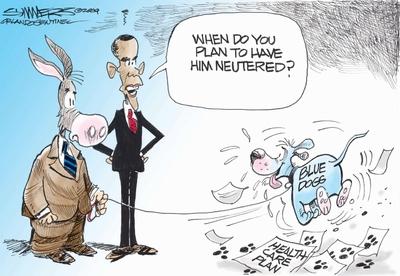
© Dana Summers
Under Obama, the conservative Democrats try to show their power on issues like healthcare reform
After another day wrangling over healthcare reform, it was no small amount of frustration that inspired Rep. Henry Waxman to stand in front of a press gathering and not-so-subtly accuse the "blue dog" Democrats of being party turncoats.
"I won't allow them to hand over control of our committee to Republicans," Waxman said, threatening to have the bill bypass the Energy and Commerce Committee he chairs if the blue dogs didn't accept the deal before them.
"I don't see what other alternative we have, because we're not going to let them empower Republicans on the committee," he added, in case his point had been lost on anyone.
That position, however, didn't last long.
House Speaker Nancy Pelosi, who has cultivated a generally positive relationship with the blue dogs, said she would not support a move to bypass the committee. Waxman backtracked shortly afterward, striking a more conciliatory tone and offering up a package of concessions to the seven blue dogs on his committee.
The episode was widely heralded as a tidy illustration of the growing clout of the coalition of 52 mostly Southern, mostly fiscally conservative House Democrats.
It also appeared to make an impression on high-profile House Republicans. "Good for them," Minority Leader John Boehner said of the holdout blue dogs. He added that he would now consider shelving the nickname "lap dogs," which he had previously taken to calling them.
But that particular moniker points to criticism within Democratic ranks as well: namely, that the blue dogs don't have the sort of
substantial sway that their recent spate of press would suggest. "The blue dogs have really created this brand name," says
Burdett Loomis, a professor at the
True, Loomis says, they have been a voice for fiscal moderates.
Many come from either rural Southern districts or Northern blue-collar coal-mining towns, for example, "that aren't very
hospitable to an extremely liberal member of
But despite the tough talk, the blue dogs have not voted against the
The blue dogs argue this doesn't mean they lack pull. Theirs is more of an inside game, they say, to get the Democratic leadership to change and modify its agenda.
Under President Obama, however, they have begun to flex their muscle within the party in high-visibility arenas like healthcare reform. Last month, they also succeeded in passing pay-as-you-go legislation, known as PAYGO. The bill institutes across-the-board spending cuts if the cost of new laws isn't matched by increased revenues or cuts elsewhere in the budget. It is a measure for which the blue dogs had been fighting for 15 years, saidRep. Baron Hill, a Democrat from Indiana. The bill also represents "an unprecedented step forward in the blue dogs' fight to restore fiscal responsibility and accountability to the federal government," he added.
But both liberal and conservative bloggers are fond of arguing that the fiscal conservatism of the blue dogs is overrated. They cite defense appropriations as one illustration. Despite a
But the big defense contractors that build them offer jobs in Congressional districts hit hard by the recession. In other areas, fellow lawmakers have noted that the blue dogs have not been immune from the influence of big lobby groups. "They are walking a fine line," says Thomas Mann, an expert on
A recent report from the
PAC contributors are well aware that the upcoming legislation will be tough votes for the blue dogs to sell to their cost-conscious constituents. Some, for example, hail from coal-mining districts that worry about how the cap-and-trade bill's limits on emissions from fossil fuels will affect them. Because they have voted with the party on energy legislation, sometimes under heavy pressure from Democratic leadership, blue dogs have held firm on issues like healthcare reform.
And so, as this week drew to a close and the congressional recess approached, Rep. Mike Ross, a blue dog from Arkansas who has emerged as a leader of the seven holdouts on Waxman's committee, enumerated the concessions that his coalition was able to win, including exempting businesses earning less than
Equally important, the healthcare dust-up allowed the blue dogs to tout their conservative credentials. "Look, there's no secret here that Henry Waxman is much more to the left than I am," Ross took pains to point out.
But Mann notes that despite requisite political theater, the blue dogs are aware that they have a vested interest in seeing that healthcare reform ultimately passes after the August recess. They know, he says, "that if they hold out for too much and this goes down, then they go down."
That's because they are the most politically vulnerable of the Democrats. "Simply voting against healthcare reform," Mann adds, "isn't going to insulate them from the downward draft if this thing blows up." The administration "has put so many chits on this one program that if it goes down, [Democrats] really look like we're not fit to govern," says one party operative. "In the end, the blue dogs and the liberals have the same calling here."
But by creating a choke point in the influential
AMERICAN POLITICS
WORLD | AFRICA | ASIA | EUROPE | LATIN AMERICA | MIDDLE EAST | UNITED STATES | ECONOMICS | EDUCATION | ENVIRONMENT | FOREIGN POLICY | POLITICS
Receive our political analysis by email by subscribing here
© Tribune Media Services