The Second Coming of Known Unknowns
Arianna Huffington on Tim Geithner, Economic Crisis & Obama Budget
A formerly famous and now mostly forgotten poet of nonsense verse once said:
"There are known knowns. There are things we know that we know. There are known unknowns . . . there are also unknown unknowns."
That was, of course, Donald Rumsfeld.
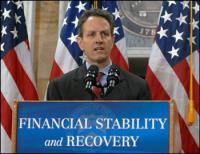
But it doesn't sound too different from your average briefing/Congressional testimony/interview by Timothy Geithner.
Besides being awash in toxic paper, credit default swaps, and collateralized debt obligations, we seem to be drowning in unknowns. Only, I get the sense that there are fewer unknowns than we're being told.
While we're rewarding the risk-taking shareholders of various zombie banks -- not to mention the mysterious, unconfirmed counterparties to AIG's serial recklessness -- how about rewarding the taxpayers, if not with an actual return on our bailout investment then at least with information about what exactly is being done with our money? It's time to call in all the unknowns.
Instead, we're greeted with a wall of manufactured complexity by the people whose job it is to make known unknowns into known knowns. There is nothing complex about the way CEOs like John Thain, Ed Liddy, Lloyd Blankfein, John Mack, Vikram Pandit and Ken Lewis turned bailout billions into Wall Street bonus money -- and no justification for keeping taxpayers in the dark about the giveaways (Vanity Fair's Michael Shnayerson breaks down the jaw-dropping and blood-boiling numbers).
Which brings us to the holy temple of unknown unknowns: CNBC. The financial channel's Erin Burnett ("Street Signs," "Squawk on the Street") was on "Real Time with Bill Maher" on Friday night, suddenly seeing all kinds of complexity, nuance and ambiguity in what can be known and not known about the economic crisis. Does the government know more than they're telling us, asked Bill.
"I don't think they know," said Burnett. "I don't think anybody knows."
And: "I don't even know that the CEOs themselves know."
And: "Tim Geithner may know more than most, but no, he doesn't know."
And as for whether the financial geniuses at CNBC should have known something:
"It's easy to say (there's) a bubble, but you don't know when it's gonna burst. And I think that the question of timing and magnitude, nobody got. That wasn't just a CNBC pundit thing, that was any expert out there." I guess she missed experts like Roubini and Taleb.
And I certainly don't remember that kind of circumspection in the run-up to the meltdown. For a look at what the CNBC sages thought they knew, and how wrong they were, there is, of course, Jon Stewart's already legendary evisceration.
As Stewart shows, the essential truth of what went on is really quite simple. Using complexity as a cover for accountability has a long historical track record of ending in disaster.
"The most dangerous thing in any economic crisis is denial," writes MIT professor Simon Johnson, a former official at the IMF, where he specialized in dealing with banking crises around the world. He's become one of the leaders of the camp arguing that the administration needs to admit the scope of the banking problem and deal with it sooner (wildly expensive) rather than later (insanely and unsustainably expensive). While "the degree of denial in the United States has fallen dramatically," Johnson writes, "there is one major aspect of denial still remaining: the scale and nature of our banking difficulties."
(Johnson, by the way, is doing his part to get rid of unknowns at his blog Baseline Scenario, which includes a terrific primer on the financial crisis.)
Johnson's insights mirror those of Paul Krugman, who writes that "officials still aren't willing to face the facts. They don't want to face up to the dire state of major financial institutions because it's very hard to rescue an essentially insolvent bank without, at least temporarily, taking it over." Not coming clean and doing what needs to be done, adds Krugman, "could result in an economy that sputters along, not for months or years, but for a decade or more."
Speaking of nationalization, CNBC's Burnett told Maher, "Nobody wants it on the left, nobody wants it on the right" -- even as calls for it continue to come from both the left and the right, demonstrating once again how obsolete that way of looking at the world is becoming. America's Business Channel, indeed.
The list of knowable knowns that we still don't know about includes the final destination of the taxpayer money the government keeps funneling to AIG. The Wall Street Journal reports that around $50 billion of the $173 billion in bailout funds given to the insurance behemoth has gone to pay off financial institutions that had insured their wildly irresponsible credit default swaps with AIG.
So who, exactly, has our money -- and why don't we know? AIG CEO Ed Liddy prefers not to say. Same with the Fed, which refused a congressional request for the names of AIG's derivative counterparties. According to unnamed sources, the list includes Goldman Sachs, Merrill Lynch / Bank of America, Morgan Stanley and Deutsche Bank.
It's worth noting that, thanks to the industry-written 2005 Bankruptcy Bill, derivatives claims are not stayed in bankruptcy -- so the financial institutions that gambled and lost would nevertheless be the first ones paid off. Isn't gaming the system fun?
The stimulus package -- and the media's coverage of it -- has also been a hotbed of known unknowns. Or, if you prefer, unreported knowns.
According to a Media Matters study of 59 network news broadcasts about the stimulus in the three weeks prior to the vote, only three mentioned concerns that the package was inadequate -- even though many economists believed it was not big enough to do the job: another known known treated like an unknown when we most needed to know. And now, of course, we're already getting reports that the bill was, indeed, too small.
I'm not saying that everything about this crisis is knowable -- far from it. But there are a number of very simple truths that are being hidden behind a smokescreen of complexity and unknowability.
It doesn't take a Ph.D. in economics to know that you can't have CEOs whose companies have received billions in bailout funds going to court and threatening to sue employees to keep the public from knowing which executives pocketed millions in bonuses -- and you can't have them pretending that no bailout money was used to pay said bonuses.
You can't have insolvent banks pretending that the problem is one of liquidity, and then using taxpayer money to protect their balance sheets instead of lending money to credit-worthy businesses and consumers.
And, ultimately, you can't allow the same people who were part of the problem to be part of the solution. There is absolutely no way on earth that the same flawed thinking that got us into this mess will ever get us out of it. We need to clean house, taking the steering wheel away from the executives and the compliant boards that steered us over the economic cliff. They didn't get it then; they still don't get it now. (See them handing out bonuses, hosting spa retreats, redecorating and throwing lavish parties while America teeters on the verge of economic collapse.)
That is something we all know that we know -- even Tim Geithner and the experts at CNBC.
Recent Political Commentary
Obama Economic Team's Flawed Cosmology:
Still Believing Universe Revolves around Banks
Arianna Huffington
A series of recent meetings with members of Barack Obama's economic team leading to a spirited back-and-forth that made me feel like I was back at Cambridge, debating the smartest kid in the class), left me with a pair of indelible impressions:
First, these are all good people, many of them brilliant, working incredibly hard with the best of intentions to solve the country's financial crisis.
Second, they are operating on the basis of an outdated cosmology that places banks at the center of the economic universe.
My Wish List
Andy Rooney
In an idle moment, trying to come up with an idea, Humorist & Commentator Andy Rooney decided to make a list of things he should do but has not.
I Would Rather Stay Home & Not Travel
Andy Rooney
Andy Rooney would like to mount a campaign once again to encourage people not to go anywhere as he was looking at all the ads in newspapers and magazines for places to go. Sometimes, travel is quite unpleasant.
I'm Hedging Today
Andy Rooney
Andy Rooney sees the phrase "hedge fund" in the newspaper every day now and does not really know what a "hedge fund" is. A hedge fund has something to do with money. He was surprised to find "hedge fund" in one of only six dictionaries, but then read the definition.
Greening My House
Arianna Huffington
Ever since I saw the Green light, thanks to my friend Laurie David, and traded in my gas-guzzling SUV, I've tried my best to up my eco-awareness.
On the Road to Buenos Aires
Even the United States can Manage Itself into Irrelevance
Chris Thomas
America has been the greatest of all nations for a long time. We have been great for so long that we believe it is part of the natural order of the universe for us to be who we are. But in reality, we managed our way to where we are now. We decided to create the Constitution. We decided to have an open culture. We decided to have free trade and open markets. The sum total of these decisions created this great human enterprise.
But we should not forget, especially at a crucial juncture like this, that with enough bad decisions and enough political incompetence, we can indeed manage ourselves into decline.
Even we can become Argentina.
Larry Summers: Brilliant Mind, Toxic Ideas
by Arianna Huffington
According to most commentators, the president's press conference went a long way toward taking the spotlight off the roiling anger over AIG, bonuses and Wall Street abuses -- and putting it back where the president wants it: on the imperative need to pass his budget.
But the best laid plans of our remarkable president may be laid to waste by a bank rescue plan that is the product of exhausted ideas put together by men far too beholden to Wall Street.
To understand why a man as brilliant and accomplished as Summers can be so wrong about what to do with the banks and Wall Street, it would be useful to turn to "The Innovator's Dilemma," by Harvard Business School professor Clayton Christensen.
What if Jon Stewart, Instead of John King,
Interviewed Dick Cheney
Arianna Huffington
Jon Stewart's Jim Cramer interview was a pivotal moment -- not just for Stewart, Cramer and CNBC, but also for journalism. Stewart kept popping into my head as I watched John King interview Dick Cheney three days later.
King opened the interview by showing clips of President Obama saying that his administration had "inherited an economic crisis" and "inherited a big mess." He then asked Cheney: "Did you leave him a mess?"
"I don't think you can blame the Bush administration for the creation of those circumstances," responded Cheney. "It's a global financial problem. . . . So I think the notion that you can just sort of throw it off on the prior administration, that's interesting rhetoric but I don't think anybody really cares a lot about that."
Rove Pontificating on Economy
Like Madoff Pontificating on Investing
Although anointed as "the intellectual force and energy behind the Republican Party," Rush Limbaugh is just a massive shiny object that distracts our attention from the real intellectual force and energy behind the Republican Party, Karl Rove.
Then there is Rove's decidedly anti-Limbaughian approach, whereby he calmly, lucidly, and shamelessly attempts to whitewash the past and rewrite history. A history he was front and center in making.
The Rush and Rahm Show
Chris Thomas
This past week, while iconic American enterprises like GE and Berkshire came under substantial market pressure, our "Leadership" in Washington became preoccupied with talk show host Rush Limbaugh. Rahm Emmanuel (left), a brilliant partisan tactician, and Clinton retreads Paul Begala and James Carville formulated a plan to make Limbaugh the face of the GOP.
After all, its much more fun than wondering why the Credit Default Swap market is treating GE like Citibank or weather we can spend ourselves out of a recession that we got into by ... well ... spending too much. Rush is much more fun to listen to than Jeff Immelt anyway.
The Credit Card Crisis: The Next Economic Domino
Hot on the heels of the banking crisis, the employment crisis and the mortgage-foreclosure crisis, the country is on the verge of experiencing a credit-card crisis.
Time to Treat American Homeowners as Well as Wall Street Bankers
Arianna Huffington
"The banks are too big to fail" has been the mantra we've been hearing since September. But when you consider the millions of American homeowners facing foreclosure, aren't they also too big to be allowed to fail? So why hasn't the foreclosure crisis gotten the attention it deserves? A combination of perverse priorities and flawed thinking.
Bipartisanship vs What's Best for America:
President Obama Needs to Choose
The first question at President Obama's primetime press conference should have been: "Mr. President, what is your priority -- bipartisanship or what is best for America? And when the two are in conflict, which are you going to choose?
Although the answer should be obvious, the president's actions over the last couple of weeks have left many wondering.
America's Best Bet: Municipal Redemption Fund (MuRF)
Stopping Foreclosures & Protecting Investors
An original economic stimulus plan developed by a real estate agent in New Jersey that is currently in the hands of the House of Representatives and every Senator in Washington D.C. The Federal Government purchases NO interest in any private property and may take NO assignment of any lien under this plan. This plan is strictly a transparent "time-out" and "reset" of the national tax lien industry for the sake of stopping foreclosures while simultaneously protecting investors by shoring up the absolute bedrock of the capitalist economy which emanates directly from real property values and the taxes thereon.
Stimulus Package: If You Jump Halfway Across a Chasm, You Fall Into the Abyss
Arianna Huffington
Here's a thought: If we are going to spend $2 trillion trying to deal with the economic crisis, shouldn't we do it right? The price of getting it wrong is, after all, extremely high.
John Thain, Poster Child for Era of Irresponsibility
Arianna Huffington
There is plenty of debate about what President Obama's stimulus bill should look like -- as well there should be, given all that is at stake. But there is a growing consensus that the guiding principle in that debate should be Obama's call for a "new era of responsibility."
Helping fuel that consensus is the saga of the rise and fall of former Merrill Lynch CEO John Thain, the poster child for the Era of Irresponsibility. The condemnation of his behavior is completely bipartisan.
Barack Obama Sober Sermon on the Steps
Arianna Huffington
The new president and the throng that turned out to cheer him and hear him on Inauguration Day were on two very different missions.
The crowd had come to celebrate. Obama had come to deliver a sober sermon.
Inaugural Address By President Barack Hussein Obama
President Obama's Inauguration Speech in text & video
President Barack Obama gives his inaugural address after taking the oath of office in Washington, D.C., Jan. 20, 2009. The presidential inauguration is a tradition dating back to George Washington's 1789 inauguration. President Obama's Inauguration Speech in full in text & video.
Laissez-Faire Capitalism Should Be as Dead as Soviet Communism
Arianna Huffington
The collapse of Communism as a political system sounded the death knell for Marxism as an ideology. But while laissez-faire capitalism has been a monumental failure in practice, and soundly defeated at the polls, the ideology is still alive and kicking.
Does the Madoff Debacle Finally End the 'Who Could have Known' Era?
Arianna Huffington
An ambitious and risky undertaking carried out with hubris, and featuring the weeding out of anyone who raises alarms, little-to-no transparency, an oversight system in which no central authority is accountable, and the deliberate manufacturing of ambiguity and complexity so that when it all falls to pieces, the excuse who could have known can be used
Rewarding Those Who Got It Right
Arianna Huffington
Among its myriad failings, the Bush administration has repeatedly gotten it wrong when it comes to getting it right.
Over the last eight years, there has consistently been no penalty for those who have gotten things -- even the most important things -- wrong, and no reward for those who have gotten things right.
Call it Bush Darwinism: Survival of the Unfittest.
The Economic Meltdown Will Be Blogged
Politics Arianna Huffington
Losing your job -- or even fearing that you might -- can make you feel powerless. But at the same time you are looking for work -- or learning a new skill -- you can take up blogging. It doesn't require anyone's permission, there is no application process. You just need blogging software (some of the best is free) and the will to express yourself.
(Arianna Huffington's e-mail address is arianna@huffingtonpost.com.)
(c) 2009 Arianna Huffington. Distributed by Tribune Media Services, Inc.
Obama Presidential Inaugural
- Presidential Inaugural History
- Obama Inauguration Schedule & Events
- Obama Inauguration Facts & Information for Kids
- Obama's new Home was Slow to Integrate
- Memorable Speeches from Past Inaugurals
- America's Leading Man for the Dramas Ahead
- Don't Take that Oath, Barack
- Riding on the Wings of Change
- America in Shock
- Great Expectations
- Awaiting the Transformational Presidency
- Europeans Love 'Alabama'
- Is This the End of Black
- A New Way of Being on this Planet
- As Decider, True Obama will Become Clear
- Special Inaugural Crossword Puzzle
- Obama Not Only One Being Inaugurated
POLITICS: ARIANNA HUFFINGTON
- Obama Call to Service & the Economic Meltdown
- Can Obama Pull Off Presidential Double Play
- All Americans Have Reason to Celebrate
- Obama Closing Arguments Election Eve
- McCain Closing Arguments Election Eve
- The Truth About Obama's Birth Certificate
- Obama Should Spill a Little Red Ink
- McCain, the Internet & the Death of Rovian Politics
- What McCain May Be Planning
- The Winner of Presidential Debate II? 'That One'
- Does McCain Still Agree with Ronald Reagan
- The Bailout Plan: Economic Shock & Awe
- Palin Doctrine: Why Neocons are Excited
- Palin: Trojan Moose Concealing 4 More Years of Bush
- The Unbearable Lightness of Being Sarah Palin
- McCain Vs. Biden: 'Foreign Policy Experience'
- Three-Man Race: Obama Versus the Two McCains
- McCain Isn't 'Ready To Lead' on National Security
- "Swing Vote": What It Tells Us About the Race
- Obama's Trip Bounce
- Why is Obama's Popularity With Our Allies A Bad Thing?
- Latest Media Blind Spot
- Surge Amnesia: Media's Newest Affliction
- Moving to the Middle Is For Losers
- McCain's Campaign Funding Hypocrisy
- John McCain The 2nd Coming of Bob Dole
- 7 Takes on Scott McClellan's New Book
- Hillary Clinton's Defeat: A Historic Triumph
Arianna Huffington is a passionate partisan who doesn't mince words and takes no prisoners in her fight for social justice. Her straightforward, unabashedly liberal commentary speaks the language of average Americans. She freely attacks the conventional wisdom of both Democrats and Republicans and, in the process, gives voice to readers frustrated by politics-as-usual.