iHaveNet.com
Larry Summers: Brilliant Mind, Toxic Ideas | Arianna Huffington
Your Single Source to Current Events, News Analysis & Reviews.
  • HOME
  • WORLD
    • Africa
    • Asia Pacific
    • Balkans
    • Caucasas
    • Central Asia
    • Eastern Europe
    • Europe
    • Indian Subcontinent
    • Latin America
    • Middle East
    • North Africa
    • Scandinavia
    • Southeast Asia
    • United Kingdom
    • United States
    • Argentina
    • Australia
    • Austria
    • Benelux
    • Brazil
    • Canada
    • China
    • France
    • Germany
    • Greece
    • Hungary
    • India
    • Indonesia
    • Ireland
    • Israel
    • Italy
    • Japan
    • Korea
    • Mexico
    • New Zealand
    • Pakistan
    • Philippines
    • Poland
    • Russia
    • South Africa
    • Spain
    • Taiwan
    • Turkey
    • United States
  • USA
    • ECONOMICS
    • EDUCATION
    • ENVIRONMENT
    • FOREIGN POLICY
    • POLITICS
    • OPINION
    • TRADE
    • Atlanta
    • Baltimore
    • Bay Area
    • Boston
    • Chicago
    • Cleveland
    • DC Area
    • Dallas
    • Denver
    • Detroit
    • Houston
    • Los Angeles
    • Miami
    • New York
    • Philadelphia
    • Phoenix
    • Pittsburgh
    • Portland
    • San Diego
    • Seattle
    • Silicon Valley
    • Saint Louis
    • Tampa
    • Twin Cities
  • BUSINESS
    • FEATURES
    • eBUSINESS
    • HUMAN RESOURCES
    • MANAGEMENT
    • MARKETING
    • ENTREPRENEUR
    • SMALL BUSINESS
    • STOCK MARKETS
    • Agriculture
    • Airline
    • Auto
    • Beverage
    • Biotech
    • Book
    • Broadcast
    • Cable
    • Chemical
    • Clothing
    • Construction
    • Defense
    • Durable
    • Engineering
    • Electronics
    • Firearms
    • Food
    • Gaming
    • Healthcare
    • Hospitality
    • Leisure
    • Logistics
    • Metals
    • Mining
    • Movie
    • Music
    • Newspaper
    • Nondurable
    • Oil & Gas
    • Packaging
    • Pharmaceutic
    • Plastics
    • Real Estate
    • Retail
    • Shipping
    • Sports
    • Steelmaking
    • Textiles
    • Tobacco
    • Transportation
    • Travel
    • Utilities
  • WEALTH
    • CAREERS
    • INVESTING
    • PERSONAL FINANCE
    • REAL ESTATE
    • MARKETS
    • BUSINESS
  • STOCKS
    • ECONOMY
    • EMERGING MARKETS
    • STOCKS
    • FED WATCH
    • TECH STOCKS
    • BIOTECHS
    • COMMODITIES
    • MUTUAL FUNDS / ETFs
    • MERGERS / ACQUISITIONS
    • IPOs
    • 3M (MMM)
    • AT&T (T)
    • AIG (AIG)
    • Alcoa (AA)
    • Altria (MO)
    • American Express (AXP)
    • Apple (AAPL)
    • Bank of America (BAC)
    • Boeing (BA)
    • Caterpillar (CAT)
    • Chevron (CVX)
    • Cisco (CSCO)
    • Citigroup (C)
    • Coca Cola (KO)
    • Dell (DELL)
    • DuPont (DD)
    • Eastman Kodak (EK)
    • ExxonMobil (XOM)
    • FedEx (FDX)
    • General Electric (GE)
    • General Motors (GM)
    • Google (GOOG)
    • Hewlett-Packard (HPQ)
    • Home Depot (HD)
    • Honeywell (HON)
    • IBM (IBM)
    • Intel (INTC)
    • Int'l Paper (IP)
    • JP Morgan Chase (JPM)
    • J & J (JNJ)
    • McDonalds (MCD)
    • Merck (MRK)
    • Microsoft (MSFT)
    • P & G (PG)
    • United Tech (UTX)
    • Wal-Mart (WMT)
    • Walt Disney (DIS)
  • TECH
    • ADVANCED
    • FEATURES
    • INTERNET
    • INTERNET FEATURES
    • CYBERCULTURE
    • eCOMMERCE
    • mp3
    • SECURITY
    • GAMES
    • HANDHELD
    • SOFTWARE
    • PERSONAL
    • WIRELESS
  • HEALTH
    • AGING
    • ALTERNATIVE
    • AILMENTS
    • DRUGS
    • FITNESS
    • GENETICS
    • CHILDREN'S
    • MEN'S
    • WOMEN'S
  • LIFESTYLE
    • AUTOS
    • HOBBIES
    • EDUCATION
    • FAMILY
    • FASHION
    • FOOD
    • HOME DECOR
    • RELATIONSHIPS
    • PARENTING
    • PETS
    • TRAVEL
    • WOMEN
  • ENTERTAINMENT
    • BOOKS
    • TELEVISION
    • MUSIC
    • THE ARTS
    • MOVIES
    • CULTURE
  • SPORTS
    • BASEBALL
    • BASKETBALL
    • COLLEGES
    • FOOTBALL
    • GOLF
    • HOCKEY
    • OLYMPICS
    • SOCCER
    • TENNIS
  • Subscribe to RSS Feeds EMAIL ALERT Subscriptions from iHaveNet.com RSS
    • RSS | Politics
    • RSS | Recipes
    • RSS | NFL Football
    • RSS | Movie Reviews
Larry Summers: Brilliant Mind, Toxic Ideas
by Arianna Huffington

HOME > USA > POLITICS > Larry Summers: Brilliant Mind, Toxic Ideas


Larry Summers Lawrence H. Summers Obama Presidency

Subscribe to Barack Obama Presidential Inauguration  RSS     SocialTwist Tell-a-Friend

According to most commentators, the president's press conference went a long way toward taking the spotlight off the roiling anger over AIG (NYSE: AIG), bonuses and Wall Street abuses -- and putting it back where the president wants it: on the imperative need to pass his budget.

But the best laid plans of our remarkable president may be laid to waste by a bank rescue plan that is the product of exhausted ideas put together by men far too beholden to Wall Street.


Even if the president desperately wants the spotlight to move on from the bank rescue, we should not allow it to.

So let me turn the high beam on one of the main architects of the plan -- less in the news than Tim Geithner, but no less important -- Larry Summers.

To understand why a man as brilliant and accomplished as Summers can be so wrong about what to do with the banks and Wall Street, it would be useful to turn to "The Innovator's Dilemma," by Harvard Business School professor Clayton Christensen.

The book explains how even very successful companies, with very capable personnel, often fail because they tend to stick to the strategies that made them successful in the first place, leaving themselves vulnerable to changing conditions and new realities. So you can have brilliant managers who miss what's needed for success in the future because they are too tied to the past.

This describes Summers to a T.

He is one of the top economic minds of his generation, a tenured professor at Harvard by the time he was 28, with plenty of real-word experience -- ranging from heading the Treasury to heading a major university. But his core beliefs and assumptions helped lay the groundwork for the current crisis.

As treasury secretary under Bill Clinton, Summers played an important role in convincing Congress in 1999 to pass the Gramm-Leach-Bliley Act, which repealed key portions of the Glass-Steagall Act and allowed commercial banks to get into the mortgage-backed securities and collateralized debt obligations game. The measure also created an oversight disaster, with supervision of banking conglomerates split among a host of different government agencies -- agencies that often failed to let each other know what they were doing and what they were uncovering.

At the signing of the bill, Summers hailed it as "a major step forward to the 21st century."

Summers also backed Phil Gramm's other financial time bomb, the Commodity Futures Modernization Act, which allowed financial derivatives to be traded without any oversight or regulation. So it was on his watch that the credit-default swaps warhead that has blown up our economy was launched.

Indeed, during a 1998 Senate hearing, Summers testified against the regulation of the derivatives market on the grounds that we could trust Wall Street. "The parties to these kinds of contract," he said, "are largely sophisticated financial institutions that would appear to be eminently capable of protecting themselves from fraud and counterparty insolvencies and most of which are already subject to basic safety and soundness regulation under existing banking and securities laws."

It would be hard to make assumptions that turned out to be more wrong than Summers' were.

For a more accurate portrayal of what Summers described as "largely sophisticated financial institutions," check out Matt Taibbi's devastating depiction in Rolling Stone of AIG's upper management as utterly clueless about the "selective accounting" scam being run by credit-default swap pusher Joseph Cassano, head of AIG's 400-person Financial Products unit (Taibbi dubs Cassano "the Patient Zero of the global economic meltdown"):

"For six months before its meltdown, according to insiders, the company had been searching for a full-time chief financial officer and a chief risk-assessment officer, but never got around to hiring either. That meant that the 18th-largest company in the world had no one checking to make sure its balance sheet was safe and no one keeping track of how much cash and assets the firm had on hand. The situation was so bad that when outside consultants were called in a few weeks before the bailout, senior executives were unable to answer even the most basic questions about their company -- like, for instance, how much exposure the firm had to the residential-mortgage market."

Taibbi describes Cassano getting on a conference call with investors in 2007 and, as his credit-default swap portfolio was racking up $352 million in losses, announcing: "It is hard for us, without being flippant, to even see a scenario within any kind of realm of reason that would see us losing $1 in any of those transactions."

These are the kinds of "parties" Summers was so confident could regulate themselves and be "eminently capable of protecting themselves from fraud and counterparty insolvencies."

Of course, not just the Financial Products unit at AIG, but also the toxic balance sheets at megabank after megabank tell a very different story.

In a speech at the Kennedy School of Government in September 2000, Summers declared: "The traditional industrial economy was a Newtonian system of opposing forces, checks and balances. . . . While, in contrast, the right metaphors for the new economy are more Darwinian, with the fittest surviving."

He forgot to add the part about the fittest surviving by being bailed out by the rest of us.

Real economic Darwinism -- or Randian capitalism -- would mean letting old institutions that have failed die. Keeping them on life support is not just catastrophically burdensome for taxpayers, but also prevents new institutions from flowering.

In a fawning new profile of Summers in The New Republic, we discover that Summers' tired thinking extends to the way he views being tired.

Noam Scheiber reports that "Summers functions on exceedingly little sleep. . . . To power through the day, Summers relies on a punishing Diet Coke regimen. The combination of fatigue and extreme caffeine intake can produce the occasional verbal and physical tic: Summers is a chronic foot-tapper and sometimes turns over words and clauses like an engine that won't start."

The notion that driving yourself to the point of exhaustion and chronic foot-tapping is a sign of commitment and achievement is as obsolete as the belief that pumping more money into the same institutions that created the crisis will solve it.

Summers' old boss, Bill Clinton, once said, "Every important mistake I've made in my life, I've made because I was too tired."

Many Wall Street high-flyers could echo this -- if they had any self-awareness. Instead, they subscribe to our culture's veneration of exhaustion. Taibbi describes how Wall Streeters, when challenged, "talk about how hard they work, the 90-hour weeks, the stress, the failed marriages, the hemorrhoids and gallstones they all get before they hit 40."

The country would be better off if Wall Street execs and, more importantly, Summers and Geithner -- who, we are admiringly told, works 15 hours a day -- knocked off early and came back to work the next day refreshed . . . and with some fresh ideas.

(Arianna Huffington's e-mail address is arianna@huffingtonpost.com.)

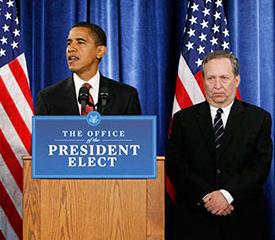
Lawrence H. Summers

Lawrence H. Summers is the Director of the National Economic Council and was appointed by President Barack H. Obama on November 24, 2008.

Until January, he was the Charles W. Eliot University Professor at Harvard University. He served as the 27th president of Harvard University from July 2001 until June 2006. From 1999 to 2001, he served as the 71st United States Secretary of the Treasury following his earlier service as Deputy and Under Secretary of the Treasury and as Chief Economist of the World Bank. Summers has taught economics at Harvard and MIT. His research contributions were recognized when he received the John Bates Clark Medal, given every two years to the outstanding American economist under the age of 40, and when he was the first social scientist to receive the National Science Foundation’s Alan T. Waterman Award for outstanding scientific achievement. He is a member of the National Academy of Science and has written extensively on economic analysis and policy publishing over 150 articles in professional economic journals.

Lawrence Summers received his B.S. from MIT and his Ph.D. in economics from Harvard. He and his wife Elisa New, a professor of English at Harvard, have six children.


Receive iHaveNet.com on Politics Enter your email address:


Delivered by FeedBurner


Recent Political Commentary

Obama Economic Team's Flawed Cosmology:
Still Believing Universe Revolves around Banks

Arianna Huffington

President Obama and His Economic Advisory Team

A series of recent meetings with members of Barack Obama's economic team leading to a spirited back-and-forth that made me feel like I was back at Cambridge, debating the smartest kid in the class), left me with a pair of indelible impressions:

First, these are all good people, many of them brilliant, working incredibly hard with the best of intentions to solve the country's financial crisis.

Second, they are operating on the basis of an outdated cosmology that places banks at the center of the economic universe.

My Wish List
Andy Rooney

In an idle moment, trying to come up with an idea, Humorist & Commentator Andy Rooney decided to make a list of things he should do but has not.

I Would Rather Stay Home & Not Travel
Andy Rooney

Andy Rooney would like to mount a campaign once again to encourage people not to go anywhere as he was looking at all the ads in newspapers and magazines for places to go. Sometimes, travel is quite unpleasant.

I'm Hedging Today
Andy Rooney

Andy Rooney sees the phrase "hedge fund" in the newspaper every day now and does not really know what a "hedge fund" is. A hedge fund has something to do with money. He was surprised to find "hedge fund" in one of only six dictionaries, but then read the definition.

Greening My House.
Arianna Huffington

Ever since I saw the Green light, thanks to my friend Laurie David, and traded in my gas-guzzling SUV, I've tried my best to up my eco-awareness.

On the Road to Buenos Aires
Even the United States can Manage Itself into Irrelevance

Chris Thomas

America has been the greatest of all nations for a long time. We have been great for so long that we believe it is part of the natural order of the universe for us to be who we are. But in reality, we managed our way to where we are now. We decided to create the Constitution. We decided to have an open culture. We decided to have free trade and open markets. The sum total of these decisions created this great human enterprise.

But we should not forget, especially at a crucial juncture like this, that with enough bad decisions and enough political incompetence, we can indeed manage ourselves into decline.

Even we can become Argentina.

What if Jon Stewart, Instead of John King,
Interviewed Dick Cheney

Arianna Huffington

Former vice-president Dick Cheney interviewed by CNN's John King | Huffington

Jon Stewart's Jim Cramer interview was a pivotal moment -- not just for Stewart, Cramer and CNBC, but also for journalism. Stewart kept popping into my head as I watched John King interview Dick Cheney three days later.

King opened the interview by showing clips of President Obama saying that his administration had "inherited an economic crisis" and "inherited a big mess." He then asked Cheney: "Did you leave him a mess?"

"I don't think you can blame the Bush administration for the creation of those circumstances," responded Cheney. "It's a global financial problem. . . . So I think the notion that you can just sort of throw it off on the prior administration, that's interesting rhetoric but I don't think anybody really cares a lot about that."

Tim Geithner, CNBC & the Second Coming of Known Unknowns | Huffington

Tim Geithner, CNBC &
The Second Coming of Known Unknowns

Arianna Huffington on Tim Geithner, Economic Crisis & Obama Budget

Besides being awash in toxic paper, credit default swaps, and collateralized debt obligations, we seem to be drowning in unknowns.


Only, I get the sense that there are fewer unknowns than we're being told. Instead, we're greeted with a wall of manufactured complexity by the people whose job it is to make known unknowns into known knowns.

Rove Pontificating on Economy Like Madoff Pontificating on Investing

Although anointed as "the intellectual force and energy behind the Republican Party," Rush Limbaugh is just a massive shiny object that distracts our attention from the real intellectual force and energy behind the Republican Party, Karl Rove.

Time to Treat American Homeowners as Well as Wall Street Bankers
Arianna Huffington

"The banks are too big to fail" has been the mantra we've been hearing since September. But when you consider the millions of American homeowners facing foreclosure, aren't they also too big to be allowed to fail? So why hasn't the foreclosure crisis gotten the attention it deserves? A combination of perverse priorities and flawed thinking.

Bipartisanship vs What's Best for America:
President Obama Needs to Choose

The first question at President Obama's primetime press conference should have been: "Mr. President, what is your priority -- bipartisanship or what is best for America? And when the two are in conflict, which are you going to choose?

Although the answer should be obvious, the president's actions over the last couple of weeks have left many wondering.

America's Best Bet: Municipal Redemption Fund (MuRF)
Stopping Foreclosures & Protecting Investors

An original economic stimulus plan developed by a real estate agent in New Jersey that is currently in the hands of the House of Representatives and every Senator in Washington D.C. The Federal Government purchases NO interest in any private property and may take NO assignment of any lien under this plan. This plan is strictly a transparent "time-out" and "reset" of the national tax lien industry for the sake of stopping foreclosures while simultaneously protecting investors by shoring up the absolute bedrock of the capitalist economy which emanates directly from real property values and the taxes thereon.

Stimulus Package: If You Jump Halfway Across a Chasm, You Fall Into the Abyss
Arianna Huffington

Here's a thought: If we are going to spend $2 trillion trying to deal with the economic crisis, shouldn't we do it right? The price of getting it wrong is, after all, extremely high.

John Thain, Poster Child for Era of Irresponsibility
Arianna Huffington

There is plenty of debate about what President Obama's stimulus bill should look like -- as well there should be, given all that is at stake. But there is a growing consensus that the guiding principle in that debate should be Obama's call for a "new era of responsibility."

Helping fuel that consensus is the saga of the rise and fall of former Merrill Lynch CEO John Thain, the poster child for the Era of Irresponsibility. The condemnation of his behavior is completely bipartisan.

Barack Obama Sober Sermon on the Steps
Arianna Huffington

The new president and the throng that turned out to cheer him and hear him on Inauguration Day were on two very different missions.

The crowd had come to celebrate. Obama had come to deliver a sober sermon.

Inaugural Address By President Barack Hussein Obama
President Obama's Inauguration Speech in text & video

President Barack Obama gives his inaugural address after taking the oath of office in Washington, D.C., Jan. 20, 2009. The presidential inauguration is a tradition dating back to George Washington's 1789 inauguration. President Obama's Inauguration Speech in full in text & video.

Laissez-Faire Capitalism Should Be as Dead as Soviet Communism
Arianna Huffington

The collapse of Communism as a political system sounded the death knell for Marxism as an ideology. But while laissez-faire capitalism has been a monumental failure in practice, and soundly defeated at the polls, the ideology is still alive and kicking.

Does the Madoff Debacle Finally End the 'Who Could have Known' Era?
Arianna Huffington

An ambitious and risky undertaking carried out with hubris, and featuring the weeding out of anyone who raises alarms, little-to-no transparency, an oversight system in which no central authority is accountable, and the deliberate manufacturing of ambiguity and complexity so that when it all falls to pieces, the excuse who could have known can be used

Rewarding Those Who Got It Right
Arianna Huffington

Among its myriad failings, the Bush administration has repeatedly gotten it wrong when it comes to getting it right.

Over the last eight years, there has consistently been no penalty for those who have gotten things -- even the most important things -- wrong, and no reward for those who have gotten things right.

Call it Bush Darwinism: Survival of the Unfittest.

The Economic Meltdown Will Be Blogged
Politics Arianna Huffington

Losing your job -- or even fearing that you might -- can make you feel powerless. But at the same time you are looking for work -- or learning a new skill -- you can take up blogging. It doesn't require anyone's permission, there is no application process. You just need blogging software (some of the best is free) and the will to express yourself.


Search Powered By Google

Google Search   

ADVERTISEMENT

POLITICS

Subscribe to Politics

Delivered by FeedBurner


More Political News Analysis Commentary and Opinion

Advertisement

ADVERTISEMENT

Job & Career Search

career & job search                    job title, keywords, company, location

Search Powered By Google

Google Search   

Advertisement

Your Ad Here
Your Ad Here
  • HOME
  • WORLD
  • USA
  • BUSINESS
  • WEALTH
  • STOCKS
  • TECH
  • HEALTH
  • LIFESTYLE
  • ENTERTAINMENT
  • SPORTS

Larry Summers: Brilliant Mind, Toxic Ideas | Arianna Huffington

  • Services:
  • RSS Feeds
  • Shopping
  • Email Alerts
  • Site Map
  • Privacy