|
Related:
The Incredible Hulk Movie Review (Chicago Tribune Film Critic Michael Phillips)
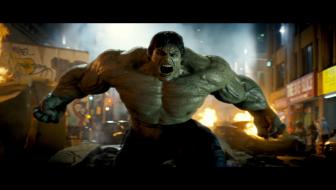
While we try to keep our tensions in check, there is a creature that
embraces the pure rage and limitless aggression—living inside one brilliant man who
finds his alter ego more and more impossible to suppress.
And you wouldn’t like him when he’s angry.
We find scientist Doctor Bruce Banner (EDWARD NORTON) desperately hunting for a cure to the gamma radiation
that poisoned his cells and unleashes the unbridled force of rage within him: The Hulk.
Banner has been living in the shadows—cut off from a life and the woman he
loves, Dr. Elizabeth "Betty" Ross (LIV TYLER). Living as a fugitive to avoid the obsessive pursuit of his
nemesis, General Thaddeus "Thunderbolt" Ross (WILLIAM HURT), he knows that a military machine seeking to
capture him and brutally exploit his power is always only a few steps behind.
As all three grapple with the secrets that led to The Hulk’s creation, they are
confronted with a vicious new adversary known as The Abomination, a monstrosity
whose destructive strength exceeds even The Hulk’s own. Portraying the human
incarnation of this powerful creature is TIM ROTH. As Emil Blonsky, Roth imagines a Super Soldier whose
lust for power manifests itself in The Abomination.
And to defeat this nemesis, one scientist must make an agonizing final choice:
accept a peaceful life as Bruce Banner or find heroism in the creature he holds inside—
THE INCREDIBLE HULK
Joining Norton, Tyler, Hurt and Roth for the film is an accomplished cast
including TY BURRELL (National Treasure: Book of Secrets, Dawn of the Dead), who
portrays Leonard, a man competing for Betty Ross’ affections, and TIM BLAKE
NELSON (Syriana, Holes), who takes on the role of Professor Samuel Sterns, a cellular
biologist who quite possibly holds the key to Banner’s quest for a cure.
The behind-the-scenes team of THE INCREDIBLE HULK is led by a seasoned
group of Super Hero and action film veterans, including producers AVI ARAD (Spider-
Man series, X-Men series, Fantastic Four series), GALE ANNE HURD (Terminator
series, Armageddon, Aliens) and KEVIN FEIGE (Iron Man, Fantastic Four series, XMen
series). The associate producer is STEPHEN BROUSSARD. The screen story and
screenplay for THE INCREDIBLE HULK are by ZAK PENN (X2, X-Men: The Last
Stand). The film is directed by noted action filmmaker LOUIS LETERRIER (The
Transporter series, Unleashed).
THE INCREDIBLE HULK’s production designer is KIRK M. PETRUCCELLI
(Fantastic Four: Rise of the Silver Surfer, Lara Croft series); the director of photography
is PETER MENZIES, JR. (Shooter, Lara Croft: Tomb Raider). THE INCREDIBLE
HULK’s editors are two-time-Oscar®-nominated filmmaker JOHN WRIGHT (X-Men,
The Passion of the Christ), RICK SHAINE (Pitch Black, television’s Rome) and VINCENT TABAILLON (Transporter 2, Finale Sentence). Music for the action-thriller
is composed by CRAIG ARMSTRONG (Ray, World Trade Center) and supervised by
DAVE JORDAN (Transformers, Iron Man); the visual effects supervisor is KURT
WILLIAMS (Fantastic Four, Dr. Seuss’ How the Grinch Stole Christmas, X-Men: The
Last Stand).
THE INCREDIBLE HULK is executive produced by the legendary STAN LEE
(Iron Man, Spider-Man series, X-Men series), DAVID MAISEL (Iron Man) and JIM
VAN WYCK (Timeline, Lemony Snicket’s A Series of Unfortunate Events).
About the Incredible: A Brief History of the Hero
With his off-the-chart strength, size, durability, speed and fighting skills, The
Hulk has achieved the enviable status of one of the most popular Super Heroes of the last
century. Created by writer Stan Lee and artist Jack Kirby, the character debuted in May
1962 in a series of Marvel Comics. A young writer, Lee had just finished the first of the
Marvel line of books with a then unknown team called the Fantastic Four, and he was
looking for a hero who wasn’t as handsome or pretty—someone, or something, totally
different who could capture the imagination of Marvel’s readers. Lee and Kirby wanted
a "misunderstood hero."
Lee remembers, "I had always loved the old movie Frankenstein. And it seemed
to me that the monster, played by Boris Karloff, wasn’t really a bad guy. He was the
good guy. He didn’t want to hurt anybody. It’s just those idiots with torches kept
running up and down the mountains, chasing him and getting him angry. And I thought,
‘Wouldn’t it be fun to create a monster and make him the good guy?’"
Wondering how to bring a new twist to Mary Shelley’s classic character as
imagined by director James Whale in 1931, Lee recalled another favorite from his
childhood: Robert Louis Stevenson’s half-man/half-monster, depicted in director Rouben
Mamoulian’s 1931 classic, Dr. Jekyll and Mr. Hyde. "I combined Jekyll and Hyde with Frankenstein," Lee tells, "and I got myself the monster I wanted, who was really good,
but nobody knew it. He was also somebody who could change from a normal man into a
monster, and lo, a legend was born."
Lee and Kirby imagined Dr. Bruce Banner, a nuclear physicist who was forever
changed after a freak accident during the testing of an experimental bomb that showered
his body with gamma radiation. (Notably, Lee, a big fan of alliteration [think Sue Storm,
Scott Summers, Peter Parker], preferred to give his heroes the same first initials in both
their names, therefore Bruce Banner was born.) Whenever seriously angered, adrenaline
would course through Banner’s body and he would morph into the fearsome Hulk, a
creature of limitless power and endless aggression. When enraged, he became a brutal
menace to society, but would learn to use his powers to help the weak and helpless. Dr.
Banner would spend the rest of his life battling to control the fury of his alter ego and do
good with The Hulk.
Though the series was initially cancelled in March 1963 after six issues, The Hulk
immediately went on to guest star in "Fantastic Four #12" and, shortly thereafter, became
one of the first members of The Avengers, appearing in the first two issues of that famous
series. Two years later, he turned up opposite Giant-Man in "Tales to Astonish (#59),"
earning his own story in the very next issue.
By 1968, the popularity of the character caught on with audiences across the
globe. The Hulk had taken over the entire book of "Tales to Astonish," which was then
renamed "The Incredible Hulk." The series ran all the way to issue #474, when it ended
its publication in 1999; it was quickly relaunched in a new series titled "The Hulk." With
issue #12, the name was changed back to "The Incredible Hulk," and the title remains
one of the most prominent in the Marvel library today.
For almost half a century, audiences have responded to the fact that Bruce Banner
and The Hulk are two sides to the same man. They have been fascinated by the idea that
he represents the extremes of the id and superego that Freud believed controlled us all.
When Banner is The Hulk, his consciousness is buried in the monster, and he has next to
no control over his green counterpart’s actions.
Lee offers that he originally thought it’d be fun if the monster and the man "both
hated each each other. The good guy, Bruce Banner, doesn’t want to turn into the monster and wishes he could cure himself. The monster thinks of Banner as a weakling and wishes he
wouldn’t have to change back to Banner." And their battle for dominance raged on for
decades while readers devoured it.
Throughout his career as a Marvel Comics character, The Hulk has been seen in a
number of incarnations. Not only has he gone from the pages of comics to television to
the big screen; he’s turned from gray to green and lumbering lunk to brilliant colleague.
He’s taken on aliases from Annihilator and Joe Fixit to the Green Scar and Green
Goliath—but he has always retained the core element that has kept him beloved by
audiences for nearly half a century. He remains indelibly linked to a scientist confused
by the fate dealt him, and the two have been intertwined in a constant, volatile
relationship.
Fifteen years after his introduction, The Hulk’s immense popularity generated a
successful CBS television series, produced by Universal Television. In 1977, the show
The Incredible Hulk, which starred Bill Bixby as David Banner and a young bodybuilder
named Lou Ferrigno as The Hulk, was imagined. The series, which premiered in March
1978, was a huge hit that enjoyed a five-season run before being cancelled in 1982. Six
years after the cancellation, the devotion of legions of fans prompted the network to
create three more telefilms, which aired in the late ’80s. In 1993, Bill Bixby passed away
from cancer, ending that legacy of The Incredible Hulk on television.
In 2003, director Ang Lee imagined The Hulk in a feature film for Universal
Pictures. The Oscar®-winning filmmaker captured Banner and his alter ego in an origin
story, one that examined a portrait of a man at war with himself and the world. HULK
told the story of a beast that was both hero and monster—whose powers embodied
Banner’s waking nightmare. The film opened in American markets with a record-setting
$62 million, third only to Spider-Man and Iron Man in highest opening-weekend grosses
for original Marvel properties.
When Universal and Marvel decided to make the next chapter in his saga, they
elected to capture the rawest elements of the franchise, selecting a French filmmaker
known for his lightning-fast camerawork and passion for the television show that
transfixed him as a child. Opting for a series reboot that embraces the spirit and narrative
of the Bixby/Ferrigno series, the studios knew it was time to give fans exactly The Hulk they demanded. THE INCREDIBLE HULK would be full of the pulse-pounding action
audiences begged to see from their hero—complete with feats of heroic strength and a
nemesis even more dangerous and powerful than The Hulk himself.
The Cast of The Incredible Hulk
When it came to casting THE INCREDIBLE HULK, Leterrier and the producers
were determined to assemble a troupe of actors who would deliver an adrenaline-fueled
summer film distinguished by solid performances. "Audiences these days are extremely
discriminating," says producer Hurd. "It’s no longer enough to have great CGI
characters and really terrific visual effects. You have to have a story that’s powerful and
characters that you care about and a journey that’s worth taking. Even though we have
great source material to draw from, from the many years that ‘The Incredible Hulk’
comic has been running, you have to sift through that and find the best story to tell and
the best actors to tell it."
To help present this chapter in The Hulk’s saga, the team would search for a
performer who was not only capable of conveying scientist Bruce Banner’s brilliant
intellect and dark conflict, but an actor who understood everything about The Hulk’s
universe and would contribute creatively over the course of production. After the
filmmakers met with two-time Academy Award®-nominated actor Edward Norton, the
search was over.
"Bruce Banner is a very complex character, and therefore a very complex role,"
offers producer Feige. "When Edward came on board, it totally upped the ante; we knew
he’d be able to bring a whole new dimension to the character. He’s one of the most
exciting actors of his generation. His immense talent and his ability to transform into a
particular role made him the ideal choice to take on the character of Bruce Banner/The
Hulk."
For Norton, lending his interpretation of one of the world’s most beloved Super
Heroes was something he took quite seriously. He has been intrigued by the
Banner/Hulk story since he was a kid. The actor notes: "Bruce Banner is the guy who
monkeys with the secret forces and gets burned by them in a way that ends up isolating
him, exiling him to this lonely existence. There’s something in the story of a lonely,
moral guy in this self-imposed exile, trying to protect the world from this terrible thing
inside himself that I think people relate to. They like the story of the oppressed, chased,
hunted man who has this righteous bite-back when you push him too hard.
"When you’re a teenager, there’s a terrific fantasy in that," Norton continues.
"It’s that feeling of being lonely, of being outside, and the fantasy that if people push you
too hard, you’ve got this thing that’s going to rise up out of you and defend you. That
taps straight into the way you feel as a teenager, and that’s where it starts."
Offers Hurd: "When Edward Norton came on board, he brought not only his
terrific acting ability and the dramatic sensibility we’ve seen in his Oscar®-nominated
performances, but he also brought great insight and love for this character and these
stories. Edward is not one-dimensional. He likes things that aren’t necessarily on the
surface. He likes to go deeper and find things that are mythic. With a larger-than-life
character like The Hulk and a larger-than-life villain like The Abomination, he’s got a
really terrific canvas to explore the material in a really enormous way."
Fortunately, her director agreed. Leterrier provides, "Edward was a perfect actor
for a film in which there is a race against the army, a race against himself and his
feelings. He brings in that emphatic sadness and intellect without being too big with his
acting. It was really good to have somebody who was very internal, because that’s what
Bruce Banner is. The Hulk is external and his primal self. Coupled with the substantial
creative direction Edward provided throughout our production and postproduction, we
wouldn’t have our Hulk without him."
Norton returns the compliment to the filmmaker, and he looked forward to their
collaboration. He offers: "When Louis and I talked about it, he was aesthetically drawn
to the same things I was. His reference points were more films like Alien and other films that were not too bright and glossy—that had some grit to them. He talked about using
handheld cameras a lot and about having the visual experience be dirty. By that he
meant not always perfectly composed, but there’s a certain sense of chaos and horror-film
aspect to it. I liked that a lot."
One piece of THE INCREDIBLE HULK that has endeared the saga to fans for so
long is the love story between Banner and his former Harvard co-ed/girlfriend (and wife
in certain chapters of The Hulk series), brilliant biologist Betty Ross. It’s the tragedy of
their romance—the fact that they’re doomed to be apart until he finds a cure—that makes Banner’s pain so much more unbearable. Betty’s love and empathy for Bruce has never
wavered and, though the relationship is complicated, she has a connection to him that
allows her to find humanity in his green alter ego.
Leterrier responded to the fact that Betty’s empathy would equal Bruce’s
downfall at the hands of his nemesis, Betty’s father, General Thaddeus "Thunderbolt"
Ross. He offers, "Banner would not have fallen back in Ross’ claws if it wasn’t his love
for Betty and the mistakes he makes because of her, and I loved that dynamic."
To play the pivotal role of Betty, the filmmakers turned to Liv Tyler, a fan
favorite since her memorable casting as the immortal Elvish princess Arwen in Peter
Jackson’s epic The Lord of the Rings trilogy. "Liv is not only a classic beauty, but an
undeniable talent," comments Feige. "Her roles in such blockbusters as The Lord of the
Rings and indie favorites like Stealing Beauty have helped her develop a unique blend of
dramatic and action-adventure experience that is perfectly suited for taking on the role of
Betty Ross."
"We really needed someone who could step up to the role—someone who could
bring the right combination of intelligence and strength to the character," adds Hurd, who
worked with the actor in the ’90s juggernaut action hit Armageddon. "She had to be
fearless but, at the same time, have a vulnerable side. Liv is perfect; she’s smart,
accessible and beautiful—the embodiment of the character."
Something Tyler didn’t know she was getting herself into was the physicality the
role demanded, especially acting against what would become a 9’ creature inserted into
the film through CGI. The actor, however, was up for the challenge. She laughs, "Even
on The Lord of the Rings, I didn’t really do this. I was reacting to things that weren’t
there, but I wasn’t necessarily interacting with things that weren’t there. I was never
physically carried off by something."
Once the star-crossed lovers were cast, Leterrier and the producers looked for a
performer to play the man who has dedicated his life to capturing The Hulk, General
"Thunderbolt" Ross. Says Leterrier: "Once we had Edward and Liv, we had to find Liv’s
father. Since Liv is a beautiful, tall woman, we couldn’t get a little, round general. I had
to find a mountain of a general, as Thunderbolt Ross was this big, scary mountain of a
man in the comic books. I wanted somebody who is rare, somebody you are not expecting and who hasn’t been in these parts before." Oscar® winner William Hurt
proved to be the ideal choice.
As he is also a big fan of The Hulk comics, it wasn’t a difficult decision for Hurt
to tackle the role. "I found the comics deeply moving," recalls the actor. "I believe in
The Hulk, absolutely. That’s why I did the movie. My son is an even bigger fan—he
knows everything about the series. We spent hours talking about Ross’ development and
the relationship between Betty and Banner.
"Thunderbolt Ross is a conflicted man," he continues. "He’s caught between his
love and loyalty to his daughter and to his country. And he’s obsessed with stopping
Bruce Banner and his alter ego." This fixation, explains Hurt, ultimately takes his
character to the point of putting his daughter in danger. "Ross starts to lose
understanding of what he’s doing, and why," says the actor. "He ends up ignoring his
primary instinct as a parent and, ultimately, he’s humiliated by the fact that the thing he
hates most in the world saves his daughter’s life. That’s a heavy emotional toll."
Every good hero needs a villain and, while Banner has General Ross, Banner’s
alter ego needed something more visually monstrous—especially to battle a powerhouse
as awesome as The Hulk. In THE INCREDIBLE HULK, The Hulk finds himself taking
on one of the most formidable adversaries from the comic series. General Ross may be
Banner’s greatest nemesis, but he’s not alone in his quest to destroy The Hulk—The
Abomination has him in his sights as well.
Elaborates Feige: "When we first encounter Banner, he’s been on the run for five
years, looking for a cure to this thing he fears within him. He is being a hero in the way
he thinks is best—by staying on the run, in the shadows, away from those he loves and
those who want to harness his power for evil. It isn’t until he reencounters the love of
his life, reencounters his old foes and a powerful new one, that he realizes that perhaps
the monster within is actually a hero within."
The filmmakers cast British actor Tim Roth as Emil Blonsky, a special ops soldier
with a thirst for domination and glory. After Blonsky volunteers for General Ross to
become exposed to the same gamma radiation that transformed Banner, Blonsky
eventually becomes The Abomination—a foe dwarfing The Hulk in both temperament
and power. The soldier morphs into the creature through two different procedures. The first is through a series of injections of Super Soldier serum from General Ross, which
begins his evolution into a military machine. The final, full transformation into The
Abomination is as a result of a transfusion of Bruce Banner’s blood from the unethical
Dr. Sterns.
While The Hulk can revert into Banner when the adrenaline that courses through
his arteries subsides, there is no going back for Blonsky once he accepts the inoculation.
His body eventually reacts to the radiation by mutating into a monstrosity whose spinal
column and other bones (which he can use to skewer his enemies) protrude outside his
body, resulting in a pale-green, color-reflecting mutant that has powers greater than those
of The Hulk.
Emil Blonsky, suggests producer Avi Arad, is the perfect antagonist: "People who
want to be villains are good villains. What happens to Blonsky is no accident; he brings
it on himself. He sees the power The Hulk has; he wants it, and he takes it. He looks at
The Hulk as a personal challenge. It’s like the fastest gun in the West—if you take this
guy down, you are the ultimate bad ass. That’s Blonsky’s mind-set, and he’ll stop at
nothing to destroy him."
"Blonsky is an action man who is unimpressed by anything," says Roth. "He’s
seen it all; he’s tired, and then he sees The Hulk. He realizes that there is a whole new
game, and he wants to be part of that. He wants to own the power."
Roth likens Blonsky’s thirst for power to an addiction. "Once Blonsky figures out
there’s an adventure to be had, he goes for it. He lives for the buzz," explains the actor.
"The injections start small, but when he realizes that they give him an ability to use his
body in a way he hadn’t been able to, he goes after the big hit: ‘Enough of these little
shots. I can run fast; I am bigger, stronger, smarter…I want more.’"
Bruce Banner’s condition has complicated his longtime romance with Betty Ross
and, after five years with no real contact with him, we find Betty trying to put the past
behind her. The man who is competing for her affections is fellow suitor Leonard. (In
one of THE INCREDIBLE HULK’s many nods to fans, this character is named after the
infamous psychiatrist who attempted to cure Banner while saving Betty’s life [after her
unfortunate encounter with Spider-Man’s archnemesis Sandman]. His dabbling in gamma technology would eventually turn him into the 6’ 6", 380-pound Doc Samson.
But that’s another story...)
Leterrier knew that he needed the competition for Betty’s affection to be someone
who "was a little older, somebody that Banner could respect." The director comments of
Leonard, "That’s the problem; the guy is amazing. He’s a great doctor; he’s handsome;
he’s funny. It was tough to find somebody with all these qualities."
The search ended when Norton suggested the producers and Leterrier meet with
actor Ty Burrell, a performer with whom he had worked in 2003 in Lanford Wilson’s off-
Broadway play Burn This. Recalling his conversation with Norton, Leterrier laughs, "I
was like, ‘Wait a minute. Ty Burrell, wasn’t he the jerk in Dawn of the Dead?’ I met
him, and he was so funny and charming. I told him, ‘You are Leonard. Banner and you
can interact; you can have the right connection.’"
Pivotal to the story of THE INCREDIBLE HULK is Banner’s search for a cure
that will allow him to rejoin society. Tim Blake Nelson was cast to portray Professor
Samuel Sterns, a cellular biologist who may hold the key to Banner’s quest (and, in
Marvel lore, eventually becomes the massive-craniumed evil Leader, future foe of The
Hulk). Sterns and Banner have been in communication throughout Banner’s exile.
While they have never met, Banner believes that Sterns’ research could lead to an
antidote. What Banner doesn’t know is that Sterns really wants to create more versions
of the infected physicist. The audience is asked to question, once again, just who are the
monsters?
"Sterns is brilliant, but he is also ethically challenged," explains Nelson. "I think
that’s what’s really appealing about a lot of the characters in THE INCREDIBLE HULK;
they get to explore this sort of id within themselves, this dark side that comes out as a
kind of monstrosity. I don’t think Sterns considers himself a villain whatsoever. In fact,
because he is so brilliant and so convinced of his own brilliance, he’s beyond any sort of
opprobrious morality. As long as he’s discovering and breaking new ground, he feels his
life is worthwhile. He doesn’t get too concerned about what’s good, and I love that kind
of character."
With the cast locked and cameos secured for both The Hulk’s creator and the
bodybuilder who is forever associated with the character, it was time to begin building a
creature that was half-man, half-beast…and the world he would attempt to not destroy.
The Incredible Hulk: About the Cast
EDWARD NORTON (Bruce Banner) has starred in the films Primal Fear,
Everyone Says I Love You, The People vs. Larry Flynt, American History X, Rounders,
Fight Club, Keeping the Faith, The Score, Death to Smoochy, Frida, Red Dragon, 25th
Hour, The Italian Job, Down in the Valley, The Illusionist, The Painted Veil and in 2008,
Pride and Glory.
Norton has been nominated for two Academy Awards®, for Primal Fear and
American History X, and won a Golden Globe along with numerous other awards for his
performances. The film Frida, for which he wrote the screenplay, was nominated for six
Academy Awards® and won two. He won the Obie Award in 2003 for his performance
off-Broadway in Burn This by Lanford Wilson.
Norton produced and directed Keeping the Faith, produced Down in the Valley
(Cannes Film Festival selection) and The Painted Veil, and is currently producing Leaves
of Grass and adaptations of Dan O’Brien’s "Buffalo for the Broken Heart" and Jonathan
Lethem’s "Motherless Brooklyn," for which he is currently writing the screenplay.
Norton also founded and runs Class 5 Films in partnership with writer Stuart
Blumberg and producer Bill Migliore. Class 5’s first two features, Down in the Valley
and The Painted Veil, were released in 2006. The company’s documentary division
produces nature, science and documentary films independently, including a featurelength
film about Barack Obama and the American political system, currently in
production.
Class 5’s documentary productions include: The Great Rivers Expedition, a film
made by Jim Norton for Versus about a historic white-water adventure that took place in China in 2003; and Dirty Work, a film by David Sampliner that premiered at the
Sundance Film Festival and aired on the Sundance Channel last spring. Class 5 also
collaborated with the Sea Studios Foundation on their highly acclaimed, multimillion
dollar series about Earth system sciences for National Geographic, Strange Days on
Planet Earth, which Norton hosts and narrates, and which premiered on PBS in April
2008. This is the second installment in the series.
Class 5 also recently announced a partnership with Brad Pitt’s Plan B
Entertainment and National Geographic to produce an epic 10-part series for HBO based
on Stephen Ambrose’s acclaimed book "Undaunted Courage" about the Lewis and Clark
expedition. Norton and Brad Pitt will executive-produce the series.
Norton is also a committed social and environmental activist.
LIV TYLER (Betty Ross) starred as Arwen in the blockbuster hit trilogy The
Lord of the Rings. She was most recently seen in the films Lonesome Jim, starring Casey
Affleck and Steve Buscemi, who also directed the film, and Reign Over Me, starring Don
Cheadle and Adam Sandler. She will next be seen in May 2008’s suspense-thriller The
Strangers, as well as in the upcoming film Smother, with Diane Keaton.
Tyler’s other film credits include Kevin Smith’s Jersey Girl, co-starring Ben
Affleck and Jennifer Lopez; a starring role in the Bernardo Bertolucci film Stealing
Beauty, opposite Jeremy Irons; Pat O’Connor’s Inventing the Abbotts, with Joaquin
Phoenix and Billy Crudup; and Michael Bay’s Armageddon, opposite Bruce Willis and
Ben Affleck. More recently, she has been seen in Robert Altman’s Cookie’s Fortune,
alongside Glenn Close, Julianne Moore and Charles S. Dutton; the Jake Scott-directed
Plunkett & Macleane; Onegin, co-starring Ralph Fiennes; and One Night at McCool’s,
opposite Matt Dillon, Paul Reiser and John Goodman.
Tyler made her film debut with the leading role in Silent Fall, directed by Bruce
Beresford, opposite Richard Dreyfuss. After another lead in Empire Records, she
portrayed a waitress in a local diner in James Mangold’s Heavy, a favorite at the 1995
Sundance Film Festival.
Tyler is the face for Parfums Givenchy, the first celebrity to be connected to the
designer since Audrey Hepburn more than 40 years ago.
Born in New York, Tyler was raised in Portland, Maine, until the sixth grade
when her family returned to Manhattan. She began modeling at age 14, and was seen in
numerous print ads and television commercials before moving into acting. Tyler recently
gave birth to her first child, a son, Milo. Tyler and her family currently reside in New
York City.
TIM ROTH (Emil Blonsky) has made a career out of portraying unforgettable
characters in one independent film after another. He made his studio feature debut in
MGM’s Rob Roy, opposite Liam Neeson and Jessica Lange, in a role that has been touted as
one of the best villains in screen history, earning him a Golden Globe nomination and an
Academy Award® nomination for Best Supporting Actor in a Drama. He also co-starred in
Tim Burton’s remake of the classic Planet of the Apes, opposite Mark Wahlberg and Helena
Bonham Carter.
Roth was most recently seen in Francis Ford Coppola’s Youth Without Youth and
Michael Haneke’s Funny Games, opposite Naomi Watts. He was also recently seen in the
Wim Wenders’ film Don’t Come Knocking. He will next be seen in The Other Side,
opposite Ryan Gosling and Brittany Murphy.
Roth made his return to the stage in Sam Shepard’s off-Broadway production of The
God of Hell, for the first time since early in his career in London where he received great
notices in Kafka’s masterpiece The Metamorphosis.
He made his directorial debut with the stunning, critically acclaimed film The War
Zone, starring Ray Winstone (Nil by Mouth), based on the book by Alexander Stuart. The
film premiered at the 1999 Sundance Film Festival to rave reviews and was also at the
Cannes Film Festival and Toronto International Film Festival.
Roth gained worldwide recognition for his roles in two Quentin Tarantino films:
Reservoir Dogs and Pulp Fiction. In Reservoir Dogs, Roth starred with Harvey Keitel,
Michael Madsen, Chris Penn and Steve Buscemi in a grim tale of a jewelry heist gone
wrong. Roth’s portrayal of Mr. Orange, an undercover cop who gets caught in the line of
fire, is a compellingly realistic glance at the agony of dying. Roth also co-starred in Pulp
Fiction (Golden Globe and Academy Award® winner for Best Original Screenplay) as a petty robber who picks "the wrong place to hold up." The ensemble cast included John
Travolta, Uma Thurman, Samuel L. Jackson and Harvey Keitel.
This British-born actor’s career was surprisingly spawned out of a schoolyard dare.
With art being his passion, Roth spent his youth aspiring to become a sculptor and painter.
But when he jokingly auditioned for a play in high school and landed the role, Roth soon
found that he truly loved the craft of acting. After graduation, he went on to study drama at
a fine arts school in London.
Working steadily in public theater, his first job in front of the camera was the lead in
the controversial and Prix Italia Award-winning telefilm, Made in Britain.
Roth’s second project came immediately after, starring in Mike Leigh’s critically
acclaimed film, Meantime.
As his success continued, Roth starred in over 15 film and television projects
including Stephen Frears’ The Hit, for which he won the Evening Standard Award for Best
Newcomer; The Cook, The Thief, His Wife and Her Lover; Rosencrantz & Guildenstern Are
Dead, with Gary Oldman; and Robert Altman’s Vincent & Theo, in which he portrayed
Vincent Van Gogh.
Brought up on American films like Taxi Driver and Mean Streets, Roth had always
wanted to come to the U.S., so he jumped at the chance when asked to take part in a
publicity tour for Vincent & Theo. He soon after moved permanently to the States, and has
since continued on the same path of offbeat films.
His other credits include Lucky Numbers, directed by Nora Ephron; Giuseppe
Tornatore’s The Legend of 1900; Werner Herzog’s first English-language film, Invincible;
Jumpin’ at the Boneyard; Bodies, Rest & Motion; Murder in the Heartland; Heart of
Darkness, opposite John Malkovich; Four Rooms; Little Odessa; Captives; Gridlock’d;
Woody Allen’s Everyone Says I Love You; Hoodlum; Dark Water; and The Beautiful
Country.
TIM BLAKE NELSON (Samuel Sterns) has appeared in over 30 films including
Warm Springs, Meet the Fockers, Holes, The Good Girl, Wonderland, Minority Report
and O Brother, Where Art Thou? Nelson was recently seen in the films Syriana, The
Amateurs, The Big White, Come Early Morning and Fido.
Nelson’s The Grey Zone, which he wrote and directed, starred Harvey Keitel,
Steve Buscemi, Mira Sorvino, David Arquette, Allan Corduner and Natasha Lyonne.
The film premiered at the 2001 Toronto International Film Festival and opened in
October 2002. The Grey Zone is a dramatic story of the Sonderkommandos, a special
squad of Jews who processed corpses in the crematoria at Birkenau. Shot in Bulgaria,
The Grey Zone is based on his award-winning play. The National Board of Review
(2002) honored The Grey Zone with a "Special Recognition of Films that Reflect the
Freedom of Expression."
Nelson also directed O, a contemporary adaptation of Shakespeare’s Othello,
starring Martin Sheen, Julia Stiles, Josh Hartnett and Mekhi Phifer. O premiered at the
2001 Seattle International Film Festival, where Nelson was awarded Best Director.
Nelson wrote and directed the film Eye of God, starring Martha Plimpton, Hal
Holbrook and Kevin Anderson, which appeared at the 1997 Sundance Film Festival, and
was released theatrically in the United States later that year. The film received the top
award at the 1997 Seattle International Film Festival, as well as the Tokyo Bronze Prize
at the Tokyo Film Festival.
TY BURRELL (Leonard) most recently starred in Steven Shainberg’s Fur: An
Imaginary Portrait of Diane Arbus, a drama about the life of photographer Diane Arbus.
In the film, Burrell plays Allan, the husband of Diane Arbus and stars opposite Nicole
Kidman and Robert Downey, Jr. The film premiered at the Telluride and Rome Film
Festivals. He was also seen in Finn Taylor’s romantic comedy The Darwin Awards,
which premiered at Sundance.
Burrell’s other film credits include Nicole Holofcener’s Friends With Money,
opposite Catherine Keener, Frances McDormand and Jennifer Aniston; David Jacobson’s
Down in the Valley, opposite Evan Rachel Wood; the Weitz brothers’ In Good Company;
Ridley Scott’s Black Hawk Down; Dawn of the Dead; and Ivan Reitman’s Evolution.
Burrell’s extensive Broadway and off-Broadway credits include starring in the
highly acclaimed Signature Theatre off-Broadway production of Burn This, opposite
Edward Norton, Catherine Keener and Dallas Roberts; starring as Lord Buckingham in
The Public Theater’s production of Richard III, opposite Peter Dinklage and directed by Peter DuBois; and starring in Paul Weitz’s Show People, opposite Debra Monk and Judy
Greer, and directed by Peter Askin at Second Stage Theatre.
He most recently starred in the world premiere of Caryl Churchill’s Drunk
Enough to Say I Love You?, opposite Stephen Dillane at the Royal Court Theatre in
London. James MacDonald directed this play about the dysfunctional relationship
between two men; it is scheduled to open in New York in the spring of 2008 at The
Public Theater.
On television, Burrell currently stars in the half-hour FOX sitcom Back to You,
opposite Kelsey Grammer and Patricia Heaton. He recently starred in the half-hour CBS
sitcom Out of Practice, opposite Stockard Channing and Henry Winkler.
He resides in New York City with his wife.
WILLIAM HURT (General Thaddeus "Thunderbolt" Ross) trained at Tufts
University and New York’s Juilliard School of Music and Drama. He has been
nominated for four Academy Awards®, including the most recent nomination for his
supporting role in David Cronenberg’s A History of Violence. The film screened at both
the Cannes Film Festival and the Toronto International Film Festival. Hurt received Best
Supporting Actor accolades for his role from the Los Angeles Film Critics Association
and the New York Film Critics Circle.
Hurt recently wrapped the remake of Yoji Yamada’s 1977 film Yellow
Handkerchief, opposite Maria Bello. The film stars Hurt as an ex-convict recently
released from prison for the accidental murder of another man. Udayan Prasad (My Son
the Fanatic) directed the project.
Hurt was most recently seen in Vantage Point, opposite Dennis Quaid, Sigourney
Weaver and Forest Whitaker. He was also seen in Into the Wild, directed by Sean Penn
and starring Marcia Gay Harden, Catherine Keener and Vince Vaughn, and in Mr.
Brooks, a psychological thriller opposite Kevin Costner and directed by Bruce Evans.
In early 2007, Hurt was seen in The Good Shepherd, written by Eric Roth and
directed by Robert De Niro. The film starred Matt Damon, Robert De Niro and Angelina
Jolie, and followed the history of over 40 years in the CIA, told through the eyes of
Edward Wilson, one of its founding officers.
In 2006, Hurt starred in James Marsh’s film The King, with Gael García Bernal.
The film follows a troubled man (Bernal), recently discharged from the Navy, who
returns to his childhood home in Texas to reunite with his father (Hurt). The King was
screened at the Cannes Film Festival. Also in 2006, Hurt appeared in Beautiful Ohio,
directed by Chad Lowe and Noise, an independent comedy opposite Tim Robbins and
Bridget Moynahan. Beautiful Ohio was screened at the 2006 AFI Film Festival.
In 2005, Hurt was seen in Syriana, directed by Stephen Gaghan and starring
George Clooney, Matt Damon and Amanda Peet. The same year, he also completed
production on the ensemble independent film Neverwas, opposite Sir Ian McKellen, Alan
Cumming and Aaron Eckhart.
In 2004, Hurt was seen in M. Night Shyamalan’s thriller The Village, opposite
Joaquin Phoenix and Sigourney Weaver as well as the independent film The Blue
Butterfly. Hurt starred in the film as a famous entomologist who takes a terminally ill
boy into the rainforest to grant his dying wish. The film was screened at the 2004
Tribeca Film Festival and was released in Canada and Japan.
In 2002, Hurt appeared in Disney’s Tuck Everlasting, directed by Jay Russell,
which premiered at the Toronto International Film Festival and had a cameo appearance
in Paramount’s Changing Lanes, starring Samuel L. Jackson.
In 2001, Hurt starred in the independent film Rare Birds, which screened at the
Toronto International Film Festival. He was also seen in a supporting role in Steven
Spielberg’s Artificial Intelligence: AI.
In 2000, Hurt delivered a memorable performance in Sunshine, opposite Ralph
Fiennes. Directed by István Szabó, Sunshine received three Genie Awards, including one
for Best Motion Picture.
In 1980, Hurt appeared in his first film, Altered States. He received a Best Actor
Oscar® nomination for Broadcast News and Children of a Lesser God. For Kiss of the
Spider Woman, he was honored with an Academy Award® as well as Best Actor awards
from the British Academy and the Cannes Festival. Among his other film credits are
Body Heat, The Big Chill, Eyewitness, Gorky Park, Alice, I Love You to Death, The
Accidental Tourist, The Doctor, The Plague, The Simian Line, Trial by Jury, Second Best, Smoke, Confidences À Un Inconnu, Jane Eyre, Michael, Dark City, The Proposition, The
Big Brass Ring and One True Thing.
In 2006, Hurt returned to television in the TNT special-event series Nightmares
and Dreamscapes: From the Stories of Stephen King, based on the stories of Stephen
King. The series was a four-week collection of eight tales based on King’s anthology,
which featured all-star casts including William H. Macy, Samantha Mathis, Claire
Forlani and Ron Livingston. Hurt’s episode, entitled "Battleground," premiered the
series. Hurt’s television credits include the Hallmark Channel’s miniseries Frankenstein,
opposite Donald Sutherland, CBS’s The Flamingo Rising, the title role in the CBS miniseries
Master Spy: The Robert Hanssen Story, Sci Fi Channel’s Dune and Varian’s War
for Showtime. Directed by Lionel Chetwynd and produced by Barbra Streisand’s
Barwood Films, Varian’s War co-starred Alan Arkin, Julia Ormond and Lynn Redgrave,
and followed the story of Varian Fry (Hurt) who rescued prominent European artists and
more than 2,000 others from Nazi persecution during World War II.
Hurt spent the early years of his career on the stage between drama school,
summer stock, regional repertory and off-Broadway, appearing in more than 50
productions including Henry V, 5th of July, Hamlet, Richard II, Hurlyburly (for which he
was nominated for a Tony Award), My Life (winning an Obie Award for Best Actor), A
Midsummer Night’s Dream and Good.
For BBC Radio 4, Hurt read Paul Theroux’s "The Great Railway Bazaar" and E.
Anne Proulx’s "Shipping News." He has recorded "The Polar Express" and "The Boy
Who Drew Cats" and narrated the documentaries Searching for America: The Odyssey of
John Dos Passos, A. Einstein: How I See the World and the English narration of Elie
Wiesel’s To Speak the Unspeakable: The Message of Elie Wiesel, a documentary directed
and produced by Judit Elek.
In 1988, Hurt was awarded the first Spencer Tracy Award from UCLA.
The Incredible Hulk: About Stan Lee
STAN LEE’s (Executive Producer) singular co-creations include Spider-Man,
The Incredible Hulk, X-Men, The Fantastic Four, Iron Man, Daredevil, The Avengers,
Silver Surfer and Dr. Strange, among many others.
Lee, known to millions as the man whose Super Heroes propelled Marvel Comics to its preeminent position in the comicbook
industry, first became publisher of Marvel Comics in 1972 and is presently the
chairman emeritus of Marvel Enterprises, Inc. In 1977, he introduced "Spider-Man" as a
syndicated newspaper strip that went on to become the most successful of all syndicated
adventure strips. "Spider-Man" now appears in more than 500 newspapers worldwide,
still written by Lee—making it the longest running of all the Super Hero strips.
Without question, Stan "The Man" Lee has exerted more influence over the
comic-book industry than anyone in history. He created or co-created 90 percent of Marvel’s recognized characters, which have been successfully licensed and marketed
since 1965. The numbers are staggering—more than two billion of his comic books have
been published in 75 countries and in 25 languages. In Europe alone, Lee’s name
appears on more than 35 million comics annually. Each year, "X-Men" sells more than
13 million copies. Lee has successfully established himself as the creator of the modernday
Super Hero.
In 1981, Lee transformed his Spider-Man and Hulk creations into Saturday
morning and syndicated television cartoons. When Marvel Comics and Marvel
Productions were acquired by New World Entertainment in 1986, Lee’s horizons
expanded even further, giving him the opportunity to become more deeply involved in
the creation and development of filmed projects for both the big and small screen. He
supervised such diverse animated series as X-Men, Spider-Man and The Hulk. To date,
Lee’s characters have populated over 24 separate television series, all of which continue
in syndication around the world. Movies based on a Marvel character, such as Blade,
Blade II, X-Men, X2, The Hulk, Daredevil, Fantastic Four, Fantastic Four: Rise of the
Silver Surfer and Ghost Rider have all become hits at the box office. Additionally, many
of Lee’s other creations, such as Dr. Strange and The Mighty Thor, are in development
for motion pictures and television series, including a feature-length film version of Iron
Man, which was released in May 2008. In the last three years, Lee’s movies have
grossed approximately $2.5 billion, not including other ancillary markets. Also, a
number of Lee’s classic animated series are available on video, released globally by 20th
Century Fox Home Entertainment. The saturation factor is high—the X-Men series has a
90 percent recognition factor among the 30 million American children between the ages
of six and 14.
In 2001, Lee formed POW! (Purveyors of Wonder) Entertainment, with producer
Gill Champion and attorney Arthur Leiberman, a company unrelated to Marvel, which
has been active in creating a number of new projects that are now in various stages of
development, preproduction and production. POW! specializes in franchises for
theatrical release, television, DVDs, video games, merchandising and related ancillary
markets.
Stan’s biography "Excelsior!: The Amazing Life of Stan Lee," a Simon and
Schuster Fireside Trade paperback, tells the story of Lee’s life, his impoverished
childhood, his amazing accomplishments and his many exciting plans for the future, and
was used as a basis for a documentary.
Now, despite the incredible record of his past achievements, as we have entered
the 21st century, Lee—with the characteristic enthusiasm of a teenager—feels that his
creative career is just beginning.
Related:
The Incredible Hulk Movie Review (Chicago Tribune Film Critic Michael Phillips)
Movie Production Notes
Wanted
Iron Man
RSS
SHARE
|