iHaveNet.com
Early Economic Recovery: Fiction or Fact - Paul A. Samuelson
Online Breaking News Headlines Single Source to Headlines Breaking News Current Events Top Stories. Find out what is happening in News & the World. Check out iHaveNet.com for the latest news & current events articles plus Movie Reviews, Wolfgang Puck Recipes, NFL Previews Analysis and Politics. Your Single Source to News Articles, Current Events & Reviews.
  • HOME
  • WORLD
    • Africa
    • Asia Pacific
    • Balkans
    • Caucasas
    • Central Asia
    • Eastern Europe
    • Europe
    • Indian Subcontinent
    • Latin America
    • Middle East
    • North Africa
    • Scandinavia
    • Southeast Asia
    • United Kingdom
    • United States
    • Argentina
    • Australia
    • Austria
    • Benelux
    • Brazil
    • Canada
    • China
    • France
    • Germany
    • Greece
    • Hungary
    • India
    • Indonesia
    • Ireland
    • Israel
    • Italy
    • Japan
    • Korea
    • Mexico
    • New Zealand
    • Pakistan
    • Philippines
    • Poland
    • Russia
    • South Africa
    • Spain
    • Taiwan
    • Turkey
    • United States
  • USA
    • ECONOMICS
    • EDUCATION
    • ENVIRONMENT
    • FOREIGN POLICY
    • POLITICS
    • OPINION
    • TRADE
    • Atlanta
    • Baltimore
    • Bay Area
    • Boston
    • Chicago
    • Cleveland
    • DC Area
    • Dallas
    • Denver
    • Detroit
    • Houston
    • Los Angeles
    • Miami
    • New York
    • Philadelphia
    • Phoenix
    • Pittsburgh
    • Portland
    • San Diego
    • Seattle
    • Silicon Valley
    • Saint Louis
    • Tampa
    • Twin Cities
  • BUSINESS
    • FEATURES
    • eBUSINESS
    • HUMAN RESOURCES
    • MANAGEMENT
    • MARKETING
    • ENTREPRENEUR
    • SMALL BUSINESS
    • STOCK MARKETS
    • Agriculture
    • Airline
    • Auto
    • Beverage
    • Biotech
    • Book
    • Broadcast
    • Cable
    • Chemical
    • Clothing
    • Construction
    • Defense
    • Durable
    • Engineering
    • Electronics
    • Firearms
    • Food
    • Gaming
    • Healthcare
    • Hospitality
    • Leisure
    • Logistics
    • Metals
    • Mining
    • Movie
    • Music
    • Newspaper
    • Nondurable
    • Oil & Gas
    • Packaging
    • Pharmaceutic
    • Plastics
    • Real Estate
    • Retail
    • Shipping
    • Sports
    • Steelmaking
    • Textiles
    • Tobacco
    • Transportation
    • Travel
    • Utilities
  • WEALTH
    • CAREERS
    • INVESTING
    • PERSONAL FINANCE
    • REAL ESTATE
    • MARKETS
    • BUSINESS
  • STOCKS
    • ECONOMY
    • EMERGING MARKETS
    • STOCKS
    • FED WATCH
    • TECH STOCKS
    • BIOTECHS
    • COMMODITIES
    • MUTUAL FUNDS / ETFs
    • MERGERS / ACQUISITIONS
    • IPOs
    • 3M (MMM)
    • AT&T (T)
    • AIG (AIG)
    • Alcoa (AA)
    • Altria (MO)
    • American Express (AXP)
    • Apple (AAPL)
    • Bank of America (BAC)
    • Boeing (BA)
    • Caterpillar (CAT)
    • Chevron (CVX)
    • Cisco (CSCO)
    • Citigroup (C)
    • Coca Cola (KO)
    • Dell (DELL)
    • DuPont (DD)
    • Eastman Kodak (EK)
    • ExxonMobil (XOM)
    • FedEx (FDX)
    • General Electric (GE)
    • General Motors (GM)
    • Google (GOOG)
    • Hewlett-Packard (HPQ)
    • Home Depot (HD)
    • Honeywell (HON)
    • IBM (IBM)
    • Intel (INTC)
    • Int'l Paper (IP)
    • JP Morgan Chase (JPM)
    • J & J (JNJ)
    • McDonalds (MCD)
    • Merck (MRK)
    • Microsoft (MSFT)
    • P & G (PG)
    • United Tech (UTX)
    • Wal-Mart (WMT)
    • Walt Disney (DIS)
  • TECH
    • ADVANCED
    • FEATURES
    • INTERNET
    • INTERNET FEATURES
    • CYBERCULTURE
    • eCOMMERCE
    • mp3
    • SECURITY
    • GAMES
    • HANDHELD
    • SOFTWARE
    • PERSONAL
    • WIRELESS
  • HEALTH
    • AGING
    • ALTERNATIVE
    • AILMENTS
    • DRUGS
    • FITNESS
    • GENETICS
    • CHILDREN'S
    • MEN'S
    • WOMEN'S
  • LIFESTYLE
    • AUTOS
    • HOBBIES
    • EDUCATION
    • FAMILY
    • FASHION
    • FOOD
    • HOME DECOR
    • RELATIONSHIPS
    • PARENTING
    • PETS
    • TRAVEL
    • WOMEN
  • ENTERTAINMENT
    • BOOKS
    • TELEVISION
    • MUSIC
    • THE ARTS
    • MOVIES
    • CULTURE
  • SPORTS
    • BASEBALL
    • BASKETBALL
    • COLLEGES
    • FOOTBALL
    • GOLF
    • HOCKEY
    • OLYMPICS
    • SOCCER
    • TENNIS
  • Subscribe to RSS Feeds EMAIL ALERT Subscriptions from iHaveNet.com RSS
    • RSS | Politics
    • RSS | Recipes
    • RSS | NFL Football
    • RSS | Movie Reviews
Early Economic Recovery: Fiction or Fact
Paul A. Samuelson

HOME > FINANCIAL MARKETS > ECONOMY >
Early Economic Recovery: Fiction or Fact


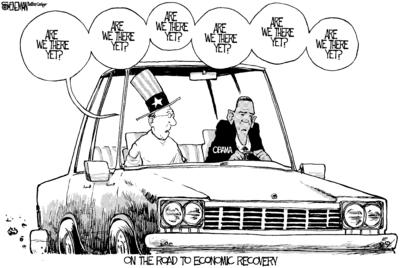
On the Road to Economic Recovery
On the Road to Economic Recovery   (c) Drew Sheneman

SocialTwist Tell-a-Friend

Legend tells of the boy who often cried "wolf" when in fact there was no wolf. It involves the case where the boy cried "wolf" when indeed there was a ferocious wolf, but no one had paid attention.

Ever since the global meltdown began in 2007, Wall Street pundits and government officials have proclaimed cheery optimism that meaningful global recovery will occur by the second half of 2009, or the first quarter of 2010. So, as in an earlier time, they're telling us we have nothing to fear except fear itself.

Well, we have now entered 2009's second half.

Yes, and unemployment is still rising. So are bankruptcies and mortgage foreclosures.

Despite the admirable rescue operations of the Obama team, the Bank of England and the European Central Bank, the vicious circle continues of consumers and investors too scared to spend.

Unemployment will worsen still, and shortfalls in the GDP growth rate will persist.

It is rational for a rescued bank to be afraid to enter into risky lending. (In serious recession times, almost all ventures seem risky to rational bankers!) Why can't orthodox central bank operations reverse accelerating recessions? Early on official shortest-term assets are given yields that approximate zero. At zero interest rates, everyone freezes up and becomes a hoarder.

Macroeconomists taught in the 1970s and 1980s at elite Harvard, Chicago, Princeton, Stanford and MIT were slow to understand the obvious. Ninety-four-year-old codgers could teach them better about "disequilibrium economics"!


When a few of us, as far back as spring of 2007, warned that meaningful recovery might be delayed by years, we were only a lunatic minority.

Yes, Japan could experience a "lost decade;" but academic financial engineers had, for the West, allegedly forged new tools to measure risk and to enable both the spread of it and the control of it. No "lost decades" for us smart guys.

A pretty fable.

Yes, those financial engineering tools, invented at the likes of MIT, Chicago and the Wharton School, could have had useful functions. But substituting fact for fiction, no CEO you will ever meet truly understood these fiendish new tools.

Instead of controlling riskiness, the new tools -- swaps, puts and calls, securitized packets of mortgage loans -- under President Bush's form of unregulated financial investment, did in fact kill off all transparency and did tempt to dangerous hyper-leveraging.

Result: an ultra-fragile financial system, prone to the global collapses and meltdowns seen in 2007-2009.

President Obama's resourceful Treasury secretary, Timothy Geithner, announces that the rescue is already working and with a little patience we can expect imminent recovery.

He errs. The rescue of needed new sustained Main Street spending has hardly begun. Without such, as the New Deal learned in the 1930s, recovery is impossible.

Yes, had there not been the massive Geithner-Bernanke rescue moves, by this time blood might be flowing in America's city streets. But has any member of Obama's crack economic team spoken day and night about the need to send to Main Street money for sustained spending and re-spending? No.

China, a one-party despotic state, by piling on new deficit spending will, paradoxically, beat the rest of us to meaningful macro recovery

When as a teenager I entered graduate study at the Chicago Midway in 1932, it was the worst time of the post-1929 depression. Republican President Herbert Hoover and his billionaire Treasury secretary, Andrew Mellon, by their paralyzed inactivism, wasted almost two years after the 1929 Wall Street crash, a long enough delay to lead to self-generating bank failures and exploding unemployment.

Today's macro scholars were poorly prepared to avoid post-2006 meltdowns.

While they still prattled mostly about transparency and inflation targeting, they didn't notice how Rome was beginning to burn.

Their textbooks, whether introductory or advanced macroeconomics, did not teach about "liquidity traps" or "paradoxes of thrift," whereby the attempt of people and businesses to save more only served to kill off rather than augment Main Street spending.

It is giving sustained funds to ready spenders that counts most.

Now, in the second half of 2009, it is too late to begin to spend on shovel-ready projects. States and municipalities need help to meet their budget needs, and they take time to achieve legislative agreement on how to deal with deficits and how to spend government stimulus funds.

Suffering states will spend whatever they are given

So discount those rosy assurances of meaningful recovery a few months from now.

The late Charles Kindleberger, expert on manias and financial crashes, reiterated the Victorian Walter Bagehot's insistence that every capitalist system needs a "lender of last resort." If alive today, Professor Kindleberger would insist that it needs also a "spender of last resort": government.

Republican members of Congress do not understand these ABCs. Nor do a few of the Democrats in Congress. Time delays are crucially lethal once a recession is becoming self-generating in the chicken-egg-chicken fashion.

Only an Obama has the charisma and popularity to insist on meaningful needed new and sustained deficit spending. Yes, deficit spending.

It took all of Franklin Roosevelt's guile and eloquence to push things and maintain the New Deal recovery. Abhorrent dictator Adolf Hitler, bent on conducting a future war of revenge, used similar deficit spending to restore Germany to full employment by 1939.

May democracies in the 21st century quickly achieve the compromises needed to restore economic sanity.


SocialTwist Tell-a-Friend


Why June Jobs Report Is So Depressing
Liz Wolgemuth

The brutal truth about the Labor Department's June jobs report is that it offers strong evidence companies are still hacking away at their payroll costs -- slicing hours and chopping jobs. Employers cut 467,000 jobs last month, according to the report. The unemployment rate -- a measure of the percentage of workers who are unemployed and looking for work -- rose slightly to 9.5 percent, from 9.4 percent in May.

Nine Reasons the Economy is Not Getting Better
Mortimer B. Zuckerman

We are now looking at unemployment numbers that undermine any confidence that we might be nearing the bottom of the recession. The appropriate metaphor is not the green shoots of new growth. A better image is to look at the true total of jobless people as a prudent navigator looks at an iceberg

Would Second Stimulus Create Jobs?
Liz Wolgemuth

Americans are stumbling through a job market that is overwhelmed with supply, stripped of security, and skimmed of hours and benefits, and the unemployment rate has already climbed much higher than officials had forecast. So, the real question is, what could a second Obama administration stimulus do that the first one couldn't? To answer that, it's necessary to know how the first $787 billion package has disappointed.

Why No One Can Guess When Recovery will Occur
Paul A. Samuelson

Federal Reserve Chairmen Ben Bernanke glimpses a possible recovery by year end. He is a cautious scholar, backed by the best forecasters in the world at the Federal Reserve Board.

I would be a rash fool to quarrel with this quasi-optimistic view that by year end some stability will occur. You and I should hope that there will indeed be a glimmer of light at the end of the tunnel ahead. ...

Joseph Stiglitz:
Will Capitalism Survive Wall Street Apocalypse

Matthew Bandyk

A few days after writing about how the United States is not heading towards socialism, Joseph Stiglitz suggests that might not be true about the rest of the world. Stiglitz argues that the lesson many Third World nations might take from the financial crisis is that capitalism is fundamentally flawed.

Not Going to Be Economic Depression
Global Economic Viewpoint

Last week at the Milken Global Conference, three Noble Laureates in Economics sat down to discuss the global recession -- Gary Becker (Nobel Prize, 1992), Roger Myerson (Nobel Prize, 2007) and Myron Scholes (Nobel Prize 1997).

All three agreed that this is not going to be a depression and that the free-market economy is fundamentally healthy.

Recent Commentary on the Economic & Financial Crisis

  • Some Good News About Banking
  • Obama Economic Team's Flawed Cosmology
  • Larry Summers: Brilliant Mind, Toxic Ideas
  • Tim Geithner, CNBC & The Second Coming of Known Unknowns
  • Could America Suffer Japan's 'Lost Decades'
  • The Global Economy: Worse & Worser
  • Today's Global Economic Debacle: The Japan Fallacy
  • Financial Outrages Past, Present & Future
  • Even the US can Manage Itself into Economic Irrelevance


(c) 2009 PAUL SAMUELSON


Receive iHaveNet.com on Politics & the Economy -- Enter your email address:


Delivered by FeedBurner


Search Powered By Google

Google Search   

POLITICS

Subscribe to Politics

Delivered by FeedBurner


More Political News Analysis Commentary and Opinion

Advertisement

Job & Career Search

career & job search                    job title, keywords, company, location

Search Powered By Google

Google Search   

Advertisement

Your Ad Here
Your Ad Here
  • HOME
  • WORLD
  • USA
  • BUSINESS
  • WEALTH
  • STOCKS
  • TECH
  • HEALTH
  • LIFESTYLE
  • ENTERTAINMENT
  • SPORTS

Early Economic Recovery: Fiction or Fact - Paul A. Samuelson

  • Services:
  • RSS Feeds
  • Shopping
  • Email Alerts
  • Site Map
  • Privacy