- MENU
- HOME
- SEARCH
- WORLD
- MAIN
- AFRICA
- ASIA
- BALKANS
- EUROPE
- LATIN AMERICA
- MIDDLE EAST
- United Kingdom
- United States
- Argentina
- Australia
- Austria
- Benelux
- Brazil
- Canada
- China
- France
- Germany
- Greece
- Hungary
- India
- Indonesia
- Ireland
- Israel
- Italy
- Japan
- Korea
- Mexico
- New Zealand
- Pakistan
- Philippines
- Poland
- Russia
- South Africa
- Spain
- Taiwan
- Turkey
- USA
- BUSINESS
- WEALTH
- STOCKS
- TECH
- HEALTH
- LIFESTYLE
- ENTERTAINMENT
- SPORTS
- RSS
- iHaveNet.com: Travel
By Bo Zaunders
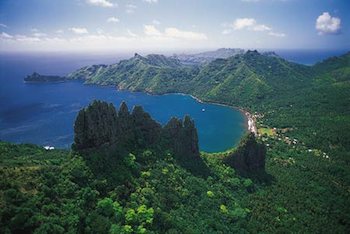
Nuku Hiva, Marquesas Islands
The skyline of Ua Pou rose dramatically out of the South Pacific -- rocky shores and lush green hills, and, above them, brooding volcanic pinnacles, soaring into the sky, summits hiding behind rain-filled clouds. It was 6 a.m., and I was standing on the deck of the cruise freighter Aranui 3. After embarkation in Papeete, Tahiti, we were already into Day Four of a two-week cruise, and had traveled nearly 1,000 miles to get to this point.
The Marquesas Islands
This is the most northerly archipelago in French Polynesia, just south of the equator, and farther from a continental landfall than any other group of islands on earth -- as far as you can get from so-called civilization.
The Aranui has been called the umbilical cord between Tahiti and the Marquesas. The most recent ship of three, the Arauni 3 was built in 2002, and was now on its 83rd voyage, carrying some 2,500 tons of cargo to be distributed to all six of the inhabited Marquesan islands. Along with freight -- everything from heavy machinery, such as trucks and SUVs, to potato chips, beer, and toilet paper -- the Aranui, on this voyage, brought 116 passengers, among them, Roxie, my wife, and I.
Already we had passed through the Tuamoto archipelago, and visited, albeit for only three hours, its second largest atoll, Fakarava. Anchor was cast in the shimmering green lagoon, passengers outfitted with life vests were guided down a ladder, and crowded into a flat-bottomed vessel that had been dropped into the water by one the ship's large cranes. Options were given. In Fakarava you could swim, snorkel, or, since it was Sunday morning, you may want to attend mass in the local
The church doors stood wide open. I could hear a chorus from inside, soft and rhythmic, with the same words repeated over and over: "Ana ana tipa tua, ana ana tipa tua..." The church was filled to the last pew, and exuded a friendly relaxed atmosphere that struck me as delightful. Two priests in long white gowns bent down in front of the altar, the soles of their bare feet facing the congregation, while a small girl with flowers in her hair sneaked out into the center aisle, and did a little dance. How utterly different from the austere, rather empty, Lutheran church of my Swedish childhood!
Back on the Aranui, we were just in time for lunch, a three-course meal beginning with a salad with mussels, then white fish with risotto and mushroom puree. As always, for lunch or dinner in the ship's dining room, complimentary bottles of red and white wine had been put on the tables -- a concession, presumably, to the French, who (followed by Australians, Americans, and Germans) constituted a majority among the passengers.
It was suggested that everybody mingle. In consequence, the dining room had no assigned seating. The arrangement would prove serendipitous. People choosing a cruise as unconventional as this were bound to be good company -- more curious, erudite, and adventurous than most. Already we had had interesting chats with a German neurologist, a French scientist working on the Space Program, a U.S.-based Frenchman involved with computer programming for Apple, and Claude and Martha from Philadelphia, both professors, she of English, he of organic chemistry.
We no longer questioned whether the combination cargo/cruise ship would work. It couldn't be better. I marveled at how relaxed and informal life onboard ship was, and how easily the crew mixed with the passengers. No black-tie events, for sure, but no lack of entertainment. One morning a couple of young girls in native costumes danced around the breakfast tables, and every night crewmembers jam in the upstairs bar, strumming ukuleles and guitars. Joelle, one of the waiters in the dining room, seemed to epitomize Aranui's easygoing style. Effusive and friendly, yet efficient, he showed up in different colorful outfits every day, usually with a crown of flowers to match -- and shoeless.
Aranui's two yellow cranes swung back and forth, lifting and lowering cargo onto the quay of Hakahau, our first port of call in the Marquesas.
Here we would stay all morning, watch paepae dances, and lunch at a local restaurant. As in Fakarava, a visit to the
Our morning in Hakahau proved idyllic. The church had large triangular openings near the roof, allowing an unobstructed view of Ua Pou's bizarre, cathedral-like mountains. A beautiful wooden pulpit was crafted to resemble the prow of God's ship, "as it cut through the stormy waves of purgatory." The paepae, which took place outdoors beneath large trees, consisted of a small group of native women in colorful dresses, swirling their hips to the beat of guitars and drums.
Then came a lavish, buffet-style, Marquesan lunch at Tata Rosalie's open-air restaurant. I recall a Poisson Cru, raw tuna marinated in lime juice, mixed with grated carrots and chopped tomatoes, and soaked in creamy liquid squeezed from coconut meat. Very refreshing.
NUKU HIVA
In 1842, 23-year-old sailor Herman Melville jumped a whaling ship and made his way across the rugged highlands to Taipi Valley, where he stayed for a few weeks with cannibals. Living to tell about his experiences, he used them for his first novel, a highly embellished melodramatic tale, which became an immediate best seller. Nuka Hiva, the largest of the Marquesas Islands, also caught the attention of Robert Louis Stevenson who, profoundly moved by its majesty and beauty, lived out his days in Polynesia.
Early morning was spent in Taiohae, the capital of the Marquesas, population: 3,000. In Cathedrale Notre Dame, Pascal, our English-speaking guide, delivered a short lecture. To our right we could hear another guide giving the same speech in French, and from behind came the German version. Suddenly, from outside, a cock crowed over and over, loud and clear, adding local color and a fourth voice to the proceedings. In every place we had visited so far there had been displays of handicrafts, and Taiohae was no exception. An hour of "free time" was granted in this little Marquesan metropolis, which boasted a few shops, a bank, and a post office with Internet facilities.
Next we climbed into jeeps for a trip to Hatiheu on the northern coast of Nuku Hiva. A steep climb took us to the top ridge of Mount Muake. Nearly 3,000 feet below lay Taiohae Bay, a natural amphitheater formed by a volcanic crater. Embraced by dark mountains, against a foreground of dense tropical forest, its blue waters sparkled in the distance. We pressed on, sighting a couple of spectacular waterfalls, and arrived at Kamuihei ceremonial center, a prehistoric site in the shadows of gigantic 400-year-old banyan trees.
Here, for the first time, we saw the kind of stone platforms on which the ancient tribes built their houses and performed sacred rituals, including human sacrifices. There were also some tiki statues and huge boulders carved with enigmatic petroglyphs of birds, fish and sacred turtles. Turtles, Pascal told us, were so highly regarded that they might well have qualified for sacrifices, along with humans.
As on the previous day, we had lunch in a local restaurant. It was called Chez Yvonne and had a high-arched, palm-thatched roof. Like Rosalie's, it served a sumptuous Marquesan buffet. Guests were invited to step outside and witness the opening of an earth oven. By the time I reached the pit, three men were already shoveling sand and removing stones. Soon they began peeling off banana leaf wrappings, and, finally, freed a number of small, well-seasoned pigs that had been roasting on red hot volcanic rocks for hours, and which were now about to become part of our noontime meal. Served with coconut milk, rice and breadfruit, the pig proved delicious, as did lobster tails, steeped in seawater.
After lunch we continued down the valley immortalized by Melville to the village of Taipivai, where, after a long day, whaleboats stood ready to bring us back to the Aranui. Warned about resident no-nos, tiny mosquito-like insects that show no mercy, we had followed the advice of George, the ship's doctor, and sprayed ourselves with some outlandishly expensive insect repellent. It was well worth it: when "Survivor," TV's popular reality show, was filmed here in 2002, the greatest complaint was the pesky no-nos.
HIVA OA
I still shudder at the memory of what might have happened this morning. Whaleboats brought us ashore, to the village of Puamau. From there we continued on foot or by jeep to Meae Lipona, the most famous archeological site in the Marquesas. Standing under huge breadfruit trees, admiring various tikis -- especially the 8-foot-tall Takaii, the biggest chief/warrior of them all -- we registered a darkening of the sky, a slight increase of wind. Suddenly, it was all over us: a torrential downpour. Never mind about getting soaked to the bone. It was my
The rain stopped as quickly as it begun. Camera equipment undamaged, we left the site with a sense of great relief. Back on the ship, in a book borrowed from the ship's library, I found a footnote on Meae Lipona. It seems that, in the 19th century, this was the property of Rev. James Kakela, a Protestant missionary, who once rescued an American whaler whom the Marquesans were preparing to roast in an earth oven. His bravery was rewarded. Years later, President Abraham Lincoln presented the cleric with a gold watch.
ATUONA, HIVA OA
This is the town where the French artist Paul Gauguin spent his final years. His gravesite is on a hill overlooking Atuona, and nearby is the final resting place of the Belgian singer Jacques Brel, who, like Gauguin came to these islands in search of a South Sea paradise. The cemetery was first on our agenda; next came a trip to town with a stop at Paul Gauguin's Cultural Center, followed by a visit to Jacques Brel's Center.
The center commemorating Gauguin was quite large and included several buildings, among them a replica of the famous -- or infamous -- Maison du Joir,
Songs from old recordings greeted us at the Jacques Brel's Center, and from the ceiling of its big hall dangled the singer's restored airplane Jojo, a Beechcraft D-50.
FATU HIVA
As Paul Gauguin is affiliated with Hiva Oa, so the Norwegian archeologist and explorer Thor Heyerdahl is associated with Fatu Hiva. He and his 20-year-old bride Liv came here for their honeymoon in 1937 to escape from civilization and, to quote Heyerdahl, "Go back to the forests. Abandon modern times. ... Leap thousands of years into the past." "We were never to see a more beautiful composition of natural scenery," he wrote when describing the island, and it's easy to see why. Fatu Hiva is the most remote of the Marquesas, and incredibly lush.
In one of its villages, we watched as a woman hammered the bark of a banyan tree on a log, shaping it into a tapa cloth, later to be decorated with ancient Marquesan designs. Two other demonstrations followed: Umu hei, the making of a fragrant bouquet of flowers rumored to be an aphrodisiac, and monoi, Marquesan-style coconut oil.
TAHUATA & UA HUKA
Tahuata is one of the smaller islands, with fewer than 700 inhabitants. It is Sunday morning and two churches, one Protestant and one Catholic, are holding services in the village of Vaitahu. In Polynesian fashion, the doors are kept open. At least 150 worshipers have gathered in the
In the late afternoon as we headed for Ua Huka, the smallest of the islands, the engines suddenly stopped. From the reception came an announcement: manta rays sighted -- to see them, proceed to the bow of the ship! Many did, pressing up against the bulkhead for a closer look at these spectacular sea creatures, some of which must have been 25 feet across -- and shining white as they turned themselves upside down. Julia and Manuel, a German couple we had befriended, were ecstatic. "This is what I came half around the world hoping to see," exclaimed Manuel, bursting with joy. Meanwhile, as the ship lay anchored, some crewmembers, lined up with fishing rods along the sides of the ship, caught exotic, colorful little fish, which they would put in a freezer and take back home to their families.
UA HUKA AND POLYNESIAN NIGHT
A busy day, with visits to a Botanical Garden, a museum, a handicraft center, and bumpy Jeep rides to various villages. One of the highlights came at the end of the day in Hane, where we watched with fascination as the brawny crew, knee-deep in water, carried sacks of copra (dried coconut meat) into the whaleboats for further delivery to Tahiti. Because of rough waters, the crew then grabbed the lady passengers in their arms and tenderly placed them in the boats as well. There were squeals of delight. "Gentle giants," these men have been called, and one could see why.
The area around Aranui's swimming pool was decked out with flowers, and tables had been set up for a buffet dinner. Tonight was Polynesian Night, a celebration for crew and passengers alike, as the cruise drew to an end. Rum punch flowed freely, many were dressed up in their best Polynesian garb, speeches were made, then it was time for contributions by the French, the Aussies and the Americans. The Aussies sang "Waltzing Matilda," the Americans responded with "I've Been Working on the Railroad," and a Frenchman sang a love song to his wife, celebrating their 60th wedding anniversary. The crew ended the show with a fiery Polynesian war dance, with husky shouts of "Hi, Ho, and Ha."
BACK TO TAHITI
The cruise still had a few days to go. Before heading back, we revisited Nuka Hiva and Ua Pou, after which came a day at sea, and a stop at Rangiroa, the largest atoll in the Tuamoto archipelago. One day, Dr. Georges -- who had kept warning us about the no nos -- gave a lecture on, of all things, pleasure!
Titled "The Case for Pleasure," it was based on rather extensive medical research, and made a wonderful case for having a good time eating and drinking and, generally enjoying life. With diagrams and pictures, Dr. Georges showed how, when you eat a good meal, your immune system becomes more effective, how a good view from a hospital room can contribute to your recovery, how chocolate thwarts Prozac, and wine beats Valium. The lecture was most enjoyable, and quite convincing. Not only were we having a wonderful time in the South Pacific, our health was improving.
Of course, in the case of Paul Gauguin, pleasure appears to have backfired.
INCIDENTAL INTELLIGENCE:
GENERAL INFORMATION:
The Marquesas Islands are a group of 12 volcanic islands in French Polynesia, six of which are inhabited. They're located some 500 miles south of the equator and approximately 1,000 miles northeast of Tahiti. The climate is subtropical, the population between 8,000 and 9,000. First discovered by the Spanish in 1595, the Marquesas became a French territory in 1843.
HOW TO GET THERE:
Although it is possible to get to the largest island, Nuku Hiva, on regularly scheduled flights by Air Tahiti, the recommended way to see the Marquesas is by Aranui 3, a cargo/cruise ship. Fifteen times a year, it brings cargo from Papeete, Tahiti, to all the inhabited islands, and can accommodate up to 200 passengers.
NUMBERS AND WEB SITES:
-- Aranui 3: In Tahiti: 1-689-42-62-42. In U.S.: 1-800-972-7268, www.aranui.com.
-- Air Tahiti NUI, 1-877-824-4848, www.airtahitinui-usa.com. (Inter Island air service is also provided by Air Moorea, Air Archipels and Polynesia Helicpteres.)
-- Tahiti Tourist Board, 1-877-GO-TAHITI, www.tahiti-tourisme.com.
© Bo Zaunders, Vacation Travel Muse
AUTOS | HOBBIES | EDUCATION | FAMILY | FASHION | FOOD & RECIPES | HOME DECOR | RELATIONSHIPS | PARENTING | PETS | TRAVEL | WOMEN
Polynesian Odyssey Voyage to the Marquesas Islands