- MENU
- HOME
- SEARCH
- WORLD
- MAIN
- AFRICA
- ASIA
- BALKANS
- EUROPE
- LATIN AMERICA
- MIDDLE EAST
- United Kingdom
- United States
- Argentina
- Australia
- Austria
- Benelux
- Brazil
- Canada
- China
- France
- Germany
- Greece
- Hungary
- India
- Indonesia
- Ireland
- Israel
- Italy
- Japan
- Korea
- Mexico
- New Zealand
- Pakistan
- Philippines
- Poland
- Russia
- South Africa
- Spain
- Taiwan
- Turkey
- USA
- BUSINESS
- WEALTH
- STOCKS
- TECH
- HEALTH
- LIFESTYLE
- ENTERTAINMENT
- SPORTS
- RSS
- iHaveNet.com: Politics
by Clarence Page
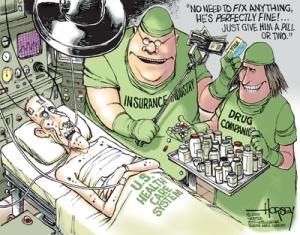
© David Horsey
As debate over President Obama's health care proposals kicks off, his opponents are lining up in a predictable way. On one side, conservatives call Obama a "socialist." On the other side, left-progressives wish that he were.
If he really were a socialist, in my view, Obama would propose something like expanding Medicare, the government's health insurance program for seniors, to cover everybody regardless of age.
It's simpler and therefore an easier sell than the hopelessly complicated health care reform plan that Bill and Hillary Clinton suggested in the early 1990s. It also would increase the mighty leverage that the world's biggest health insurance program could negotiate in lowering costs for drugs and services.
But when I brought up that option with Obama in an interview during last year's primaries, he rejected it. One big reason: he didn't think it could get enough votes to get through Congress. He may be right, considering the stormy opposition that more moderate alternatives are running up against in Congress -- especially from leading Democrats!
Yet the central argument in the health care debate appears to be centered on Medicare by another name, the "public option," a government-run health insurance plan that would compete for our consumer dollars against private plans.
Obama reiterated his belief in a Tuesday news conference that a public option "made sense" and that private insurers should find ways to compete for clients. But he declined to say whether he would veto legislation that did not include a public plan option.
It's too early in the process to "draw lines in the sand," he said, speaking for himself. Some Republican leaders and insurance companies are drawing lines of their own.
Over in the House, for example, Republican Leader John Boehner of Ohio compared the public option to "the DMV (Department of Motor Vehicles)" and the post office, as if that's a bad thing.
Please. After having gone through telephone hell with my insurance provider a few times, the DMV and post office look remarkably consumer-friendly.
Besides, as several late-night comics have noted, who else will come to your house, pick up your letter to Aunt Nelly and reliably deliver it to her anywhere in the country in two or three days for 44 cents?
The post office argument already is getting old. A recent CBS News/ New York Times poll found a commanding 72 percent of Americans supported a government-administered insurance plan that would compete with private insurers for customers. Yet Americans are realists. While the surveyed folks mostly said they were willing to pay more in taxes for universal coverage, that support dropped when dollar amounts are mentioned. We Americans know what we want, we're just haggling about the price.
The haggling turned to shock on Capitol Hill when the Congressional Budget Office estimated the price tag on the bill working its way out of the Senate Finance Committee could come to $1.6 trillion over ten years. That figure caused such a bad case of "yikes" that Sen. Max Baucus of Montana, the committee's chairman, postponed a drafting session for the bill in his committee. Sen. Charles Grassley of Iowa, the committee's top Republican, suggested on CNN "dialing down some of our expectations" to cut costs when we already have "trillions of dollars of debt."
Piling on more debt, even $1.6 trillion worth, is an important concern, but it need not be crippling. Team Obama argues that new efficiencies in health care can bring those costs down, closer to a less ghastly trillion dollars. Besides, even $1.6 trillion over ten years they point out is less than one percent of the nation's gross domestic product, by their estimates. If so, less than a penny on the dollar doesn't sound like too much to pay for a new health care safety net.
Unfortunately cutting costs has been an unnatural act for our nation's lawmakers and so far, the health care debate has not given them a sudden burst of thrift.
Nor have they shown much interest in offending the insurance industry or big employers.
For example, Senate moderates are pushing health-care "cooperatives" as an alternative to a public option. Trouble is, nobody seems to know exactly what a health care "cooperative" is.
There has been a lot of general talk about some sort of quasi-public/private organization, but few specifics yet.
After a summer of more haggling, I still expect a final health care plan to make its way through a House-Senate conference committee some muscle applied by Obama and his Chief of Staff Rahm Emanuel.
The package should include a Medicare-like public option or some kind of cost-cutting co-op that offers close to the same thing.
Anything short of that won't look like much of a victory.
Receive our political analysis by email by subscribing here
AMERICAN POLITICS
WORLD | AFRICA | ASIA | EUROPE | LATIN AMERICA | MIDDLE EAST | UNITED STATES | ECONOMICS | EDUCATION | ENVIRONMENT | FOREIGN POLICY | POLITICS
© Tribune Media Services