- MENU
- HOME
- SEARCH
- VIDEOS
- WORLD
- MAIN
- AFRICA
- ASIA
- BALKANS
- EUROPE
- LATIN AMERICA
- MIDDLE EAST
- United Kingdom
- United States
- Argentina
- Australia
- Austria
- Benelux
- Brazil
- Canada
- China
- France
- Germany
- Greece
- Hungary
- India
- Indonesia
- Ireland
- Israel
- Italy
- Japan
- Korea
- Mexico
- New Zealand
- Pakistan
- Philippines
- Poland
- Russia
- South Africa
- Spain
- Taiwan
- Turkey
- USA
- BUSINESS
- WEALTH
- STOCKS
- TECH
- HEALTH
- LIFESTYLE
- ENTERTAINMENT
- SPORTS
- RSS
- iHaveNet.com: Economy
by Jules Witcover
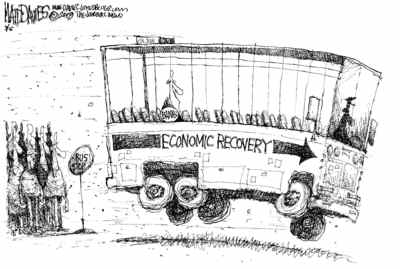
To counter the pessimistic observations of Republicans who haven't been able to come up with their own answer to the economic mess they left to President Obama, he trotted out ever-optimistic Vice President Joe Biden the other day to declare a solid start to a job only barely getting underway.
In a long speech at the
At the same time, he asked for public patience on what he called "a two-year marathon" in which only "the nine-mile mark," or about one-third of the way, has been reached, with only $90 billon of the $787 billion congressional allocation for the race yet spent.
In the act's first 200 hundred days, Biden reported, 10 specific projects he assigned to Obama cabinet officers as head of a new
In Biden's assigned task of accentuating the positive, however, he said nothing about the unemployment rate, which rose to 9.7 percent in August and is the cause of much of the continued public pessimism. And in all the heat generated by the health care debate, his claim that the stimulus is paying off itself faces an uphill climb.
"Instead of talking about the beginning of a depression," he boasted, "we are talking about the end of a recession" only eight months after he and Obama took office. As for criticism that the Recovery Act "is simply a grab bag of different programs," Biden said the fact that it "is multifaceted doesn't reflect a lack of design; it is the design."
The economic collapse was "so complex and so wounded," he said, "that reinvigorating one segment alone, or using one tool alone, would never do all that needed to be done. The Recovery Act is not a single silver bullet," he said, "but it is silver buckshot."
From the first days of the
Well known and often criticized for undisciplined long-windedness, Biden had teleprompters on the platform on either side of him as he spoke, and he referred to them throughout. But he could not refrain from folksy asides, such as his observation that, "as my Grandpop would say, 'No one horse can carry the whole load.' " And in a brief question period, he filibustered as if he were still in the
But he seemed comfortable in his new harness as vice president. When asked by the Brookings president, Strobe Talbott, to comment on the health-care reform debate now raging in the country, Biden noted that Obama would be addressing Congress on the matter in a few days.
His own specialty, he said after speaking nearly an hour on the economic recovery, was foreign policy, not health care. He concluded with a grin that with that, "I yield the floor to the president, as I always do."
Though vice presidents traditionally are known for doing the dirty work of attacking the opposition, Biden in this case was wearing his salesman's hat on a recovery not yet widely perceived in the country. At the least, his marathon metaphor does make a credible argument for waiting for the race to run its course.
WORLD | AFRICA | ASIA | EUROPE | LATIN AMERICA | MIDDLE EAST | UNITED STATES | ECONOMY | EDUCATION | ENVIRONMENT | FOREIGN POLICY | POLITICS
Economy: Selling the Economic Recovery