- MENU
- HOME
- SEARCH
- WORLD
- MAIN
- AFRICA
- ASIA
- BALKANS
- EUROPE
- LATIN AMERICA
- MIDDLE EAST
- United Kingdom
- United States
- Argentina
- Australia
- Austria
- Benelux
- Brazil
- Canada
- China
- France
- Germany
- Greece
- Hungary
- India
- Indonesia
- Ireland
- Israel
- Italy
- Japan
- Korea
- Mexico
- New Zealand
- Pakistan
- Philippines
- Poland
- Russia
- South Africa
- Spain
- Taiwan
- Turkey
- USA
- BUSINESS
- WEALTH
- STOCKS
- TECH
- HEALTH
- LIFESTYLE
- ENTERTAINMENT
- SPORTS
- RSS
- iHaveNet.com
By George Friedman
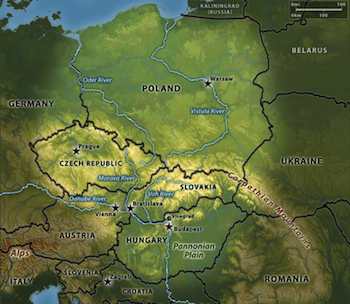
With the Palestinians demonstrating and the International Monetary Fund in turmoil, it would seem odd to focus on something called the Visegrad Group. But this is not a frivolous choice. What the Visegrad Group decided to do will, I think, resonate for years, long after the alleged attempted rape by Dominique Strauss-Kahn is forgotten and long before the Israeli-Palestinian issue is resolved. The obscurity of the decision to most people outside the region should not be allowed to obscure its importance.
The region is Europe — more precisely, the states that had been dominated by the Soviet Union. The Visegrad Group, or V4, consists of four countries — Poland, Slovakia, the Czech Republic and Hungary — and is named after two 14th century meetings held in Visegrad Castle in present-day Hungary of leaders of the medieval kingdoms of Poland, Hungary and Bohemia. The group was reconstituted in 1991 in post-Cold War Europe as the Visegrad Three (at that time, Slovakia and the Czech Republic were one). The goal was to create a regional framework after the fall of Communism. The group took an interesting new turn.
On May 12, the Visegrad Group announced the formation of a “battle group” under the command of Poland. The battle group would be in place by 2016 as an independent force and would not be part of NATO command. In addition, starting in 2013, the four countries would begin military exercises together under the auspices of the NATO Response Force.
Since the fall of the Soviet Union, the primary focus of all of the Visegrad nations had been membership in the European Union and NATO. Their evaluation of their strategic position was threefold. First, they felt that the Russian threat had declined if not dissipated following the fall of the Soviet Union. Second, they felt that their economic future was with the European Union. Third, they believed that membership in NATO, with strong U.S. involvement, would protect their strategic interests. Of late, their analysis has clearly been shifting.
First, Russia has changed dramatically since the Yeltsin years. It has increased its power in the former Soviet sphere of influence substantially, and in 2008 it carried out an effective campaign against Georgia. Since then it has also extended its influence in other former Soviet states. The Visegrad members’ underlying fear of Russia, built on powerful historical recollection, has become more intense. They are both the front line to the former Soviet Union and the countries that have the least confidence that the Cold War is simply an old memory.
Second, the infatuation with Europe, while not gone, has frayed. The ongoing economic crisis, now focused again on Greece, has raised two questions: whether Europe as an entity is viable and whether the reforms proposed to stabilize Europe represent a solution for them or primarily for the Germans. It is not, by any means, that they have given up the desire to be Europeans, nor that they have completely lost faith in the European Union as an institution and an idea. Nevertheless, it would be unreasonable to expect that these countries would not be uneasy about the direction that Europe was taking. If one wants evidence, look no further than the unease with which Warsaw and Prague are deflecting questions about the eventual date of their entry into the Eurozone. Both are the strongest economies in Central Europe, and neither is enthusiastic about the euro.
Finally, there are severe questions as to whether NATO provides a genuine umbrella of security to the region and its members. The NATO strategic concept, which was drawn up in November 2010, generated substantial concern on two scores. First, there was the question of the degree of American commitment to the region, considering that the document sought to expand the alliance’s role in non-European theaters of operation. For example, the Americans pledged a total of one brigade to the defense of Poland in the event of a conflict, far below what Poland thought necessary to protect the North European Plain. Second, the general weakness of European militaries meant that, willingness aside, the ability of the Europeans to participate in defending the region was questionable. Certainly, events in Libya, where NATO had neither a singular political will nor the military participation of most of its members, had to raise doubts. It was not so much the wisdom of going to war but the inability to create a coherent strategy and deploy adequate resources that raised questions of whether NATO would be any more effective in protecting the Visegrad nations.
There is another consideration. Germany’s commitment to both NATO and the EU has been fraying. The Germans and the French split on the Libya question, with Germany finally conceding politically but unwilling to send forces. Libya might well be remembered less for the fate of Moammar Gadhafi than for the fact that this was the first significant strategic break between Germany and France in decades. German national strategy has been to remain closely aligned with France in order to create European solidarity and to avoid Franco-German tensions that had roiled Europe since 1871. This had been a centerpiece of German foreign policy, and it was suspended, at least temporarily.
The Germans obviously are struggling to shore up the European Union and questioning precisely how far they are prepared to go in doing so. There are strong political forces in Germany questioning the value of the EU to Germany, and with every new wave of financial crises requiring German money, that sentiment becomes stronger. In the meantime, German relations with Russia have become more important to Germany. Apart from German dependence on Russian energy, Germany has investment opportunities in Russia. The relationship with Russia is becoming more attractive to Germany at the same time that the relationship to NATO and the EU has become more problematic.
For all of the Visegrad countries, any sense of a growing German alienation from Europe and of a growing German-Russian economic relationship generates warning bells. Before the  Belarusian elections there was hope in Poland that pro-Western elements would defeat the least unreformed regime in the former Soviet Union.
This didn’t happen. Moreover, pro-Western elements have done nothing to solidify in Moldova or break the now pro-Russian government in Ukraine. Uncertainty about European institutions and NATO, coupled with uncertainty about Germany’s attention, has caused a strategic reconsideration — not to abandon NATO or the EU, of course, nor to confront the Russians, but to prepare for all eventualities.
Belarusian elections there was hope in Poland that pro-Western elements would defeat the least unreformed regime in the former Soviet Union.
This didn’t happen. Moreover, pro-Western elements have done nothing to solidify in Moldova or break the now pro-Russian government in Ukraine. Uncertainty about European institutions and NATO, coupled with uncertainty about Germany’s attention, has caused a strategic reconsideration — not to abandon NATO or the EU, of course, nor to confront the Russians, but to prepare for all eventualities.
It is in this context that the decision to form a Visegradian battle group must be viewed. Such an independent force, a concept generated by the European Union as a European defense plan, has not generated much enthusiasm or been widely implemented. The only truly robust example of an effective battle group is the Nordic Battle Group, but then that is not surprising. The Nordic countries share the same concerns as the Visegrad countries — the future course of Russian power, the cohesiveness of Europe and the commitment of the United States.
In the past, the Visegrad countries would have been loath to undertake anything that felt like a unilateral defense policy. Therefore, the decision to do this is significant in and of itself. It represents a sense of how these countries evaluate the status of NATO, the U.S. attention span, European coherence and Russian power. It is not the battle group itself that is significant but the strategic decision of these powers to form a sub-alliance, if you will, and begin taking responsibility for their own national security. It is not what they expected or wanted to do, but it is significant that they felt compelled to begin moving in this direction.
Just as significant is the willingness of Poland to lead this military formation and to take the lead in the grouping as a whole. Poland is the largest of these countries by far and in the least advantageous geographical position. The Poles are trapped between the Germans and the Russians. Historically, when Germany gets close to Russia, Poland tends to suffer. It is not at that extreme point yet, but the Poles do understand the possibilities. In July, the Poles will be assuming the EU presidency in one of the union’s six-month rotations. The Poles have made clear that one of their main priorities will be Europe’s military power. Obviously, little can happen in Europe in six months, but this clearly indicates where Poland’s focus is.
The militarization of the V4 runs counter to its original intent but is in keeping with the geopolitical trends in the region. Some will say this is over-reading on my part or an overreaction on the part of the V4, but it is neither. For the V4, the battle group is a modest response to emerging patterns in the region, which STRATFOR had outlined in its 2011 Annual Forecast. As for my reading, I regard the new patterns not as a minor diversion from the main pattern but as a definitive break in the patterns of the post-Cold War world. In my view, the post-Cold War world ended in 2008, with the financial crisis and the Russo-Georgian war. We are in a new era, as yet unnamed, and we are seeing the first breaks in the post-Cold War pattern.
I have argued in previous articles and books that there is a divergent interest between the European countries on the periphery of Russia and those farther west, particularly Germany. For the countries on the periphery, there is a perpetual sense of insecurity, generated not only by Russian power compared to their own but also by uncertainty as to whether the rest of Europe would be prepared to defend them in the event of Russian actions. The V4 and the other countries south of them are not as sanguine about Russian intentions as others farther away are. Perhaps they should be, but geopolitical realities drive consciousness and insecurity and distrust defines this region.
I had also argued that an alliance only of the four northernmost countries is insufficient. I used the concept “Intermarium,” which had first been raised after World War I by a Polish leader, Joseph Pilsudski, who understood that Germany and the Soviet Union would not be permanently weak and that Poland and the countries liberated from the Hapsburg Empire would have to be able to defend themselves and not have to rely on France or Britain.
Pilsudski proposed an alliance stretching from the Baltic Sea to the Black Sea and encompassing the countries to the west of the Carpathians — Czechoslovakia, Hungary, Romania and Bulgaria. In some formulations, this would include Yugoslavia, Finland and the Baltics. The point was that Poland had to have allies, that no one could predict German and Soviet strength and intentions, and that the French and English were too far away to help. The only help Poland could have would be an alliance of geography — countries with no choice.
It follows from this that the logical evolution here is the extension of the Visegrad coalition. At the May 12 defense ministers’ meeting, there was discussion of inviting Ukraine to join in. Twenty or even 10 years ago, that would have been a viable option. Ukraine had room to maneuver. But the very thing that makes the V4 battle group necessary — Russian power — limits what Ukraine can do. The Russians are prepared to give Ukraine substantial freedom to maneuver, but that does not include a military alliance with the Visegrad countries.
An alliance with Ukraine would provide significant strategic depth. It is unlikely to happen. That means that the alliance must stretch south, to include Romania and Bulgaria. The low-level tension between Hungary and Romania over the status of Hungarians in Romania makes that difficult, but if the Hungarians can live with the Slovaks, they can live with the Romanians. Ultimately, the interesting question is whether Turkey can be persuaded to participate in this, but that is a question far removed from Turkish thinking now. History will have to evolve quite a bit for this to take place. For now, the question is Romania and Bulgaria.
But the decision of the V4 to even propose a battle group commanded by Poles is one of those small events that I think will be regarded as a significant turning point. However we might try to trivialize it and place it in a familiar context, it doesn’t fit. It represents a new level of concern over an evolving reality — the power of Russia, the weakness of Europe and the fragmentation of NATO. This is the last thing the Visegrad countries wanted to do, but they have now done the last thing they wanted to do. That is what is significant.
Events in the Middle East and Europe’s economy are significant and of immediate importance. However, sometimes it is necessary to recognize things that are not significant yet but will be in 10 years. I believe this is one of those events. It is a punctuation mark in European history.
U.S.-Pakistani Relations Beyond Bin Laden is republished with permission of STRATFOR.
Available at Amazon.com:
Aftermath: Following the Bloodshed of America's Wars in the Muslim World
Displacement and Dispossession in the Modern Middle East (The Contemporary Middle East)

The End of History and the Last Man
The Clash of Civilizations and the Remaking of World Order
The Tragedy of Great Power Politics
The End of the Free Market: Who Wins the War Between States and Corporations?
Running Out of Water: The Looming Crisis and Solutions to Conserve Our Most Precious Resource
Bottled and Sold: The Story Behind Our Obsession with Bottled Water
Water: The Epic Struggle for Wealth, Power, and Civilization

At War with the Weather: Managing Large-Scale Risks in a New Era of Catastrophes
Friendly Fire: Losing Friends and Making Enemies in the Anti-American Century
Dining With al-Qaeda: Three Decades Exploring the Many Worlds of the Middle East
Uprising: Will Emerging Markets Shape or Shake the World Economy
Copyright ©, STRATFOR
WORLD | AFRICA | ASIA | EUROPE | LATIN AMERICA | MIDDLE EAST | UNITED STATES | ECONOMICS | EDUCATION | ENVIRONMENT | FOREIGN POLICY | POLITICS
World - Visegrad: A New European Military Force | Global Viewpoint