- MENU
- HOME
- SEARCH
- WORLD
- MAIN
- AFRICA
- ASIA
- BALKANS
- EUROPE
- LATIN AMERICA
- MIDDLE EAST
- United Kingdom
- United States
- Argentina
- Australia
- Austria
- Benelux
- Brazil
- Canada
- China
- France
- Germany
- Greece
- Hungary
- India
- Indonesia
- Ireland
- Israel
- Italy
- Japan
- Korea
- Mexico
- New Zealand
- Pakistan
- Philippines
- Poland
- Russia
- South Africa
- Spain
- Taiwan
- Turkey
- USA
- BUSINESS
- WEALTH
- STOCKS
- TECH
- HEALTH
- LIFESTYLE
- ENTERTAINMENT
- SPORTS
- RSS
- iHaveNet.com
An important change is evident in what since Samuel Huntington's time has been mistakenly identified and manipulated as a war between Muslim and Western civilizations.
I say mistakenly for several reasons, one of them being that Professor Huntington himself actually foresaw a war in which an alliance of Muslim and Chinese civilizations attacked the West, in an exaggerated cold war scenario. (The Chinese are now on the American side, where much of their fortune is tied up).
I say manipulatively because the Huntington thesis served the purpose of those Americans who believed in the inevitability of conflict with Islam as a whole -- not just with individual states.
This was because 9/11 was not taken in the U.S. as an attack by a state, but as the action of a whole society "that hates Americans for their freedoms." Islamic radicalism was not understood as a politico-nationalist reaction to foreign intrusion, composed of collective Arab enmity toward Israel because of its creation on Arab territory, and fear of a Western strategic threat to the region's strategic resources.
Washington, and many if not most Americans, have conceived of the affair as a conflict between us and them. "
"Them" might be composed of several states, including even those governed by elites with ties to the United States, as well as those dominated by radical anti-Western forces. But ultimately, they were all "them."
It followed from this bi-polar interpretation that "we" had to do something about "them." Such as overturning or subverting hostile Muslim governments, or organizing international opposition or sanctions on those Islamic countries identified as "rogue" or "failing" (or "failed") states, vulnerable to radical Islamic forces.
When all of this was added together, it was simple for the West to sum it up as war by Islam against the West, dictating a Western counteroffensive against this Islamic threat; and for the other side to interpret events as a war against Islam by the West.
A war that began with the Crusades, was followed by imperialism in modern times, continuing with the seizure of Arab land to create Israel, and producing the Suez invasion, the Western-organized coup in Iran in 1953, various Lebanon interventions, two wars against Iraq and the invasion of Afghanistan -- all part of a vast neo-colonial enterprise inspired by Western religion and Western oil interests.
The thesis of war of religion, promoted on both sides, neglected the existence of a vast part of Muslim society lying outside the Middle East and Central Asia, in Indonesia, Malaysia, China and Africa, all of it with other problems to think about than oil and Israel.
The West was wrong about this being a war of civilizations, and so were the Muslims.
George W. Bush's Great War on Global Terror, against Islamic radicalism and Muslim terrorism, and the Great Fear that came close to paralyzing America after 9/11, and continues to preoccupy the American and West European governments, are both fundamentally due to a crisis inside Islamic civilization: a double crisis, of modernity and of religion.
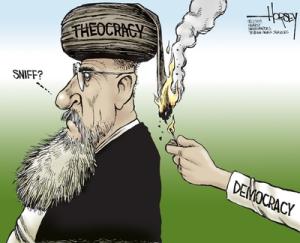
Nothing could be clearer today in Tehran.
Iran is convulsed by a struggle between its modernizing classes, reaching out to become part of a cosmopolitan international society, and to possess the respect of Western nations (if necessary, through the dangerous possession of nuclear weapons, as well as other evidences of Western modernity), and to be taken into the high councils of the modern world and be invited to participate in the rounds of international meetings where the Iranians no doubt think the world's problems are today being settled over their heads and against their interests.
The Iranian modernizers want all this, while remaining an Islamic great power (the Islamic Great Power, if possible). They want it without losing their immortal souls and their civilization. They will, of course, as others before them (as in Turkey, and on the Christian side, in Europe and the United States), find that this combination is not easily achieved.
That is why they also suffer a religious crisis.
The Ayatollahs' revolution in 1979 was a successful rejection by the Iranians of the flamboyant Westernization efforts of the Shah Reza Pahlevi, America's "gendarme in the Middle East."
In 1971, the Shah arranged a colossally extravagant party at Persepolis to celebrate the 2,500th anniversary of the founding of the empire of Cyrus the Great, Zoroastrian in religion. The guest list of the world's great personages included Emperor Haile Selassi, King Moshoeshoe of Lesotho, the Duke of Edinburgh, Prince Ranier and Princess Grace. It extended to the Presidents Tito, Nicolae Ceausescu of Romania and Mobutu of Zaire, Imelda Marcos, and Spiro Agnew.
The Ayatollah Khomeini, from his exile, called it "the Devil's Festival."
The Islamic revolution followed in 1979, and the Ayatollah then ruled Iran, in Muhammad's name, as his successors do today.
But the Iranian people are restless, unsatisfied, unsure of what they should want.
NEWS & CURRENT EVENTS [...]
WORLD | AFRICA | ASIA | EUROPE | LATIN AMERICA | MIDDLE EAST | UNITED STATES | ECONOMICS | EDUCATION | ENVIRONMENT | FOREIGN POLICY | POLITICS
The War Between Civilizations That Never Was