The 'Neda Moment' Shows Promise of Social Networking
by Leonard Pitts, Jr.
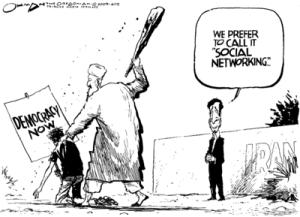
Iran Under Scrutiny
Maybe you were there when Neda died.
If you were, you saw a tragedy, of course, a 26-year-old Iranian protester gunned down in the streets. But I am convinced you also saw the future -- a profound change in the way you and I will henceforth comprehend the world.
Many of us -- your humble correspondent prominent among them -- have been less than impressed with the ubiquity of social-networking Web sites. Spurred by reports of congresspersons who tweet banalities during a presidential speech, of cyber-bullying and flash mobs, we have regarded them as an engine of vanity and inanity, a mirror reflecting the utter vapidity of much of American life and culture.
In this judgment, we have been exactly right. And also exactly wrong.
This is not to say that social-networking media have not been guilty of dumbing down the discourse. But it "is" to admit the obvious lesson of recent days: they can facilitate higher purposes as well. For this reality, the cause of human freedom can be grateful.
After all, when angry Iranian voters took to the streets to protest a stolen presidential election last week and were clubbed and shot in retaliation, the events could easily have been a non-story in the rest of the world, given that Iran had placed heavy restrictions on foreign reporters.
But what the theocratic regime had not counted on was that ordinary Iranians armed with camcorders, laptops and cell phones would document the unrest or that it would make its way to YouTube, Facebook, Twitter and other Web places where people connect.
If the world could not come to the outrage, they would bring the outrage to the world.
The result has been an international furor that has caught Iran's government in an awkward dance of backpedaling (it now admits to election irregularities but claims they did not affect the outcome) and bluster (warnings that protesters face a harsh crackdown). The world did not force the regime to that point. Its people did. Neda did.
There is something ... electrifying in watching Neda Agha-Soltan, blood-streaked and prostrate on the sidewalk, dying on camera and knowing this moment has not been framed and contextualized for you by a blow-dried network news reporter but is, rather, the grief cry of some unknown person with a cell phone camera who is desperate for you to see what is happening, desperate for you to "know."
It is a raw, person-to-person connection, and one is hard-pressed to imagine its equal in any other medium.
No, this is not the first time people have used social networks for this purpose, but it is certainly among the more dramatic and compelling. As such, it presents a stark argument that the way we receive and process information is changing and even more fundamentally than it did 18 years ago when cable network news came of age in its coverage of the Gulf War. That moment represented the ascension of a new medium.
This one recognizes that each of us has become a medium unto ourself, that each of us can now reach the rest of us.
If tweeting banalities during a presidential address represents the nadir of that potential, if a cyberspace filled with unfactual "facts" that undermines reasoned and informed discourse represents its threat, then the death of Neda represents its promise: henceforth, you are not alone. We all stand witness, one for another.
Were I at the head of some repressive regime, I would watch with trepidation.
Once upon a time, it was easy to impose the darkness necessary for evil deeds. But in a world where people now have means of linking to each other beyond government strictures and structures, darkness is much harder to come by.
As you doubtless know if you were there when Neda died.
Iran Elections
Iran: Death to Election Fraud
by Rick Steves
Last year, while in Iran producing a documentary for public television, I observed freedom-loving people patiently making do under a repressive regime. Today, the relatively peaceful Iran I experienced is in turmoil.
Iran Election Mess Is Just a Reflection of Global Human Failings
by Louis René Beres
Today's dramatic Iranian instability is more a specific symptom of general civilizational fragility than an isolated disease. Beneath the surface, all world politics readily reveals a distinctly common disorder. This is the incapacity of human beings to find both meaning and identity as individuals, within themselves.
Iran Election Twitters In a Revolution
by Mary Kate Cary
It was a battle to show who could best harness the only real news source on the ground -- the new social media -- to report fast, accurate, and insightful information. Cable and network news lost both the battle and the war. Two of the journalists who won were Andrew Sullivan, a political blogger for the old-line magazine Atlantic Monthly, and Nico Pitney of the younger Huffington Post. Sullivan and Pitney looked at the gold mine of information sitting on the new social media platform and, with two staffers, jumped in. Sullivan and his staff cut and pasted the most interesting, useful, and profound tweets into a document he called "Live-Tweeting the Revolution," updated every few minutes.
Iranian Protests a Direct Challenge to Khamenei
by Anna Mulrine
"Flexing muscle on the streets after the election is not right," warned Iran's supreme leader, Ayatollah Ali Khamenei, in the days before the bloodshed. "If they don't stop, the consequences of the chaos would be their responsibility." Those consequences included casualties that resulted from the worst upheaval in Tehran in 30 years, as well as mass arrests last week, with more than 600 protesters jailed ...
President Obama's Iran News Conference
by Cal Thomas
For the first time in a long time, the president was challenged about his positions on Iran, health care and his "occasional" smoking. This may be due to the heavy criticism the media have been getting from commentators who have accused them of not doing their jobs with coverage that has bordered on the worshipful.
As Iranians Revolt, Their Government Reveals True Self
by William Pfaff
The truly significant result of the suppressed Iranian revolt is that the most important Islamist radical movement in the contemporary world has demonstrated that it has become a brutally repressive dictatorship whose leaders rig elections and beat down clear popular demands for a true election count or repeat of the election itself.
The War Between Civilizations That Never Was
by William Pfaff
An important change is evident in what since Samuel Huntington's time has been mistakenly identified and manipulated as a war between Muslim and Western civilizations.
Iran's (So Far) Revolution-less Struggle
by William Pfaff
Iran's cosmopolitan and liberal middle classes and its students are making a revolutionary bid without intending a revolution. Few think that the demonstrations in Tehran, and now in other Iranian cities, can produce a change in regime.
Hungary 1956, Iran 2009
by Paul Greenberg
Liberty is not something that can be rationed; one freedom leads to another. Iran's demagogue-in-chief understands that old truth, which is why he is so determined to crush this peaceful revolution in today's Iran. All the odds are in favor of his doing just that, but Mahmoud Ahmedinejad has already lost something far more important than Iran's presidency; he has lost legitimacy.
Iran Elections: The Silent Revolution
by Paul Greenberg
This is something new: a Silent Revolution. The huge throng that marched through the Iranian capital last Monday spoke nary a word, Theirs was a silent vigil for a liberty not so much lost as never gained, from Shah to Ayatollah. Meanwhile, the White House and President Obama practiced its own form of silence. Things have changed since a president of the United States could be counted on to at least voice a protest when another people are cowed.
Iranian Regime Change Is for Iranians to Decide
by Mary Sanchez
I find Iran's government structure of vaguely democratic elections and Islamic theocracy almost incomprehensible. However, if Iran's government needs reform, it is Iran's people that must make that case -- and they are, very eloquently and tragically even with their lives. The last thing Iranian reformers and protesters need is to be painted as agents of the Great Satan.
The 'Neda Moment' Shows Promise of Social Networking
by Leonard Pitts, Jr.
Maybe you were there when Neda died. If you were, you saw a tragedy, of course, a 26-year-old Iranian protester gunned down in the streets. But I am convinced you also saw the future -- a profound change in the way you and I will henceforth comprehend the world.
Obama's Iran Policy Is a Bomb
by Jonah Goldberg
Here is the one immutable fact of Barack Obama's foreign policy agenda as it relates to Iran: It's over. If the forces of reform and democracy win, Obama's plan to negotiate with the regime is moot, for the regime will be gone.
Obama's Choice Is Not to Choose on Iran
by Jonah Goldberg
Stop measuring the success of your diplomacy with Iran by the degree to which the grinning, hate-filled stooge of a clerical junta will "temper" his rhetoric about the pressing need to destroy Israel and slow his ineluctable pursuit of nuclear weapons.
Iran's Crisis of Legitimacy
Ramin Jahanbegloo - Global Viewpoint
Increasingly, Iran's divine sovereignty has been less about religion than about political theology. As for the popular sovereignty, it has found its due place in social networks and political action of Iranian civil society
Iran Must Void Elections to Restore Peace on Streets
Shirin Ebadi - Global Viewpoint
People's dissatisfaction with the results does not concern the present elections alone: Many objections were made four years ago when Mahmoud Ahmadinejad was first elected president. Ahmadinejad's most important position until then had been mayor of Tehran. He was, however, supported by Basij and Ayatollah Khamenei, the Islamic Republic's leader for life. Ahmadinejad's four years of presidency resulted in people's great dissatisfaction.
Will Iran Look More Like Turkey, or Turkey Like Iran
Nathan Gardels - Global Viewpoint
The effort to forge new forms of non-Western modernity in the Muslim world has pushed Iran into bloody civil strife while Turkey swirls with persistent rumors of military plots against the Islamist-rooted government. The great historical question is whether, at the end of the day, Iran will look more like Turkey, or Turkey like Iran
(c) 2008 TRIBUNE MEDIA SERVICES, INC.
