iHaveNet.com
Not Enough Health Care to Go Around: Some say Americans Use Too Much Healthcare
Online Breaking News Headlines Single Source to Headlines Breaking News Current Events Top Stories. Find out what is happening in News & the World. Check out iHaveNet.com for the latest news & current events articles plus Movie Reviews, Wolfgang Puck Recipes, NFL Previews Analysis and Politics. Your Single Source to News Articles, Current Events & Reviews.
  • HOME
  • WORLD
    • Africa
    • Asia Pacific
    • Balkans
    • Caucasas
    • Central Asia
    • Eastern Europe
    • Europe
    • Indian Subcontinent
    • Latin America
    • Middle East
    • North Africa
    • Scandinavia
    • Southeast Asia
    • United Kingdom
    • United States
    • Argentina
    • Australia
    • Austria
    • Benelux
    • Brazil
    • Canada
    • China
    • France
    • Germany
    • Greece
    • Hungary
    • India
    • Indonesia
    • Ireland
    • Israel
    • Italy
    • Japan
    • Korea
    • Mexico
    • New Zealand
    • Pakistan
    • Philippines
    • Poland
    • Russia
    • South Africa
    • Spain
    • Taiwan
    • Turkey
    • United States
  • USA
    • ECONOMICS
    • EDUCATION
    • ENVIRONMENT
    • FOREIGN POLICY
    • POLITICS
    • OPINION
    • TRADE
    • Atlanta
    • Baltimore
    • Bay Area
    • Boston
    • Chicago
    • Cleveland
    • DC Area
    • Dallas
    • Denver
    • Detroit
    • Houston
    • Los Angeles
    • Miami
    • New York
    • Philadelphia
    • Phoenix
    • Pittsburgh
    • Portland
    • San Diego
    • Seattle
    • Silicon Valley
    • Saint Louis
    • Tampa
    • Twin Cities
  • BUSINESS
    • FEATURES
    • eBUSINESS
    • HUMAN RESOURCES
    • MANAGEMENT
    • MARKETING
    • ENTREPRENEUR
    • SMALL BUSINESS
    • STOCK MARKETS
    • Agriculture
    • Airline
    • Auto
    • Beverage
    • Biotech
    • Book
    • Broadcast
    • Cable
    • Chemical
    • Clothing
    • Construction
    • Defense
    • Durable
    • Engineering
    • Electronics
    • Firearms
    • Food
    • Gaming
    • Healthcare
    • Hospitality
    • Leisure
    • Logistics
    • Metals
    • Mining
    • Movie
    • Music
    • Newspaper
    • Nondurable
    • Oil & Gas
    • Packaging
    • Pharmaceutic
    • Plastics
    • Real Estate
    • Retail
    • Shipping
    • Sports
    • Steelmaking
    • Textiles
    • Tobacco
    • Transportation
    • Travel
    • Utilities
  • WEALTH
    • CAREERS
    • INVESTING
    • PERSONAL FINANCE
    • REAL ESTATE
    • MARKETS
    • BUSINESS
  • STOCKS
    • ECONOMY
    • EMERGING MARKETS
    • STOCKS
    • FED WATCH
    • TECH STOCKS
    • BIOTECHS
    • COMMODITIES
    • MUTUAL FUNDS / ETFs
    • MERGERS / ACQUISITIONS
    • IPOs
    • 3M (MMM)
    • AT&T (T)
    • AIG (AIG)
    • Alcoa (AA)
    • Altria (MO)
    • American Express (AXP)
    • Apple (AAPL)
    • Bank of America (BAC)
    • Boeing (BA)
    • Caterpillar (CAT)
    • Chevron (CVX)
    • Cisco (CSCO)
    • Citigroup (C)
    • Coca Cola (KO)
    • Dell (DELL)
    • DuPont (DD)
    • Eastman Kodak (EK)
    • ExxonMobil (XOM)
    • FedEx (FDX)
    • General Electric (GE)
    • General Motors (GM)
    • Google (GOOG)
    • Hewlett-Packard (HPQ)
    • Home Depot (HD)
    • Honeywell (HON)
    • IBM (IBM)
    • Intel (INTC)
    • Int'l Paper (IP)
    • JP Morgan Chase (JPM)
    • J & J (JNJ)
    • McDonalds (MCD)
    • Merck (MRK)
    • Microsoft (MSFT)
    • P & G (PG)
    • United Tech (UTX)
    • Wal-Mart (WMT)
    • Walt Disney (DIS)
  • TECH
    • ADVANCED
    • FEATURES
    • INTERNET
    • INTERNET FEATURES
    • CYBERCULTURE
    • eCOMMERCE
    • mp3
    • SECURITY
    • GAMES
    • HANDHELD
    • SOFTWARE
    • PERSONAL
    • WIRELESS
  • HEALTH
    • AGING
    • ALTERNATIVE
    • AILMENTS
    • DRUGS
    • FITNESS
    • GENETICS
    • CHILDREN'S
    • MEN'S
    • WOMEN'S
  • LIFESTYLE
    • AUTOS
    • HOBBIES
    • EDUCATION
    • FAMILY
    • FASHION
    • FOOD
    • HOME DECOR
    • RELATIONSHIPS
    • PARENTING
    • PETS
    • TRAVEL
    • WOMEN
  • ENTERTAINMENT
    • BOOKS
    • TELEVISION
    • MUSIC
    • THE ARTS
    • MOVIES
    • CULTURE
  • SPORTS
    • BASEBALL
    • BASKETBALL
    • COLLEGES
    • FOOTBALL
    • GOLF
    • HOCKEY
    • OLYMPICS
    • SOCCER
    • TENNIS
  • Subscribe to RSS Feeds EMAIL ALERT Subscriptions from iHaveNet.com RSS
    • RSS | Politics
    • RSS | Recipes
    • RSS | NFL Football
    • RSS | Movie Reviews
Not Enough Healthcare to Go Around
by Michael D. Tanner

HOME > USA >
Not Enough Healthcare to Go Around


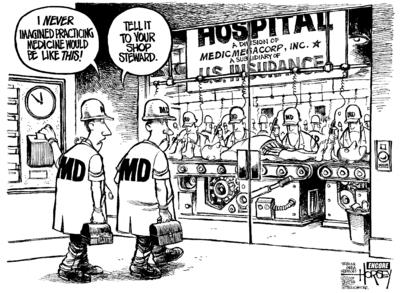
healthcare; insurance; hospoitals; doctors medical factories | iHaveNet.com
(c) David Horsey

SocialTwist Tell-a-Friend

Some say Americans use too much healthcare, that even if reform is achieved, universal access should not mean unlimited access

Tough choices must be made.

Others worry that the most needy or least able to fight for themselves will be left waiting.

Should healthcare be rationed?

No one can fail to be moved by heartbreaking stories of people suffering and unable to get healthcare they want or need. But compassion is a sentiment, not a policy.

We tend to talk about healthcare in the philosophically abstract. "Is healthcare a right or a privilege?" goes the refrain. In reality, it is neither.

Healthcare is a commodity -- and a finite one at that.

There are only so many doctors, hospitals, and, most important, money to go around. After all, every dollar spent on healthcare is one not spent on education, infrastructure, or defense.

President Obama is right about the unsustainable trajectory of healthcare spending.

We spend $2.5 trillion per year for healthcare, 17.5 percent of the gross domestic product. Under current trends, that will increase to 48 percent of GDP by 2050. At that point, government healthcare programs like Medicare and Medicaid alone will consume 20 percent of GDP. Quite simply, we cannot provide all the healthcare everyone might want.

Sure, there are efficiency savings to be had here and there. But savings from things like greater emphasis on preventive care, better evidence as to best practices, and electronic medical records are unlikely to be realized for years, if at all. Any healthcare reform will have to confront the biggest single reason costs keep rising: The American people keep buying more and more healthcare.

At its most basic, no one wants to die.

If a treatment can save our lives or increase quality of life, we want it. Therefore, in the long run, the only way to spend less on healthcare is to consume less healthcare. Someone, sometime, has to say no.

Take just one example. If everyone were to receive a CT brain scan every year as part of an annual physical, we would undoubtedly discover a small number of brain cancers earlier than we otherwise would, perhaps early enough to save a few lives. But given the scan's cost, adding it to all annual physicals would quickly bankrupt the nation.

False hope.

The real debate, therefore, is not about whether we should ration care but about who should ration it. Currently, that decision is often made by insurance companies or other third-party payers. Obama and congressional Democrats want to shift that decision-making power to the federal government. Some, frustrated by the insurance-based rationing of the current system, naively believe that putting the government in charge would mean unlimited access to the care they need and desire. When Michael Moore, in Sicko, showcased emotional tales of people denied experimental treatment by insurance companies, he implied that a government-run system would certainly pay for it.

The reality, however, is that every government-run healthcare system around the world rations care.

In Great Britain, the National Institute on Clinical Effectiveness makes such decisions, including a controversial determination that certain cancer drugs are "too expensive." The government effectively puts a price tag on each citizen's life -- some $44,305 per year, to be exact. That's just a baseline, of course, and, as the British institute's chairman, Michael Rawlins, points out, the agency has at times approved treatments costing as much as $70,887 per year of extended life. But these are approved only if it can be shown they extend life by at least three months and are used for illnesses that affect fewer than 7,000 new patients per year.


Free-market healthcare reformers, on the other hand, want to shift more of the decisions (and therefore the financial responsibility) back to the individual.

People should have the absolute right to spend their own money on whatever they want, including buying as much healthcare as they want. And, if they are spending their own money, they will make their own rationing decisions based on price and value.

That CT scan that looked so desirable when someone else was paying may not be so desirable if you have to pay for it yourself. The consumer himself becomes the one who says no.

Of course, as a compassionate society, we may choose to help others pay for some care. That's a worthwhile debate to have. But our resources are not unlimited. Choices will have to be made. And, therefore, the real question should be: Who will make those choices?

The only way to spend less on healthcare is to consume less healthcare.

Michael Tanner is a senior fellow at the Cato Institute, a conservative think tank in Washington, D.C.


SocialTwist Tell-a-Friend


Hard Choices on Healthcare Reform
by Mortimer B. Zuckerman

In the 1980s, if you had a heart attack and got to the hospital, you had about a 60 percent chance of living a year. Today, it is over 90 percent. We have been able to transform the health of the American public because of the rapid development of new medicines and technology. These innovations have come at a cost: They are responsible for as much as two thirds of the annual spending increases in healthcare. We'd like to get back to the costs of 1980, but nobody is willing to go back to 1980 medicine

Healthcare Reform's Effect on You
by Bernadine Healy M.D.

Some elements might change before a final healthcare bill is in hand, but enough common threads have emerged for people to look beyond the headlines for an idea of how the new healthcare system will affect them personally. For starters, consider these seven ways in which your healthcare experience is apt to change ...

Lack of Competition in Healthcare Insurance Market
by Kent Garber

Should healthcare reform include an option for Americans to buy insurance from the government? President Obama has made it a priority, arguing that a government plan would make the insurance market more competitive and help lower costs. Republicans aggressively oppose this, asserting that a public plan would all but destroy the private market.

  • America's Hospitals Can't Afford Healthcare Cuts
  • Healthcare Reform Estimates Have Democrats on Defensive
  • Uwe Reinhardt: Plain Talk on Healthcare Reform
  • Employers to Make Deeper Cuts in 2010 Health Coverage
  • When Healthcare Reform Hits Grandma
  • Government-run Healthcare Insurance-Program Sure to Backfire
  • Obama's Uphill Battle to Reform Healthcare

Healthcare Industry jobs

Find your next job in the Healthcare Industry. Search Healthcare jobs from thousands of job and career search sites.

Not Enough Care to Go Around: Some say Americans Use Too Much Healthcare


(c) 2009 U.S. News & World Report


Search Powered By Google

Google Search   

Advertisement

Job & Career Search

career & job search                    job title, keywords, company, location

Advertisement

Your Ad Here
Your Ad Here

Advertisement

  • HOME
  • WORLD
  • USA
  • BUSINESS
  • WEALTH
  • STOCKS
  • TECH
  • HEALTH
  • LIFESTYLE
  • ENTERTAINMENT
  • SPORTS

Not Enough Care to Go Around: Some say Americans Use Too Much Healthcare

  • Services:
  • RSS Feeds
  • Shopping
  • Email Alerts
  • Site Map
  • Privacy