iHaveNet.com
55 MPH Speed Limit Makes Economic, Political, and Environmental Sense
Online Breaking News Headlines Single Source to Headlines Breaking News Current Events Top Stories. Find out what is happening in News & the World. Check out iHaveNet.com for the latest news & current events articles plus Movie Reviews, Wolfgang Puck Recipes, NFL Previews Analysis and Politics. Your Single Source to News Articles, Current Events & Reviews.
  • HOME
  • WORLD
    • Africa
    • Asia Pacific
    • Balkans
    • Caucasas
    • Central Asia
    • Eastern Europe
    • Europe
    • Indian Subcontinent
    • Latin America
    • Middle East
    • North Africa
    • Scandinavia
    • Southeast Asia
    • United Kingdom
    • United States
    • Argentina
    • Australia
    • Austria
    • Benelux
    • Brazil
    • Canada
    • China
    • France
    • Germany
    • Greece
    • Hungary
    • India
    • Indonesia
    • Ireland
    • Israel
    • Italy
    • Japan
    • Korea
    • Mexico
    • New Zealand
    • Pakistan
    • Philippines
    • Poland
    • Russia
    • South Africa
    • Spain
    • Taiwan
    • Turkey
    • United States
  • USA
    • ECONOMICS
    • EDUCATION
    • ENVIRONMENT
    • FOREIGN POLICY
    • POLITICS
    • OPINION
    • TRADE
    • Atlanta
    • Baltimore
    • Bay Area
    • Boston
    • Chicago
    • Cleveland
    • DC Area
    • Dallas
    • Denver
    • Detroit
    • Houston
    • Los Angeles
    • Miami
    • New York
    • Philadelphia
    • Phoenix
    • Pittsburgh
    • Portland
    • San Diego
    • Seattle
    • Silicon Valley
    • Saint Louis
    • Tampa
    • Twin Cities
  • BUSINESS
    • FEATURES
    • eBUSINESS
    • HUMAN RESOURCES
    • MANAGEMENT
    • MARKETING
    • ENTREPRENEUR
    • SMALL BUSINESS
    • STOCK MARKETS
    • Agriculture
    • Airline
    • Auto
    • Beverage
    • Biotech
    • Book
    • Broadcast
    • Cable
    • Chemical
    • Clothing
    • Construction
    • Defense
    • Durable
    • Engineering
    • Electronics
    • Firearms
    • Food
    • Gaming
    • Healthcare
    • Hospitality
    • Leisure
    • Logistics
    • Metals
    • Mining
    • Movie
    • Music
    • Newspaper
    • Nondurable
    • Oil & Gas
    • Packaging
    • Pharmaceutic
    • Plastics
    • Real Estate
    • Retail
    • Shipping
    • Sports
    • Steelmaking
    • Textiles
    • Tobacco
    • Transportation
    • Travel
    • Utilities
  • WEALTH
    • CAREERS
    • INVESTING
    • PERSONAL FINANCE
    • REAL ESTATE
    • MARKETS
    • BUSINESS
  • STOCKS
    • ECONOMY
    • EMERGING MARKETS
    • STOCKS
    • FED WATCH
    • TECH STOCKS
    • BIOTECHS
    • COMMODITIES
    • MUTUAL FUNDS / ETFs
    • MERGERS / ACQUISITIONS
    • IPOs
    • 3M (MMM)
    • AT&T (T)
    • AIG (AIG)
    • Alcoa (AA)
    • Altria (MO)
    • American Express (AXP)
    • Apple (AAPL)
    • Bank of America (BAC)
    • Boeing (BA)
    • Caterpillar (CAT)
    • Chevron (CVX)
    • Cisco (CSCO)
    • Citigroup (C)
    • Coca Cola (KO)
    • Dell (DELL)
    • DuPont (DD)
    • Eastman Kodak (EK)
    • ExxonMobil (XOM)
    • FedEx (FDX)
    • General Electric (GE)
    • General Motors (GM)
    • Google (GOOG)
    • Hewlett-Packard (HPQ)
    • Home Depot (HD)
    • Honeywell (HON)
    • IBM (IBM)
    • Intel (INTC)
    • Int'l Paper (IP)
    • JP Morgan Chase (JPM)
    • J & J (JNJ)
    • McDonalds (MCD)
    • Merck (MRK)
    • Microsoft (MSFT)
    • P & G (PG)
    • United Tech (UTX)
    • Wal-Mart (WMT)
    • Walt Disney (DIS)
  • TECH
    • ADVANCED
    • FEATURES
    • INTERNET
    • INTERNET FEATURES
    • CYBERCULTURE
    • eCOMMERCE
    • mp3
    • SECURITY
    • GAMES
    • HANDHELD
    • SOFTWARE
    • PERSONAL
    • WIRELESS
  • HEALTH
    • AGING
    • ALTERNATIVE
    • AILMENTS
    • DRUGS
    • FITNESS
    • GENETICS
    • CHILDREN'S
    • MEN'S
    • WOMEN'S
  • LIFESTYLE
    • AUTOS
    • HOBBIES
    • EDUCATION
    • FAMILY
    • FASHION
    • FOOD
    • HOME DECOR
    • RELATIONSHIPS
    • PARENTING
    • PETS
    • TRAVEL
    • WOMEN
  • ENTERTAINMENT
    • BOOKS
    • TELEVISION
    • MUSIC
    • THE ARTS
    • MOVIES
    • CULTURE
  • SPORTS
    • BASEBALL
    • BASKETBALL
    • COLLEGES
    • FOOTBALL
    • GOLF
    • HOCKEY
    • OLYMPICS
    • SOCCER
    • TENNIS
  • Subscribe to RSS Feeds EMAIL ALERT Subscriptions from iHaveNet.com RSS
    • RSS | Politics
    • RSS | Recipes
    • RSS | NFL Football
    • RSS | Movie Reviews
55 MPH Speed Limit Makes Economic, Political, and Environmental Sense
Tim Castleman

HOME > USA >
55 MPH Speed Limit Makes Economic, Political, and Environmental Sense


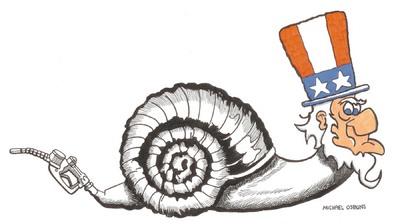
Michael Osbun relates to the slow pace of U.S. efforts to enforce conservation and produce alternative fuels
Energy Conservation Moving at Snail's Pace
(c) Michael Osbun

SocialTwist Tell-a-Friend

Driving a little slower prevents crashes and tie-ups and could be the road to energy independence

Tim Castleman is the founder of the Drive 55 Conservation Project, which promotes energy independence.

It's easy to understand why Americans don't like to be told how to drive.

Private motor vehicles represent freedom, in a figurative sense as well as a practical one.

Our vehicles are more than just tools of autonomy, though. They are an extension of the self, intimately intertwined with personal identity. To a large degree, our cars are us, and restricting how we drive is tantamount to threatening our independence.

Coming from a culture that values liberty, we balk at such infringements.

In the bigger picture, however, this is just a reactionary response. The critical thinkers among us know that freedom demands responsibility, knowledge, and considerate action. We have good reason to reduce the speed at which we drive, for personal gain as well as the good of the nation.

This is why the Drive 55 Conservation Project is asking Americans to make the choice to slow down to observe all speed limits, never exceeding 55 mph.

The reason is painfully obvious: This is a time for conservation and moderation. Our nonrenewable fossil fuels, like those used in gasoline, are dwindling at an alarming rate. Climate change caused by human activity poses a significant challenge for future generations. Our economy has faltered so markedly that people at nearly all levels of society are feeling a financial pinch. And our roadways have become dangerous places, with nearly 39,800 motor vehicle-related deaths in 2008. In response, manufacturers are fielding a new fleet of small cars that would be safer at more moderate speeds, especially during this time of transition from large, heavy vehicles.

Biofuels like ethanol and biodiesel may play an important role in reducing pollution and our dependence on fossil fuels; however, given the volume we consume, we have learned it is impractical and socially irresponsible to attempt to replace fossil fuels entirely with biofuels. There is a simple way to remedy all of these problems. Right now, every driver has the power to conserve gasoline, reduce pollution, save money, and reduce the risk of deadly traffic accidents, without using new technology or having to purchase a new vehicle: Observe all posted speed limits, and never exceed 55 mph.

Many drivers say they don't have time to slow down, but they often don't consider how much time is taken up by speed-related collisions and other traffic problems. Speeders create "bottlenecks" that turn into traffic jams. Consider the example of pouring rice through a funnel: Only so much can get through the small end, no matter how fast it is poured into the large end. To remedy this problem, engineers have begun using digital traffic signs to reduce speed limits based on the volume of cars on the road.

Traffic moving at dissimilar speeds can cause collisions, and this is yet another reason for everyone to slow down. Generally, the faster a driver is going, the higher the risk of collision and the odds that a crash will cause a fatality. Back in 1984, it was estimated that the 55 mph speed limit saved up to 4,000 lives per year. One can reasonably extrapolate that, given the increase in the number of drivers on our highways during the past two decades, we could save even more lives today if we slowed down. Fewer collisions will also keep roadways clear and keep traffic moving, saving everyone time on the road.

Even if a driver is able to avoid these traffic problems, the risks and costs of driving fast aren't justified by the extra few minutes that can be saved by speeding. All in all, the time factor is nearly insignificant. Consider the example of a woman with a 25-mile daily commute. This driver will lose less than 10 minutes by slowing down from 80 mph to 55, but she will save nearly 30 percent in energy and arrive safely at her destination more relaxed and stress free, with a little extra money in her purse.

When evaluating the matter of time vs. speed, we must first recognize this fact: As far as energy consumption is concerned, the optimum speed for cars is 35 to 45 mph. After this peak, efficiency falls off rapidly. Because of a law of physics called "drag," the energy required to move a car is quadrupled when its speed is doubled. This means the faster you go, the more you waste. A top speed of 55 mph is a compromise between speed and efficiency. Major trucking companies have known this for a long time, and they govern their fleets accordingly. During the last price hike, many trucking companies adjusted their governors down to 62 mph. Even airlines have slowed their jets to cut fuel costs.

Of course, conserving gasoline also has advantages beyond the economic bottom line. Naturally, the environment benefits from a reduction in the pollution that's caused from burning fossil fuels. In addition, using less gasoline decreases our dependence on foreign oil. One has only to look at recent history to realize this point.

In 1974, as a response to a historic gasoline shortage, the U.S. adopted a 55 mph national speed limit. This was an emergency measure intended to reduce our dependence on imported crude oil, and it worked. Foreign oil accounted for 36 percent of our energy use before the national speed limit took effect, but in 1985, foreign oil made up just 28 percent of U.S. energy consumption, a record low.

These reductions were short-lived, however. In 1987, Congress relaxed the speed limit law to allow vehicles to drive 65 mph on rural highways, and consumption of imported oil began to skyrocket. Nonetheless, efforts to scale back the law continued, and in 1996, the national 55 mph speed limit was repealed. Our dependence on imported oil has increased dramatically ever since, rising to more than 60 percent of U.S. consumption.

History and science are offering us this simple lesson: Slowing down our motor vehicles has significant political, financial, and environmental rewards. All we have to do is observe posted speed limits and keep the speedometer from exceeding 55 mph. As the Drive 55 Conservation Project puts it, the result is modern-day alchemy. By reducing your vehicle's speed, you change the lead in your right foot into gold in your pocket.


Niall Ferguson's Books & DVDs are available at Amazon.com (Click Here)


SocialTwist Tell-a-Friend


RELATED ARTICLES

55 MPH Speed Limit Is Unenforceable and Counterproductive
James Baxter

Motorist compliance with the 55 mph limit has always been problematic. Ticketing binges, threatened financial sanctions, relentless PR, and increased fines and penalties failed to stem noncompliance. Despite increasing noncompliance and increased highway speeds, fatality rates continue to decline, contradicting the folklore that higher speed limits and higher speeds result in more serious accidents.

When It Pays to Go Green
Kimberly Palmer

Going green sometimes comes with a price: Organic vegetables can cost twice as much as their mainstream counterparts. So when is going green really worth it? We asked some top environmental experts to weigh in -- and their answers might surprise you. They say that while spending extra is often justified, you can almost always find a cheaper alternative.


Receive iHaveNet.com on Politics & the Economy -- Enter your email address:


Delivered by FeedBurner


(c) 2009 U.S. News & World Report

Search Powered By Google

Google Search   

Advertisement

Advertisement

Job & Career Search

career & job search                    job title, keywords, company, location

Advertisement

Advertisement

Your Ad Here
Your Ad Here
  • HOME
  • WORLD
  • USA
  • BUSINESS
  • WEALTH
  • STOCKS
  • TECH
  • HEALTH
  • LIFESTYLE
  • ENTERTAINMENT
  • SPORTS

55 MPH Speed Limit Makes Economic, Political, and Environmental Sense

  • Services:
  • RSS Feeds
  • Shopping
  • Email Alerts
  • Site Map
  • Privacy