- MENU
- HOME
- SEARCH
- WORLD
- MAIN
- AFRICA
- ASIA
- BALKANS
- EUROPE
- LATIN AMERICA
- MIDDLE EAST
- United Kingdom
- United States
- Argentina
- Australia
- Austria
- Benelux
- Brazil
- Canada
- China
- France
- Germany
- Greece
- Hungary
- India
- Indonesia
- Ireland
- Israel
- Italy
- Japan
- Korea
- Mexico
- New Zealand
- Pakistan
- Philippines
- Poland
- Russia
- South Africa
- Spain
- Taiwan
- Turkey
- USA
- BUSINESS
- WEALTH
- STOCKS
- TECH
- HEALTH
- LIFESTYLE
- ENTERTAINMENT
- SPORTS
- RSS
- iHaveNet.com: Politics
by Justin Ewers
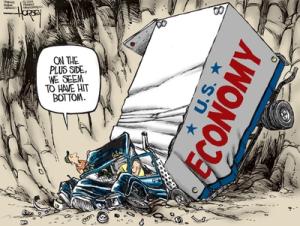
© David Horsey
When Ronald Reagan took office in 1981, he, too, referred to the fiscal crisis he inherited as "the worst economic mess since the Great Depression."
After several years of sagging productivity and deteriorating confidence, millions of workers were unable to find jobs. The unemployment rate, climbing past 7 percent, was almost exactly the same as it was when Barack Obama was sworn in.
Economists were fretting about the long-term consequences of the soaring national debt, then approaching $1 trillion.
While there was no Wall Street meltdown or housing crisis to confront, the Reagan-era economy, teetering on the brink of recession, was beset by another seemingly insurmountable problem: out-of-control inflation, which was making it difficult for workers to pay for goods and services.
"If we get the economy in shape, we're going to be able to do a lot of things," Reagan wrote to a friend after defeating Jimmy Carter. "If we don't, we're not going to be able to do anything."
As similar as the economic challenges facing Reagan and Obama may sound, the fiscal solutions proposed by the two presidents could not be more different.
Obama has gone on a Keynesian spending spree, raising taxes on the highest-income earners and pouring money into energy, healthcare, and a massive stimulus bill. Reagan took the opposite path during his first few months in office, pushing through the biggest tax cuts in history, while massively increasing the defense budget.
Mixed legacy.
Politicians have been arguing ever since about which approach works better.
Some pundits heralded Obama's election as the end of the "Reagan era," viewing his victory as a firm repudiation of Reagan's most recent disciple, George W. Bush. But it seems clear, after several months of bitter partisan politics, that the book is not closed on Reaganomics.
"It's time for Washington to stop spending away our children's future," Jim DeMint, a Republican senator from South Carolina, said in a typical response to Obama's budget. Republicans in Congress suggested a Reaganesque array of tax cuts, instead.
This lingering faith in trickle-down economics puzzles many historians, since Reagan's approach has had a decidedly mixed legacy.
While Reagan's tax cuts may have helped pull the economy out of recession, they did not achieve most of their stated goals, and the huge deficits they caused contributed to the next crisis.
"A lot of the time, we wish we had a clear score card with presidents, but we don't; we have a messy score card," says Julian Zelizer, a professor of history at Princeton.
"That's definitely the case with Reagan."
When Reagan arrived in office in 1981, he certainly didn't believe his economic policies might someday be viewed with such skepticism.
At the beginning of his first term, he was determined not just to get the economy back on track but to drastically reduce the size of the federal government.
After taxes were cut, he predicted, economic activity would increase so much that tax revenues would go up, allowing the government to pay down the deficit -- a radical new theory known as supply-side economics.
With the help of conservative Democrats in control of the House, Reagan got his way, pushing a plan through Congress to cut the highest marginal tax rate from 70 percent to 50 percent and, over the next five years, all the way down to 28 percent. Reagan never made an equally substantive effort to cut spending, though, and when Congress approved several massive increases in the defense budget, huge deficits appeared.
Only a month after Reagan signed his tax cuts into law, the economy slid into recession.
Many historians give Reagan high marks for the early stages of his economic recovery program, though his tax policy is not what receives the most praise.
One of Reagan's top priorities when he arrived in Washington was bringing down inflation, then averaging 12.5 percent. He stoically backed the efforts of Paul Volcker, the newly appointed chairman of the Federal Reserve, to whittle away at soaring prices by restricting the money supply but paid a steep political price for his support. Fewer dollars circulating in the economy pushed unemployment past 10 percent in 1982, dragging Reagan's approval rating down from 68 percent to 35 percent.
Still, historians believe it was this tight-fisted approach to monetary policy that paved the way to recovery.
"Reagan did break the back of the recession," says Lou Cannon, author of the biography President Reagan: The Role of a Lifetime. "But he did it by sticking with Volcker."
As the 1984 election approached, the inflation rate had fallen to just over 4 percent, Volcker had begun to loosen the money supply, and the unemployment rate was dropping.
Timing is everything in politics, and Reagan's timing was good.
"Suddenly, what had seemed like an insoluble problem was essentially solved," says John Sloan, a retired professor of political science at the University of Houston and the author of The Reagan Effect: Economics and Presidential Leadership. "By 1984, you had peace and prosperity, and Reagan looked terrific." Campaigning with the slogan "It's morning again in America," Reagan won re-election in a landslide.
Reagan's economic legacy didn't end there, though. Economists generally agree that the sky-high tax rates of the 1970s needed to come down and that Reagan's policies helped lay the foundation for the economic boom that followed, including the 18 million jobs created during his presidency. But because Reagan never made any real effort to cut spending in his second term and kept his tax cuts in place, his policies also had some decidedly negative consequences. "Reagan's fiscal policy was certainly a stimulus to the economy, and if that stimulus had been removed after the economy got back to full employment, then I would have found very little to criticize," says Benjamin Friedman, an economist at Harvard who was an outspoken critic of Reagan in the 1980s. "When the economy is at less than full employment, government deficits are a good idea. That's why they're a good idea now. What's a bad idea is keeping the government in significant deficit when the economy has recovered."
Deep red.
But keeping the government in deficit is exactly what Reagan did.
Despite his years of lip service to balancing the budget, total discretionary spending had climbed almost 16 percent by the time he left office, dwarfing the Carter budgets he had once criticized. Revenues, limited by Reagan's tax cuts, were never able to keep pace. The result was a spiraling national debt that nearly tripled during his two terms, hitting $2.7 trillion.
Some of Reagan's aides, including William Niskanen, the former chairman of Reagan's Council of Economic Advisers, believe there is a simple explanation for these growing deficits: Reagan's tax cuts did not do what supply-side economists said they would do. Because the cuts didn't substantively increase tax revenues, they didn't allow Reagan to shrink the deficit. They also didn't decrease the size of government by choking off spending.
"The 'starving the beast' hypothesis is understandably popular among politicians -- that you can have tax cuts without a deficit increase -- but it's just empirically wrong," says Niskanen, now chairman emeritus of the Cato Institute. "That idea has destroyed for several decades the traditional Republican commitment to fiscal responsibility."
Many historians believe this is Reagan's real legacy.
"The combination of military spending, tax cuts, and ultimately a failure to control most domestic spending led to a fiscal straitjacket by the end of the decade," says Zelizer.
In 1991, Reagan's successor, George H.W. Bush, was forced to increase taxes to close huge gaps in the budget, but government debt still climbed past $4 trillion on his watch. When George W. Bush adopted a Reaganesque economic policy, with Dick Cheney, early in Bush's first term, famously saying that "Reagan proved deficits don't matter," more tax cuts and more spending led to even more debt.
By the time Obama took office, the federal government was more than $11 trillion in the red.
The lesson of Reaganomics, in other words, may be a simple one. In times of economic crisis, all roads seem to lead to the same place: deficits.
The real test of a president and his economic policy, historians say, is what happens to those deficits when the economy recovers.
For all of his many successes, that is a test Reagan seems to have failed.
AMERICAN POLITICS
WORLD | AFRICA | ASIA | EUROPE | LATIN AMERICA | MIDDLE EAST | UNITED STATES | ECONOMICS | EDUCATION | ENVIRONMENT | FOREIGN POLICY | POLITICS
Receive our political analysis by email by subscribing here
© Tribune Media Services, Inc