- MENU
- HOME
- SEARCH
- WORLD
- MAIN
- AFRICA
- ASIA
- BALKANS
- EUROPE
- LATIN AMERICA
- MIDDLE EAST
- United Kingdom
- United States
- Argentina
- Australia
- Austria
- Benelux
- Brazil
- Canada
- China
- France
- Germany
- Greece
- Hungary
- India
- Indonesia
- Ireland
- Israel
- Italy
- Japan
- Korea
- Mexico
- New Zealand
- Pakistan
- Philippines
- Poland
- Russia
- South Africa
- Spain
- Taiwan
- Turkey
- USA
- BUSINESS
- WEALTH
- STOCKS
- TECH
- HEALTH
- LIFESTYLE
- ENTERTAINMENT
- SPORTS
- RSS
- iHaveNet.com: Politics
by Jules Witcover
You knew it was going to happen.
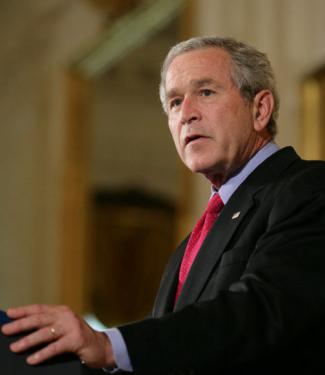
After five months of holding his tongue, former President George W. Bush has broken his pledge of non-criticism and joined the fray.
In a closed-door talk to businessmen in Erie, Pa., Bush according to the Bush-friendly Washington Times jumped into the Republican-led argument that President Obama's sweeping and expensive government interventions into the private sector are steering the country into "socialism."
"I know it's going to be the private sector that leads this country out of the current economic times we're in," he was quoted as saying.
"You can spend your money better than the government can spend your money. Government does not create wealth. The major role for the government is to create an environment where people take risks to expand the job rate in the United States."
Former President Bush went on: "There are a lot of ways to remedy the situation without nationalizing health care. I worry about encouraging the government to replace the private sector when I comes to providing insurance for health care."
Asked directly whether he thought Obama was embracing "socialist" policies, Bush replied: "We'll see."
In the Republican Party's opposition to Obama's stimulus package to jump-start the stalled economy he inherited, waving the red flag of "socialism" has been a prime conservative talk-show counterattack. Bush's comments obviously will add fuel to that strategy.
In another pointed criticism of the new Democratic administration, the former president sharply disagreed with Obama's announced but beleaguered plan to close the war detainee camp at Guantanamo Bay.
"I told you I'm not going to criticize my successor," he said, proceeding to do so.
"I'll just tell you that there are people at Gitmo that will kill American people at the drop of a hat, and I don't believe that persuasion (is) going to work. Therapy isn't going to cause terrorists to change their mind." And he repeated that his administration used "every (interrogation) technique and tool within the law to bring terrorists to justice before they strike again."
Until now, Bush seemed content to leave the criticism of Obama and defense of the Bush administration to former Vice President Dick Cheney, who voiced it in much sharper and defiant terms. And the departed president received considerable editorial praise for his reticence.
The White House, in keeping with Obama's call for a new bipartisanship, offered a mild retort from presidential press secretary Robert Gibbs. "We had a debate about individual policies, " he said. "We had that debate in particular, we kept score last November and we won."
Rebutting the implied specter of "socialism," Gibbs said, "President Obama believes that the free market is what governs our economic principles, and looks forward to getting out of the business of being involved in banks and in auto companies."
As the champion of the free-market economy that came to near-collapse during his previous eight years in the White House, Bush would appear not to be the best spokesman for a party struggling to recover from the November defeat to which Gibbs referred.
Meanwhile, other reminders of the recent Bush years continue to pop up.
A federal judge considering a Freedom of Information Act seeking Cheney's notes of his testimony in the outing of CIA agent Valerie Plame in 2005 has just chastised a Justice Department ruling that they could be withheld on grounds release would provide fodder for television talk shows.
Up to now, the Obama White House has insisted it had no interest in stirring up old complaints about the Bush years with any kind of "truth commission" investigations.
Bush rising from the ashes to start criticizing his successor could end the Obama policy of turning the other cheek.
In any event, the less he is heard from, the better, as far as the Republican Party's quest for a fresh voice to present new policies is concerned.
Bush lapsing into silence again will be his best contribution as the GOP strives to make a comeback, or least to limit further bleeding, in the congressional elections next year.
Jules Witcover's latest book, on the Nixon-Agnew relationship, "Very Strange Bedfellows," has just been published by Public Affairs Press. You can respond to this column at juleswitcover@earthlink.net.)
AMERICAN POLITICS
WORLD | AFRICA | ASIA | EUROPE | LATIN AMERICA | MIDDLE EAST | UNITED STATES | ECONOMICS | EDUCATION | ENVIRONMENT | FOREIGN POLICY | POLITICS
Receive our political analysis by email by subscribing here
© Tribune Media Services