- MENU
- HOME
- SEARCH
- WORLD
- MAIN
- AFRICA
- ASIA
- BALKANS
- EUROPE
- LATIN AMERICA
- MIDDLE EAST
- United Kingdom
- United States
- Argentina
- Australia
- Austria
- Benelux
- Brazil
- Canada
- China
- France
- Germany
- Greece
- Hungary
- India
- Indonesia
- Ireland
- Israel
- Italy
- Japan
- Korea
- Mexico
- New Zealand
- Pakistan
- Philippines
- Poland
- Russia
- South Africa
- Spain
- Taiwan
- Turkey
- USA
- BUSINESS
- WEALTH
- STOCKS
- TECH
- HEALTH
- LIFESTYLE
- ENTERTAINMENT
- SPORTS
- RSS
- iHaveNet.com: Pets
by Steve Dale
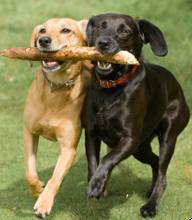
It turns out that your dog's brain isn't all that different from your own. Dr. Nicholas Dodman, director of the behavior clinic at
Today, science has finally met up with Dodman.
The window first opened in 1991 with work published in the
Dodman has been waiting to prove his theory -- that while compulsive behavior may be expressed differently in dogs than in people, such behavior is all pretty much the same. "The only differences are in the ways compulsive behaviors are expressed as a result of species and breed," Dodman explains.
For example, Border Collies, an intense herding breed, generally express their breed-specific compulsive behavior by chasing lights. Bull Terriers convey compulsion consistent with their predator lineage by chasing their own tails. Dobermans don't suck their thumbs (maybe they would if they had thumbs) but do express their breed-specific compulsive behavior by sucking on their own flanks, and sometimes sucking on blankets.
Interestingly, thumb-sucking can be a compulsive disorder in people. Other examples of OCDs include non-stop double-checking to ensure appliances are turned off, compulsive hand-washing, even self-mutilation like pulling out hair.
Dodman says he believes the genetic explanation for compulsive disorders is all pretty much the same, whether it's a horse that cribs (grabs a solid object, such as a stall door or fence rail with its incisors, arches its neck and sucks in air), a cat who sucks on fabric, a Doberman who sucks on his flank, or a person who compulsively sucks his thumb.
That's where Dr. Edward Ginns, director of
So, the
"Bingo" is a specific spot on chromosome 7 which contains a gene called Neuronal cadherin-2, or CDH2. This spot consistently appeared at a far higher frequency in the compulsive dogs.
At first, this finding may not seem significant. But consider the flurry of activity happening as a result. For starters, scientists at the
Ginns points out that more work needs to be done to formalize the specific alteration in chromosome 7, but the outcome for dogs might be a new class of drugs to more efficiently target compulsive behaviors in dogs, and also ultimately for people. Right now, SSRI drugs (like Prozac) are used to treat compulsive behaviors in dogs with mixed success. The odds for success are far greater with behavior modification.
The genetic finding offers proof, for the first time, that at least for dogs, there's likely a genetic predisposition for compulsive behaviors. Still, these behaviors only seem to occur in dogs, cats and horses with the right set of environmental stressors, which is also true for people. However, since no one completely understands the relationship between genetics and these stressors, this work could be a start.
For sure, if the gene is confirmed in Dobermans, breeders in the future may be able to use a simple blood test to determine if the genetic defect indicating a higher risk for compulsive disorders is present before breeding. Careful breeding could lessen the chances of the problem occurring in Dobermans, and potentially other dog breeds, even other species.
Dodman does have DNA samples collected for other breeds; Bull Terriers will be investigated next. Dodman says he guesses the same gene alteration may be present in other breeds, and even in people.
"I'm confident that we're on our way to a better understanding of the expression of compulsive behaviors, and that will help dogs and also help people," Ginns says.
AUTOS | HOBBIES | EDUCATION | FAMILY | FASHION | FOOD & RECIPES | HOME DECOR | RELATIONSHIPS | PARENTING | PETS | TRAVEL | WOMEN
PET STORIES and PET ARTICLES ...
- Is Your Dog Cut out for Field Trials?
- Should You Crate-train Your Puppy?
- How to Play Soccer With Your Dog
- The Best Way for Your Dog to Ride in the Car with You
- Good Dog Park Etiquette
- What Is Freestyle Dancing With Dogs?
- Canicross: An Easier Way to Run With Your Dog
- Reading Your Dog's Body Language
- Kitten Kindergarten
- Tips to Keep Your Dog Safe While Flying
- Keep Your Dog Warm in the Winter
- Scottish Deerhound: The Ideal Exercise Buddy
- Teach Your Dog to Fetch
- Is Your Dog Bored?
- 7 Ways to Pamper Your Cat
- The Best Games to Play With Your High-Energy Dog
- Dog Feeding Mishaps Corrected
- How to Succeed at Off-Leash Dog Play
- ID Your Relationship With Your Cat
- Photographing Your Elusive Feline
- How to Keep Your Pet Safe During the Holidays
- When Good Dogs Turn Bad
- From Finicky Fido to Chowhound Charlie
- Insure Your Kitty's Health
- Unconditional Love: My Cat Forgives Me Every Day
- From Feline to Family Member
- Is Water From a Christmas Tree Stand Harmful to Cats?
- A Day in the Life of a Sheepherding Dog
- Go on a Desert Retreat With Your Dog
- Dog Food Goes Natural and Holistic
- Determining a Food Allergy
- Exercise Gone to the Dogs
- Find the Right Sport for Your Dog
- Make Your Dog a Part of Your Wedding
- Hydrotherapy Helps Dogs Get in Shape
- How Your Cat Says 'I Love You'
- Lost Cats Found
- De-stress Veterinary Visits for Your Cat
- Keeping Cat Food Fresh
- Second-Hand Cat, First-Rate Pet
Copyright ©
Pets | Veterinary Research on Compulsive Behavior Could Benefit Dogs and People