Amanda Ruggeri
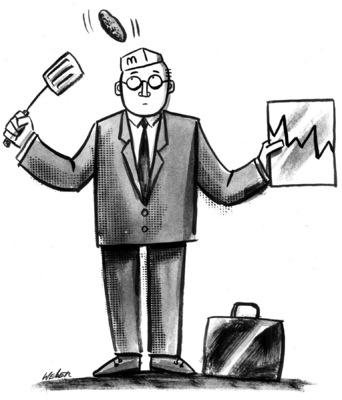
Concerns about Jobs & Unemployment (c) Mark Weber
The increase keeps the country on track to hit 10 percent unemployment by year's end
The Labor Department's job report this morning may not be surprising, but it's still disappointing: The unemployment rate rose in June to 9.5 percent, making it the worst in 26 years.
The rise, from 9.4 percent in May, is slight.
Still, it keeps the economy on track to hit a 10 percent unemployment level by the end of the year, as analysts have predicted. And at 467,000, the number of jobs shed in June was much worse than the 350,000 that economists had forecast.
In total, 14.7 million Americans are looking for work--almost twice the number when the recession began in December 2007.
The news isn't good for the Obama administration, which lobbied for the $787 billion stimulus package based on the idea that it would create millions of jobs.
The White House says there are more jobs in the economy than there would have been without the legislation. But that explanation isn't convincing the public, only 52 percent of whom now say the stimulus has or will restore the economy, according to one recent poll.
As usual, the numbers would have been even worse if it weren't for the
If jobless individuals haven't "actively" sought jobs in the past four weeks, such as by submitting applications or attending interviews, they're not included in the tally. Also excluded are those who would like full-time jobs but can find only part-time work.
The unemployment rate would be 16.5 percent if those individuals were included.
The data also show that some industries are much worse off than others.
The hardest-hit are construction workers, more than 17 percent of whom are unemployed. That's more than twice their unemployment rate one year ago. Meanwhile, those involved in mining, quarrying, and oil and gas extraction are facing a 13.6 percent unemployment rate, more than four times the 3.3 percent they saw last year.
Even education and healthcare -- which together saw growth in June, adding 34,000 jobs -- have a 6.1 percent unemployment rate.
While it's daunting, the unemployment rate isn't necessarily a clear sign of how the economy is doing as a whole.
That's because it's a lagging indicator: Businesses can't hire (or even retain) their workers until they have the money to do so, which comes about when the credit markets loosen up and when consumers start spending again.
The good news, therefore, is that the unemployment rate doesn't automatically mean the economy's not stabilizing. The bad news? Even once the country emerges from recession, it's likely that the unemployment rate will continue to slump.
Why June Jobs Report Is So Depressing
Liz Wolgemuth
The brutal truth about the
Making Sense of 'Cash for Clunkers'
Matthew Bandyk
With new-car sales slumping, automotive companies have been looking for ways to get consumers back into showrooms. Washington checked one item off car companies' wish list when it passed the Consumer Assistance to Recycle and Save Act of 2009 -- commonly known as 'Cash for Clunkers' ...
Nine Reasons the Economy is Not Getting Better
Mortimer B. Zuckerman
We are now looking at unemployment numbers that undermine any confidence that we might be nearing the bottom of the recession. The appropriate metaphor is not the green shoots of new growth. A better image is to look at the true total of jobless people as a prudent navigator looks at an iceberg
Would Second Stimulus Create Jobs?
Liz Wolgemuth
Americans are stumbling through a job market that is overwhelmed with supply, stripped of security, and skimmed of hours and benefits, and the unemployment rate has already climbed much higher than officials had forecast. So, the real question is, what could a second Obama administration stimulus do that the first one couldn't? To answer that, it's necessary to know how the first $787 billion package has disappointed.
Accurately Counting Stimulus Jobs Proving Tough
Amanda Ruggeri
As Americans become more skeptical of the administration's promise that the stimulus package will create or save 3.5 million jobs, there's an added frustration: Even if the $787 billion act is successful in creating work, Americans may never know. That's because counting the jobs involves estimating what would have happened without legislation, a slippery task even if the economy weren't so volatile.
Why No One Can Guess When Recovery will Occur
Paul A. Samuelson
Federal Reserve Chairmen Ben Bernanke glimpses a possible recovery by year end. He is a cautious scholar, backed by the best forecasters in the world at the Federal Reserve Board.
I would be a rash fool to quarrel with this quasi-optimistic view that by year end some stability will occur. You and I should hope that there will indeed be a glimmer of light at the end of the tunnel ahead. ...
Joseph Stiglitz:
Will Capitalism Survive Wall Street Apocalypse
Matthew Bandyk
A few days after writing about how the United States is not heading towards socialism, Joseph Stiglitz suggests that might not be true about the rest of the world. Stiglitz argues that the lesson many Third World nations might take from the financial crisis is that capitalism is fundamentally flawed.
Not Going to Be Economic Depression
Global Economic Viewpoint
Last week at the Milken Global Conference, three Noble Laureates in Economics sat down to discuss the global recession -- Gary Becker (Nobel Prize, 1992), Roger Myerson (Nobel Prize, 2007) and Myron Scholes (Nobel Prize 1997).
All three agreed that this is not going to be a depression and that the free-market economy is fundamentally healthy.
The Complex Case of Complexity
by Alvin and Heidi Toffler
In an important recent speech, months after the current financial crisis began, the chairman of the U.S. Federal Reserve Board, Ben Bernanke, placed partial blame for the catastrophe on "the sharp increase in the complexity of the financial products offered to consumers." Unfortunately, his description of the problem comes late and underestimates its importance. ...
Why are Bankers Still Being Treated as Beltway Royalty
by Arianna Huffington
President Obama said that he's been "sobered by the fact that change in Washington comes slow" and "humbled by the fact that the presidency is extraordinarily powerful, but we are just part of a much broader tapestry of American life and there are a lot of different power centers." Well, one of those different power centers -- the entrenched special interests that continue to call so many shots on Capitol Hill -- is the main reason change in D.C. comes so slow. But despite all that I know about the reform-killing power unleashed by the nexus of lobbying, campaign cash and legislation, I have been flabbergasted by the amount of behind-the-scenes influence recently being wielded by the banking lobby.
Recent Commentary on the Economic & Financial Crisis
- Some Good News About Banking
- Obama Economic Team's Flawed Cosmology
- Larry Summers: Brilliant Mind, Toxic Ideas
- Tim Geithner, CNBC & The Second Coming of Known Unknowns
- Could America Suffer Japan's 'Lost Decades'
- The Global Economy: Worse & Worser
- Today's Global Economic Debacle: The Japan Fallacy
- Financial Outrages Past, Present & Future
- Even the US can Manage Itself into Economic Irrelevance
(c) 2009 U.S. News & World Report