- MENU
- HOME
- SEARCH
- WORLD
- MAIN
- AFRICA
- ASIA
- BALKANS
- EUROPE
- LATIN AMERICA
- MIDDLE EAST
- United Kingdom
- United States
- Argentina
- Australia
- Austria
- Benelux
- Brazil
- Canada
- China
- France
- Germany
- Greece
- Hungary
- India
- Indonesia
- Ireland
- Israel
- Italy
- Japan
- Korea
- Mexico
- New Zealand
- Pakistan
- Philippines
- Poland
- Russia
- South Africa
- Spain
- Taiwan
- Turkey
- USA
- BUSINESS
- WEALTH
- STOCKS
- TECH
- HEALTH
- LIFESTYLE
- ENTERTAINMENT
- SPORTS
- RSS
- iHaveNet.com: Economy
by Amanda Ruggeri
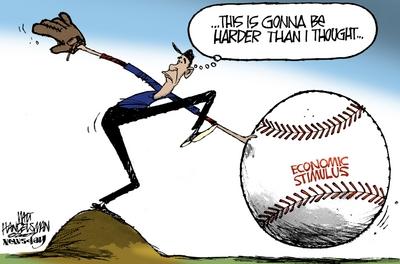
Obama promised $787 billion stimulus package would create or save 3.5 million jobs
As Americans become more skeptical of the administration's promise that the stimulus package will create or save 3.5 million jobs, there's an added frustration: Even if the $787 billion act is successful in creating work, Americans may never know.
That's because counting the jobs involves estimating what would have happened without legislation, a slippery task even if the economy weren't so volatile.
"We will probably have a better sense two years down the road, after a number of careful studies," says Steven Davis, a University of Chicago economics professor. "But even then, there will be lots of arguments."
The Obama administration says that 150,000 jobs were created in the first hundred days after the stimulus was passed. But that figure comes from the same economic formula that predicted how many jobs the stimulus would create overall, not from reporting on the ground.
So far, two measures are being used, economic modeling and direct reporting.
The first, a formula from the president's Council of Economic Advisers, relies on the well-established idea that a certain amount of spending generates a given number of jobs. It's particularly useful since it accounts for ripple effects that direct reporting doesn't, like how a construction worker buying a sandwich on the job supports the local eatery and lets it hire more people.
But like many economic estimates, it's inexact.
The other yardstick is direct reporting, in which agencies tell the government how many people they hired with stimulus funds.
But that can also get murky. The Office of Management and Budget recently released guidance on such an assessment to stimulus funding recipients. Experts say that although it clarified how recipients are supposed to report jobs and other data, it doesn't make an exact count likelier.
"The fear was that [job reporting] would not capture the full extent of jobs created or retained," says Gary Bass, director of the watchdog group OMB Watch. "This does nothing to allay those fears."
Part of the problem is that job reporting goes down only to the first subcontractor level.
If a state receives a stimulus grant and subcontracts it to a city, for example, the state counts how many people it employed to administer the funding and estimates how many the city employed. The sum of the two is reported as the number of jobs created. But if the city contracts out the program, as expected, those jobs aren't added in.
Then, experts say, there is the question of how to count "saved" jobs, especially important since the final job numbers will lump those together with "created" jobs.
Some cases are clear-cut, like school districts' decisions not to pink-slip employees after stimulus funds came through. But as agencies get more information about what funding will be available and plan accordingly, defining a saved job gets trickier.
"It will likely become a question of 'If you did not have this money, what budget changes would you need to have made?' " says Leslee Fritz, director of Michigan's economic recovery office.
It's not unlikely that the White House will issue more guidance on counting stimulus jobs.
Given the intricacies involved, though, even the best methods won't yield a precise count, at least not before the recession's end.
WORLD | AFRICA | ASIA | EUROPE | LATIN AMERICA | MIDDLE EAST | UNITED STATES | ECONOMY | EDUCATION | ENVIRONMENT | FOREIGN POLICY | POLITICS
Accurately Counting Stimulus Jobs Proving Tough: Obama promised $787 billion stimulus package would create or save 3.5 million jobs