- MENU
- HOME
- SEARCH
- WORLD
- MAIN
- AFRICA
- ASIA
- BALKANS
- EUROPE
- LATIN AMERICA
- MIDDLE EAST
- United Kingdom
- United States
- Argentina
- Australia
- Austria
- Benelux
- Brazil
- Canada
- China
- France
- Germany
- Greece
- Hungary
- India
- Indonesia
- Ireland
- Israel
- Italy
- Japan
- Korea
- Mexico
- New Zealand
- Pakistan
- Philippines
- Poland
- Russia
- South Africa
- Spain
- Taiwan
- Turkey
- USA
- BUSINESS
- WEALTH
- STOCKS
- TECH
- HEALTH
- LIFESTYLE
- ENTERTAINMENT
- SPORTS
- RSS
- Personal Finance
New Student Loan Repayment Plan Is Based on Borrower's Income
Kathy Kristof
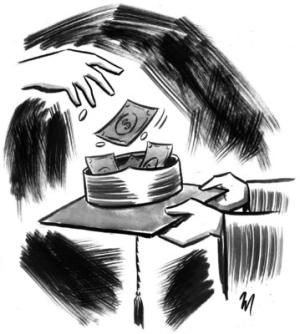
New student loan repayment options came just in time for Jeff Zollinger.
The 32-year-old father of two just graduated from architecture school with $125,000 in debt. He and his wife, an audiologist, expect to make good money someday -- more than enough to pay the loans. But between the rotten economy and a new baby, the Savannah, Ga., couple have only been able to find part-time work. They're struggling to make ends meet, so the $1,200 a month that Jeff's lenders want on his loans doesn't seem feasible.
Fortunately for the Zollingers, a new federal student loan repayment plan goes into effect this month that could dramatically reduce payments for highly indebted borrowers. Called "income-based repayment," the plan limits the monthly payments to a percentage of the borrower's monthly income.
The program is complex and won't apply to every borrower. But those who have federal student loan balances that exceed their annual income almost certainly qualify, said Edie Irons, communications director for the Institute for College Access and Success in Berkeley, Calif. In many cases, loan payments could be sliced in half.
How does it work, and how can you apply? Here's a look.
What's income-based repayment?
It's the newest of six repayment options for federal student loans. It differs from most options in that the other loan payment plans are designed to repay the balance over a set period of time, such as 10 years. Income-based repayment doesn't base payments on a set payoff date. Instead, the payments are based on the borrower's discretionary income. That's calculated by determining how much the borrower's income exceeds federal poverty guidelines for his or her family size and location. The less you earn, the less you pay.
If you pay less each month, doesn't that mean you'll pay for more years and end up paying more interest, too?
Yes. Interest accrues on student loan balances each month, and if you're paying less than the interest that's accruing, the balance of your loan could actually rise. For that reason, anyone who could afford to pay more would be advised to, Irons said. But if the loan payments are making it impossible to pay other bills, this gives you the flexibility to help your cash flow without hurting your credit.
Does that mean I'll be paying on my student loans forever?
No. This plan says that any borrower who has faithfully made payments for 25 years can have his or her remaining loan balance forgiven or wiped away at the end of that time.
In addition, if you work for government or a nonprofit and repay your debts under the direct loan program for 10 years, you could have your loan balance wiped out faster under another federal program called Public Service Debt Forgiveness.
How much would I have to pay each month?
That depends on your income, your debt and the number of people in your household. However, the Education Department says if you are single and earning $20,000 annually, the most you'd have to pay against student loans is $47 a month. If you earned $25,000, the required payment would be $109. If you earned $35,000, the required payment would be capped at $234.
Comparatively, if you had $50,000 in student debt at a 6.8 percent interest rate, you'd have to pay $575.40 a month under the standard repayment plan, no matter how much you earned.
Am I going to be locked out of the program if I earn more?
No. The formula determining whether you qualify looks at your loan payments versus your discretionary income. You could have a substantial income and still qualify if you also have a lot of debt. Borrower's payments are adjusted once annually to reflect changes in income and family size.
Can I do this with all my loans?
The program is only available for federal student loans under the Stafford, Grad Plus and federal consolidation loan programs. It does not apply to parent's loans for students (called Plus Loans), and only applies to Perkins Loans if they're consolidated into the Federal Family Education Loan or Direct Loan programs. It also does not apply to private loans, state loans and loans that are not backed by the federal government.
How do I figure out if I qualify and how much my payments might be?
The Project on Student Debt has set up a Web site dedicated to answering questions about income-based repayment at www.ibrinfo.org. The site has a calculator that estimates whether you'll qualify for the program and roughly what your payment amount will be.
The Education Department also offers a Web-based calculator on its site that explains all the repayment options for student borrowers. That site is at www.studentaid.ed.gov. (Scroll down and look for "repaying your loans" on the left side of the page. After you click on that, you'll see "repayment plans and calculators." Click again and it will link to repayment calculators for the various options, including standard and extended repayment.)
How do I apply?
Gather your loan information, showing balances, type of loans and lenders. Then contact your lenders. If your lender will not offer income-based repayment, call the Education Department at 1-800-4-FED-AID and look into consolidating your qualifying loans into the Direct Loan program, which is administered by the federal government.
Personal Finances - New Student Loan Repayment Plan Is Based on Borrower's Income
© TRIBUNE MEDIA SERVICES, INC.