
 RSS
RSS
ECONOMICS |
EDUCATION |
ENVIRONMENT |
FOREIGN POLICY |
POLITICS |
OPINION |
TRADE
U.S. CITIES:
Iran at the Crossroads of History
Will this Regime Fall Like the Shah's
Abolhassan Bani-Sadr
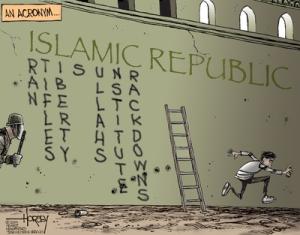
Iran at the Crossroads of History
(c) David Horsey
Abolhassan Bani-Sadr was the first president of
Within six short weeks since the recent election, the government of the
Historically speaking, the Iranian government has enjoyed four sources of legitimacy: its ability to manage state affairs (and thus the people's consent), its official religious authority, its commitment to
The massive vote rigging on
Shortly after, in his speech at Friday prayer, Ayatollah Ali Khamenei, the supreme leader, declared war on the people, threatening a violent crackdown unless the results of the election were duly accepted. This removed the last vestiges of the regime's religious legitimacy as well.
It had been waning for some time already, not only because it stands in opposition to Islam understood as a discourse of freedom, but even within the regime and among traditionalists. Ayatollah
Even the traditional sharia, which the government had used to justify many of its actions, had been emptied of its original content and reduced to a theory of general violence. Ayatollah
Far from strengthening the regime's religious authority, however, Yazdi's theory of legitimate violence undermined it. It also violated another of the regime's major sources of legitimacy, the constitution. The Iranian constitution states unambiguously that the authority of the supreme leader, the president and the parliament should emanate from the people's vote, not from God.
Velayat-e-Faqih compromised this from the start. Apart from this, the regime had already lost two of the three bases of power that had historically made despotism possible in
Finally, the regime's first and foremost base of support, the clergy, has been replaced by a military-financial mafia. The Revolutionary Guard occupies the entire government and believes that the clergy's only task is not to run the country, but simply to lend its legitimacy to those who do.
Like the monarchy before it, the power of the present regime rests on both an internal and external foundation, which makes it vulnerable to public unrest. We can draw a comparison between
There are other similarities as well. The popular chant "Velayat-e Faqih is dead," for example, is reminiscent of slogans during the run-up to the 1979 revolution, in which people declared the Shah's regime to be illegitimate. And, just as in 1979, this uprising is nonviolent.
But the present movement differs from the political unrest that led to the 1979 revolution in some important ways. While the first actions of dissent in 1979 were located outside the regime, the present opposition began from within the regime itself when the election was rigged against
Of course, there are strong indicators that the uprising has now moved beyond the regime to become genuinely popular. But it still needs time to spread throughout the entire country; time for it to be possible for "flowers to conquer bullets," as was the case in the 1979 uprising.
The 1979 revolution is a historical event, while this uprising is still in process. Where might it lead? In part, the future may depend on the outcome of a political deadlock created by Khamenei himself. The facts that the election was rigged and that Khamenei attempted to stage a "velvet coup d'etat" have polarized both sides.
Changing position in either camp would be political suicide. Khamenei and Ahmadinejad cannot admit that they rigged the election, since doing so would strip them of their remaining legal and political legitimacy. Former President
Several outcomes of this crisis are possible. Historically, the regime's top tactic for maintaining control has been to divide society's elites into two competing groups and eliminate one. Now, as this process has reached into the heart of the regime, it has become lethal. The regime's own cadres oppose Ahmadinejad, and the deepening economic crisis has both deprived the regime of resources and spurred further public discontent. This has provided an opening in which the Iranian people can determine the outcome of the struggle.
If the Iranian people cease resisting, times will become even harder; if they continue, their uprising will be transformed into a full-fledged revolution. This would make the establishment of democracy a real possibility. All indications now point to the Iranians' determination to see this uprising through.
From Iraq to Afghanistan, U.S. Foreign Wars Not Going According to Plan
by William Pfaff
In Iraq, tension was reported to be increasing between the Americans and the Iraqi military and security forces, who were supposed to take over the Americans' responsibilities. Move to another front: Pakistan-Afghanistan. Here there was also supposed to be a straightforward job to do: drive the Taliban out of Afghanistan, into the Tribal Areas of the Pakistan border. There, the Pakistan army, with American urging and help, would defeat and disarm them.
America's Homeland Security Surplus
William Pfaff
Janet Napolitano, Barack Obama's secretary of Homeland Security gave a talk at the Council on Foreign Relations in New York, meant to convince American civil libertarians and security specialists that the country can be kept safe, and neighborly as well.
Berlusconi's Indiscretions, Sarkozy's Rep - Why Sometimes Pays to Be Like Gordon Brown
by William Pfaff
Flamboyance of the Latin kind gets you into the newspapers, but for bad reasons as well as good. Nicolas Sarkozy of France is not a man noted for charm but for his unchecked energies and the restless activity. Italy's Silvio Berlusconi is another matter entirely. He is a success in politics apparently because the majority of Italians like him. Indeed, sometimes pays to be a nondescript politician like Gordon Brown of Britain.
Obama, Solana Mean Business About Two-State Solution
by William Pfaff
The Israeli press reports with alarm that the United States has threatened to reduce by $1 billion the guarantee the U.S. Treasury customarily provides for Israel state borrowings, which assure them the best commercial terms. This is evidence that the Obama government is serious about halting Israel's colonization of the Palestinian territories -- and about imposing, rather than merely inviting, a two-state Middle East solution.
Iran at the Crossroads of History: Will this Regime Fall Like the Shah's
(c) 2009 Global Viewpoint - Tribune Media Services, Inc.
