
 RSS
RSSIn Afghanistan, It's President Obama's War Now
By Anna Mulrin
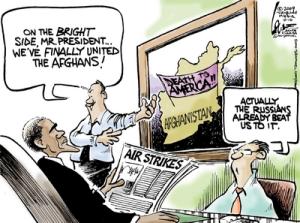
By Jennifer Kohnke
There is a popular proverb that has been making the rounds in Kabul involving the inadvisability of juggling two watermelons with one hand.
It is used to suggest the peril -- some say folly -- of taking on large tasks with too few resources.
Lately, it has been cropping up as Afghans struggle to describe the enormity of the task that confronts President Obama in their country, where conditions have deteriorated dramatically over the past year. Deaths among both Afghan and U.S. troops are on the rise, confidence in the Kabul government is falling to new lows, and the ability of America to turn things around remains an open question.
"There's no shortage of problems," says Michele Flournoy, Obama's Pentagon policy chief. "And we can't afford to solve them all."
This blunt assessment portends some tough choices for the president.
Before unveiling his new strategy for Afghanistan, Obama dispatched 17,000 additional U.S. soldiers and marines to the increasingly violent country, where monthly troop casualties now surpass those in Iraq. In so doing, he fulfilled a long-standing request for reinforcements by Gen. David McKiernan, commander of U.S. forces in Afghanistan. In his new strategy, Obama also called for a surge of civilian development experts, long at the top of wish lists of overwhelmed U.S. military officials on the ground.
With these steps, Obama moved into the ring for what will be one of the toughest fights of his presidency. Indeed, if Iraq was decidedly George W. Bush's war, then Afghanistan firmly belongs to Obama. Now begins the daunting task of changing the dynamic in Afghanistan. Up to this point, U.S. troops "have done a fabulous job making a little go a long way," says Flournoy. "They haven't had a choice in the matter."
This is particularly the case as Afghanistan has become less and less of a global effort. With appeals to NATO allies for more combat troops going largely unheeded, U.S. officials sound increasingly resigned to bearing most of the burden of the war. "We're seeking to ask each of our partners to do what they can in turning this around," says Flournoy, reflecting the kind of scaled-back entreaty that has lately characterized America's expectations of its allies.
The allies' pullback is a problem, particularly with many major indicators on a downward trend in advance of Afghanistan's presidential elections in August. Though some NATO nations are sending more soldiers to help with security for the voting, the reinforcements are almost certain to be temporary. By summer's end, U.S. troop levels will approach 60,000, which is still less than McKiernan requested. Whether Obama sends more, senior defense officials say, will depend on Afghanistan's success in meeting a series of yet-to-be-determined benchmarks.
The difficulty of figuring out how to measure progress points to how hard it is to define what victory looks like. While an al Qaeda-free Afghanistan is clearly an Obama goal, democracy as a priority is rarely mentioned these days. Flournoy says officials are mulling essential questions, including "Why are we fighting in Afghanistan?" and "What's at stake if we fail?" Finally, she adds, they are asking themselves, "What's working, and what's not?"
What's not, it seems clear, is the Pakistan piece. Many U.S. officials consider Pakistan's ungoverned border tribal areas a key obstacle to peace in Afghanistan. The border is porous, and even a considerable increase in U.S. force levels in Afghanistan will have limited impact, they say, until the Pakistani sanctuaries are cleared out. Platoon-size U.S. outposts along the Afghan border are vulnerable and are having little success stemming the flow of insurgents, according to senior U.S. military officials, who have quietly begun closing some of these bases.
Senior Pentagon officials say that they want to see more military cooperation with Pakistan. The big debate, though, is how to go about it. One point of contention is how much intelligence to share at joint border coordination centers since some members of Pakistan's powerful intelligence service have close ties to the Taliban and Pakistani officers have been discovered passing along plans about future operations. For these reasons, the U.S. military is sharing only "local intelligence at this point," says Maj. Gen. John Macdonald, deputy commander of U.S. forces in Afghanistan.
Confidence. In the meantime, conditions in Pakistan "continue to move in the wrong direction," according to Joint Chiefs of Staff Chairman Adm. Mike Mullen, who says he is "increasingly both concerned and frustrated by the progression of the danger" there. Largely as a result, the Pentagon has been a vocal proponent of economic aid for Pakistan in an effort to ameliorate some of the poverty that encourages many young men to become radicalized foot soldiers in the first place. This aid will be tied to Pakistan's progress in tracking down insurgents within its borders, which U.S. military officials consider a vital mission. In Pakistan, a nuclear-armed country with a population six times the size of Afghanistan's, "the stakes are as high as they can get," says Flournoy.
In both countries, people continue to lose confidence in their governments. And there is only so much that U.S. forces or NATO can do to bolster local authorities, even in Afghanistan. They might fund a school in one village, only to find that there are no teachers to staff it. Or they hire local contractors to dig wells requested by tribal elders, then discover neighbors down the road up in arms months later because the wells deplete their water supply.
When U.S. troops move in to a particular area, they bring along significant Pentagon money to pave the way for their arrival. If they spend it well, these funds can win local support and trust. But officers say that figuring out the right projects, while simultaneously working to uncover the competing interests of local leaders, is not their forte. For years, they have been asking for more civilian experts, including engineers, agricultural specialists, and diplomats, to help them avoid rookie mistakes. But while Obama has promised hundreds of civilians to fill such central roles, the State Department is struggling to find skilled personnel, once again forcing the U.S. military to address the shortfall by bringing in reservists.
Despite the strain, such efforts to strengthen the Afghan government are vital. Ask most Afghans what their biggest gripe is these days, and they are not likely to say the rising number of suicide strikes or roadside bombs but corruption within the government, which they find humiliating and enraging. "Every single interaction with the government" involves a financial transaction, says Sarah Chayes, a former journalist who is a founder of a development cooperative in the restive city of Kandahar. "To pay your electricity bill, you have to go to eight different desks in two different buildings and you have to pay bribes." In exchange for this disheartening drill, Afghans get about four to five hours of power every two to three days in Kandahar, more than seven years after the U.S. invasion.
For this reason, many U.S. military officials cite corruption as one of their greatest concerns. And so they are pushing for more prosecutions of Afghan officials who are on the take. The anticorruption effort is being bolstered by the arrival of U.S. Department of Justice officials, who are training Afghan judges in the arts of negotiation and mediation, according to Macdonald. "A lot of it here has to do with lands, things that go back hundreds of years. It's a dispute that you'll never figure out with a piece of paper," he says. "How do you make the best out of this deal so that everyone's happy and the tribes get along?"
The U.S. military has a vested interest in finding answers to such questions and is experimenting with different solutions. In the central Wardak province, it has launched the "Afghan public protection program" to pay and arm locals to protect their communities. Establishing these local militias has worried many in the international community, who fear it could reignite competition among warlords. The U.S. military is aware of this risk. "We asked, 'Are we arming the right guys?'" Macdonald says. Military officials recorded recruits' biometric identification data, consulted tribal elders, and ultimately changed their original plan. As the program was conceived, the militia members, who are younger and paid less than policemen, were going to work for the tribal elders, Macdonald explains. "But we realized that they needed to work for the local police." U.S. troops "also made sure the tribal elders picked the right folks," he says. "We trust but verify."
Despite their efforts, Afghanistan remains desperately short of resources. "We have our work cut out for us," Flournoy says. "The challenges are enormous. We do not have rose-colored glasses on. But we also know that we cannot afford to fail."
(c) 2009 U.S. News & World Report
